

Quantum Cryptography in Space
Quantum cryptography in space, specifically Quantum Key Distribution (QKD), uses the principles of quantum mechanics to establish secure, shared secret keys, offering a potential solution for secure communication in space and on Earth, even with the advent of quantum computers.
Background
The space industry is experiencing unprecedented growth, propelled by rapid technological advancements and the increasing democratization of space. Innovations in satellite-to-cell phone communication and the widespread integration of artificial intelligence (AI) throughout the space ecosystem are not merely removing barriers—they are redefining them. This wave of technological progress is enhancing global communication networks, making them more robust and extensive than ever before. Nonetheless, these advancements also bring significant challenges related to security, identity, and privacy, which must be addressed to safeguard the future of space technology and ensure its benefits are accessible to all.
Currently, messaging technology uses mathematical or cryptographic methods of protection, including end-to-end encryption. This technology is employed by WhatsApp, as well as corporations, governments, and the military, to protect sensitive data from interception. Encryption operates by converting data or text into an unreadable format using an algorithm and a key that only the sender and recipient can utilize to decode the data. These algorithms can theoretically be deciphered, but they are designed to be so complex that even the most advanced supercomputers would require millions of years to convert the data into a readable format.
Quantum computers, though still in their early stages, are expected to eventually break encryption algorithms. This is due to their ability to process many calculations simultaneously using qubits, unlike classical computers that process calculations sequentially. The inevitable effect is that quantum computing will soon make all conventional key distributions obsolete.
The Promise of Quantum Key Distribution (QKD)
The future threat posed by quantum computers to traditional encryption methods has prompted scientists to explore different approaches, including the application of quantum cryptography in space. Quantum cryptography in space, specifically Quantum Key Distribution (QKD), is a cryptographic technique that leverages the principles of quantum mechanics to establish a shared, secret key between two parties. QKD uses light particles, called photons, and the laws of physics to generate private encryption keys. QKD works by transmitting individual light particles, known as photons, with specific properties, such as polarization, between two parties via satellites. This information cannot be extracted or copied because any measurement of a quantum system alters its state. This means that if information is intercepted, the light particles alter their characteristics and these state changes can be measured. Thus, any attempt to intercept the key would alert the sender and receiver to a potential intrusion, securing the encryption key generation process.
Why Space?
Unlike classical encryption, quantum cryptography ensures security by making any interception detectable due to changes in the quantum state of particles. Traditional, earth-based quantum cryptography is limited in its ability to transmit data over long distances, with a maximum range of just a few hundred miles (because light tends to scatter as it travels and there's no easy way to copy or amplify light signals through fiber optic cables). However, at altitudes higher than 6 miles, the atmosphere is so thin that light is not scattered or absorbed, so signals can be extended over longer distances.
Space thus offers a unique environment that can potentially protect against quantum computing breaking encrypted communications by utilizing "quantum cryptography" through satellite-based systems. By transmitting data through the vacuum of space, there are fewer potential points of interception, compared to terrestrial fiber optic cables. A satellite can monitor the quantum signals for any disturbances, indicating a potential attempt to eavesdrop. Challenges persist in establishing a robust quantum communication network in space. Light scattering over long distances requires extensive satellite networks for global coverage and satellite-based communication may not reach remote areas easily. Additionally, atmospheric conditions can degrade quantum signal quality.
Applications of Quantum Technologies for Space
Quantum Communication and Security
Quantum Key Distribution (QKD) allows secure communication using quantum mechanics, ensuring data remains secure even if intercepted. This technology enhances communication security for satellite networks, ground stations, and future crewed missions. China demonstrated quantum communication between satellites and ground stations through the Micius satellite, marking a milestone in secure space communication. New QKD missions are planned worldwide, with many on cubesats for higher risk tolerance and reduced costs.
Quantum Navigation and Positioning
Quantum sensors, such as atomic clocks and accelerometers, offer a new approach to navigation through extreme precision. Next-generation quantum atomic clocks, which exploit higher frequencies and possibly entanglement, measure time with billionths-of-a-second accuracy, essential for determining positions in space. These systems provide more precise and reliable positioning data for satellites, spacecraft, and planetary rovers, enabling autonomous navigation without external signals.
Quantum Sensing and Earth Observation
Quantum sensors, using superposition and entanglement, detect changes in physical properties like gravity, magnetic fields, and temperature with unparalleled sensitivity. These sensors significantly improve Earth observation, detecting minute environmental changes and providing insights into geological structures, water resources, and natural disasters. In space, quantum magnetometers monitor space weather, and ultra-sensitive sensors aid precise navigation and mapping. Quantum metrology could enhance space telescope resolution, enabling imaging of exoplanets and deeper exploration of the universe's origins.
Moreover, quantum sensors enhance space exploration by enabling accurate measurements of celestial bodies' physical properties, aiding scientists in studying distant planets and moons' composition, atmosphere, and magnetic fields for a better understanding of our universe.
Implementing Quantum Cryptography in Space
China’s Micius satellite, launched in 2016, was a milestone showing of QKD’s workability over long distances. Since then, governments, research institutions and private companies have shown an interest in developing and deploying space-based QKD systems.
China has invested heavily in space-based QKD, seeing it as a strategic asset. European agencies are now showing interest, though some member states are less convinced. However, the U.S. National Security Agency, by contrast, has expressed ter greater skepticism, citing concerns about system complexity and performance limitations and concern that QKD’s theoretical security may not translate into practical, foolproof security. Potential side-channel attacks, implementation weaknesses, the complexities involved in managing quantum keys in real-world environments are factors that remain under scrutiny.
Nonetheless, in the United States, NASA, IBM, and Google are key leaders in developing and exploring quantum computing for space applications. NASA, through its Quantum Artificial Intelligence Lab (QuAIL), focuses on assessing the potential of quantum computing for future missions, while IBM and Google are pushing the boundaries of quantum computing technology.
Recent Private Sector Initiatives
In a paper published on 21 January 2025 in the journal, Advanced Quantum Technologies, scientists describe a mission called "Quick3," which uses particles of light called photons to transmit data through a massive satellite network. The Quick3 project aims to address current limitations in Earth-based quantum cryptography, particularly the challenges of transmitting data over long distances, by establishing a global quantum communication network using thousands of satellites.1
The Quick3 system already includes various components necessary for transmitting data via satellites, and testing has already been conducted on Earth. The next step will be to test the system in space, with a satellite launch scheduled for 2025. Hundreds, or even thousands, of satellites will likely be needed for a fully working space-based quantum communications system.2
Boeing is notably pioneering quantum communications technology with its first in-space test satellite, Q4S, expected to launch next year. Q4S is designed to demonstrate quantum entanglement swapping capabilities on orbit. This first-of-its-kind space mission, funded by Boeing, brings humanity closer to building a secure, global quantum internet that connects quantum sensors and computers.3
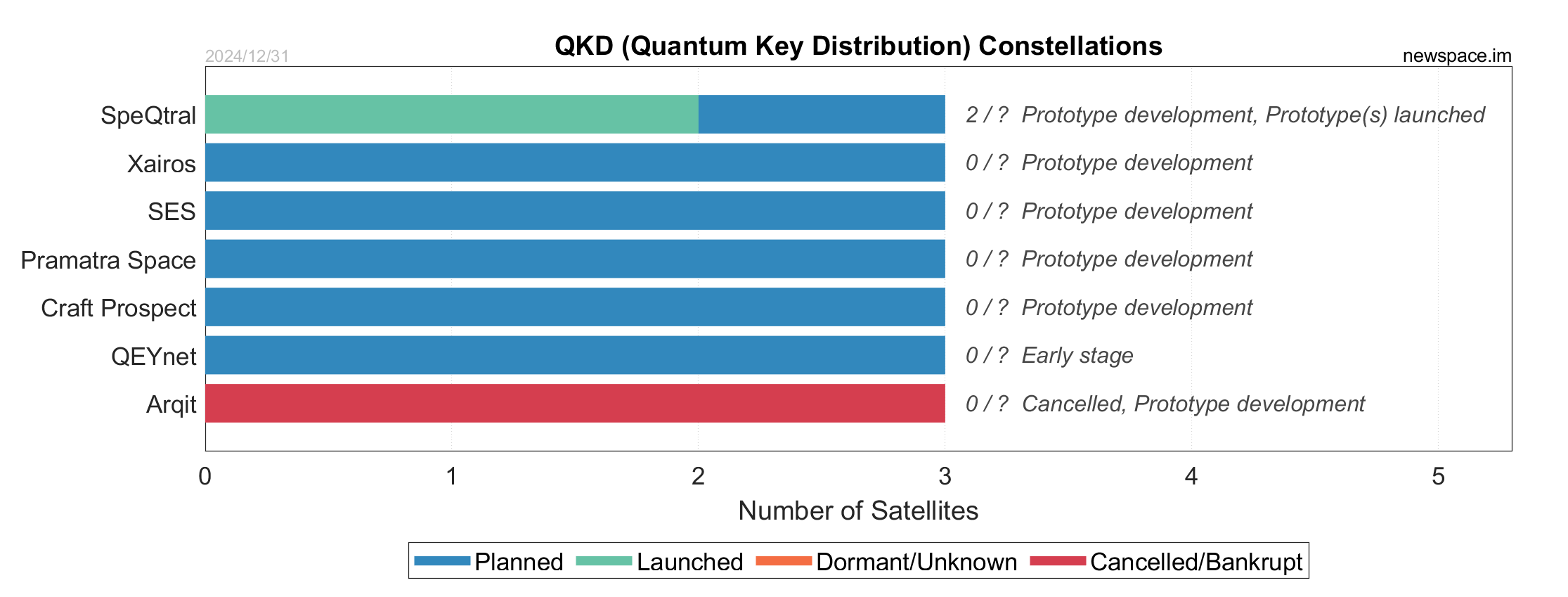
SpeQtral, a company based in Singapore, is another company at the forefront of developing and launching satellites equipped with quantum key distribution (QKD) technology. By integrating QKD nodes in space with terrestrial transmitters and receivers, it will be feasible to transmit quantum-encrypted communications globally without the reliance on fiber-optic cables.4
Conclusion
Space-based QKD is positioned to create substantial value in the coming decade: estimates indicate that approximately $4 billion in value will be generated between 2025 and 2030. Government users currently account for around 20% of the total market and are expected to remain the primary driver of space-based QKD adoption. By 2030, following agreed-upon standards for operation and implementation, the space-based QKD will be integral for secure-communication systems. Current investment in QKD is relatively focused from a geographical perspective, with China leading investment.5 The US is increasingly investing in Quantum Computing (QC) developments, along with the UK. Other countries, such as Japan and India are likely to develop an initial capability over the period of interest.
While QKD development continues, classical laser communications technology is advancing swiftly in the space sector. Laser communication offers data rates higher than those offered by traditional radio frequency systems, enhanced security due to narrow beam divergence, and more efficient power consumption. In the short to medium term, classical laser communications will continue to be the reliable choice for space-based data transmission.
Learn more about laser communications in space.
N. Ahmadi, S. Schwertfeger, P. Werner, L. Wiese, J. Lester, E. Da Ros, J. Krause, S. Ritter, M. Abasifard, C. Cholsuk, R. G. Krämer, S. Atzeni, M. Gündoğan, S. Sachidananda, D. Pardo, S. Nolte, A. Lohrmann, A. Ling, J. Bartholomäus, G. Corrielli, M. Krutzik, T. Vogl, QUICK3 - Design of a Satellite-Based Quantum Light Source for Quantum Communication and Extended Physical Theory Tests in Space. Adv Quantum Technol. 2024, 7, 2300343. https://doi.org/10.1002/qute.202300343
https://www.livescience.com/technology/communications/future-quantum-computers-will-be-no-match-for-space-encryption-that-uses-light-to-beam-data-around-with-the-1st-satellite-launching-in-2025.
https://investors.boeing.com/investors/news/press-release-details/2024/Boeing-Pioneering-Quantum-Communications-Technology-with-In-Space-Test-Satellite/default.aspx
https://www.forbes.com/councils/forbestechcouncil/2024/08/09/quantum-security-in-space-satellites-bring-qkd-closer-to-earth/
Gaida, J., Wong-Leung, J., & Robin, S. (2023). Critical technology tracker. Who Is Leading the Critical Technology Race. A Project by the Australian Strategic Policy Institute.
https://techtracker.aspi.org.au