

What Makes a Good Rocket Launch Site: Global Analysis and European Prospects
The global space launch sector is experiencing unprecedented growth, with 261 orbital launch attempts in 2024 alone—a threefold increase from a decade ago. This remarkable expansion is reshaping the geography of launch sites worldwide, as nations and private companies seek optimal locations for reliable access to space. Ideal launch sites are determined by a complex interplay of geographical advantages, climate stability, infrastructure requirements, and regulatory frameworks. While the United States and China currently dominate launch activities with their established facilities, new spaceports are emerging across the globe. Continental Europe, despite its rich space heritage, faces unique geographical challenges in establishing launch capabilities on its mainland territory. This report examines the factors that make an ideal launch site, analyzes the current global distribution of launch activities, explores new and developing spaceports, and evaluates the prospects for a future continental European launch site.
Ideal Characteristics of Launch Sites
Geographical Advantages
The geography of a launch site significantly impacts its operational efficiency, safety, and orbit accessibility. Several key geographical factors determine a location's suitability:
Proximity to the equator provides a substantial advantage for launches to equatorial orbits, particularly geostationary orbits. At the equator, Earth's rotational velocity (465 m/s) provides a natural boost that reduces fuel requirements and increases payload capacity[1]. This explains why Europe's Spaceport in French Guiana, situated at latitude 5°3', is so valuable for European access to space—it enables a greater payload fraction to reach orbit compared to higher-latitude locations[2].
Coastal locations are highly preferable as they allow rockets to launch over large bodies of water rather than populated areas. This significantly reduces risks to human populations in case of launch failures or when discarding rocket stages[1]. Most major spaceports, including Cape Canaveral, Vandenberg Space Force Base, and the European Spaceport in Kourou, are situated on coastlines for this reason[3].
Launch azimuths (the horizontal direction of the launch trajectory) must be carefully considered. A rocket's launch azimuth is constrained by the need to avoid passing over populated areas or foreign territories. For example, Cape Canaveral's allowable azimuths lie between 35° and 120° to avoid the populated east coast of the United States to its north and southern Florida and Caribbean islands to its south[4]. These constraints determine which orbits are accessible from a given location.
Latitude constraints directly impact the accessible orbital inclinations. A spaceport can only directly launch to orbits with inclinations equal to or greater than its latitude without performing costly plane change maneuvers[1]. This is why high-latitude spaceports like those in Russia and northern Europe are primarily used for polar and sun-synchronous orbits, while equatorial spaceports offer greater flexibility[1][4].
Weather and Climate Considerations
Weather reliability is critical for launch operations, with specific meteorological parameters affecting launch safety.
Lightning and electrical activity are major constraints. Launch criteria typically prohibit launches within 10 nautical miles of thunderstorms or within 30 minutes after lightning is observed near the launch pad[5][6]. The space shuttle Columbia disaster tragically demonstrated the dangers of ignoring weather constraints.
Wind conditions at various altitudes must meet strict requirements. For example, sustained winds at the 162-foot level of launch pads typically cannot exceed 30 mph, and upper-atmosphere wind shear that could compromise vehicle control must be absent[5][6].
Temperature limits are carefully monitored, with both extreme cold and heat potentially affecting vehicle systems. The Challenger disaster occurred partly due to low temperatures affecting O-ring seals[7].
Natural disaster vulnerability is another consideration, with ideal sites having low risk of hurricanes, typhoons, earthquakes, or other natural calamities that could damage infrastructure or delay operations[2].
Infrastructure Requirements
Modern spaceports require extensive infrastructure beyond the launch pad itself:
Launch and landing facilities must accommodate specific vehicle requirements, including flame trenches, propellant loading systems, and recovery areas for reusable vehicles[8][9].
Propellant production and storage capabilities are essential, with specialized facilities for handling cryogenic liquids like liquid oxygen and hydrogen, as well as solid propellants[10][9].
Communication and tracking systems must maintain constant contact with vehicles during flight, requiring sophisticated radar installations, ground stations, and downrange tracking assets[8].
Safety and security infrastructure includes personnel access control, hazardous material handling procedures, weather monitoring systems, and emergency response capabilities[10].
Payload processing facilities with cleanrooms, integration areas, and testing capabilities are needed to prepare satellites and other payloads for launch[8].
Current Global Launch Landscape
Distribution of Active Launch Sites
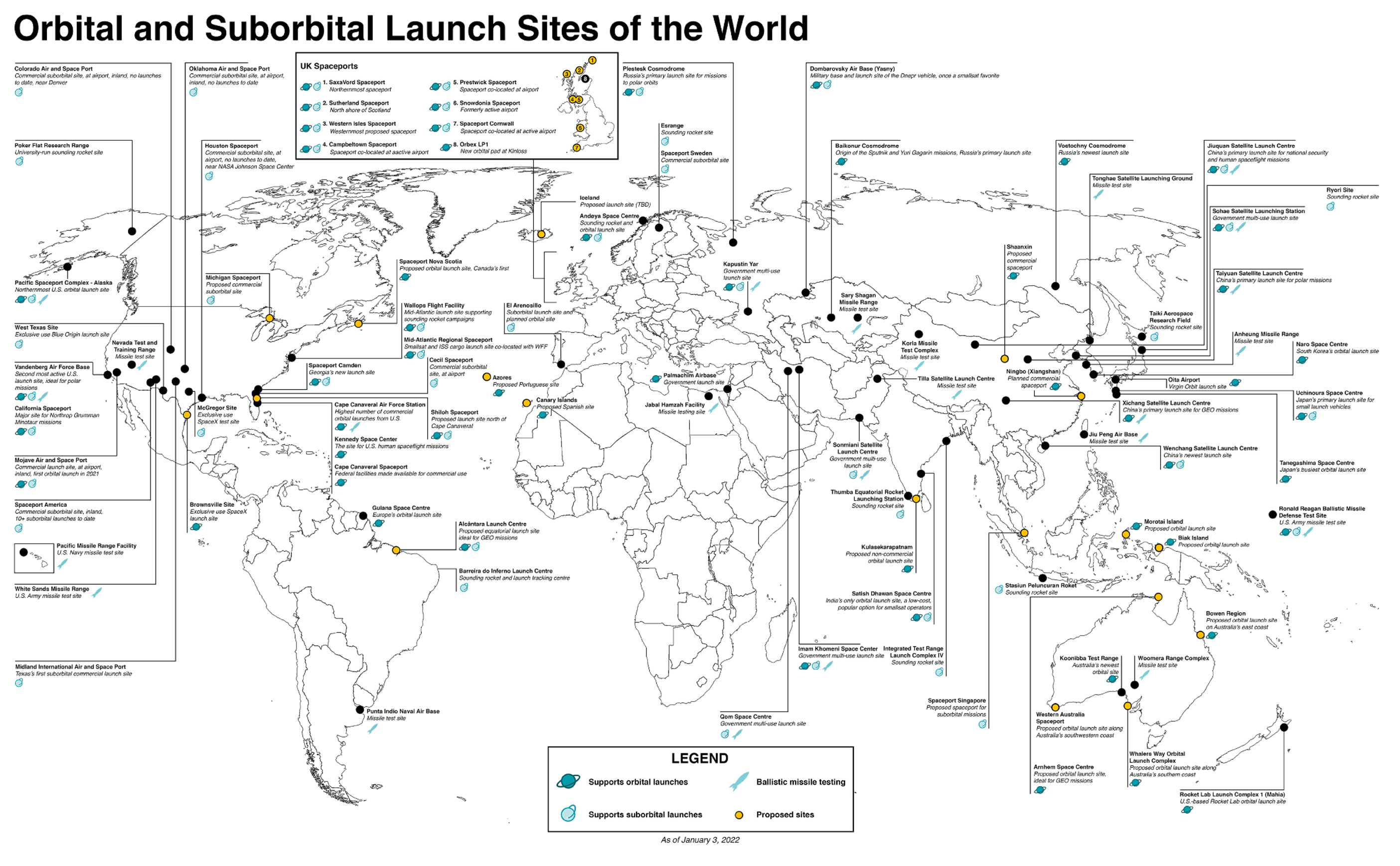
As of 2024, there are approximately 23 active orbital launch sites globally, with the Global Spaceport Alliance listing 38 spaceport members (including those under development)[11][12]. These sites are distributed across several regions:
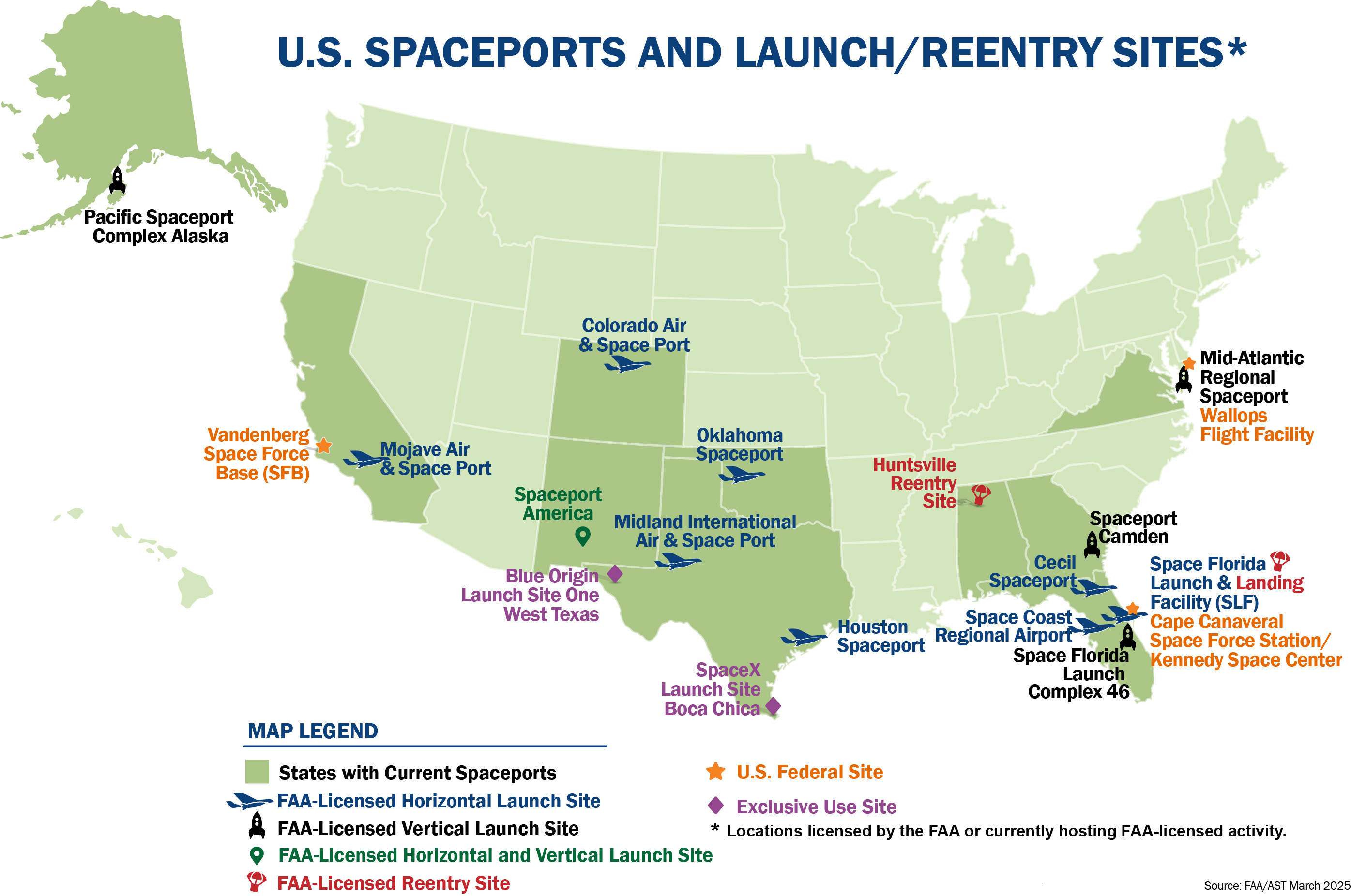
North America hosts several major facilities, with Cape Canaveral Space Force Station and Kennedy Space Center in Florida serving as the principal U.S. East Coast launch sites, while Vandenberg Space Force Base in California provides access to polar orbits[11][3]. Additional U.S. sites include Wallops Flight Facility in Virginia, Pacific Spaceport Complex in Alaska, Spaceport America in New Mexico, and recent commercial spaceports like Starbase in Texas[11].
Asia contains numerous significant launch facilities, including Russia's historic Baikonur Cosmodrome in Kazakhstan and Plesetsk Cosmodrome, China's network of launch centers (Jiuquan, Taiyuan, Xichang, and Wenchang), Japan's Tanegashima and Uchinoura facilities, and India's Satish Dhawan Space Centre[11][3].
Europe has limited orbital launch capabilities on its continental territory, with Russia's Plesetsk Cosmodrome being the primary site. Europe's main launch facility, the Guiana Space Centre in Kourou, is located in South America[11][2]. Recently, new European facilities like Andøya Spaceport in Norway, SaxaVord in the UK, and Spaceport Esrange in Sweden have been developed for small-scale orbital launches[13][14][15].
Oceania hosts Rocket Lab's Launch Complex 1 in New Zealand, which has become increasingly active for small satellite launches[11].
Launch Statistics by Country and Region
The distribution of launch activities has shifted dramatically in recent years:
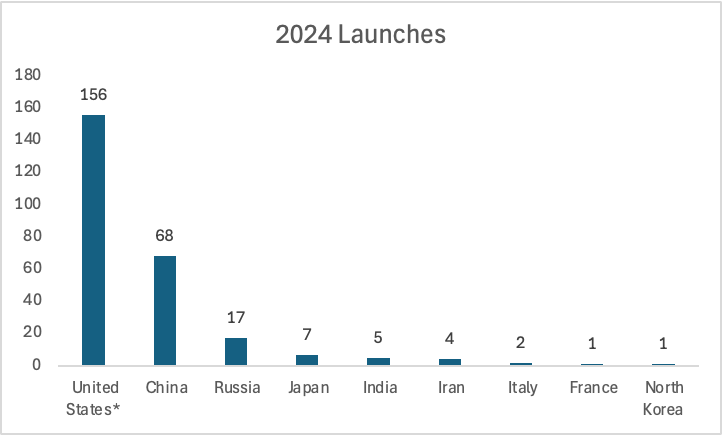
United States led global launches in 2024 with 156 attempts, a remarkable increase from just 22 launches in 2016. This surge is primarily attributable to SpaceX, which alone conducted 136 launches in 2024—more than all other launch providers worldwide combined[16][17].
China has steadily increased its launch cadence, reaching 68 attempts in 2024 compared to 22 in 2016. The country has successfully developed multiple rocket families and established a reliable launch rhythm[16].
Russia has experienced a decline from its former leading position, dropping from 27 launches in 2015 to just 17 in 2024, reflecting both economic challenges and competition from new providers[18][16].
Other active launch nations include Japan (7 launches in 2024), India (5), Iran (4), Europe (3), and North Korea (1)[16]. These statistics demonstrate the broadening of space access across multiple countries.
The total number of global orbital launch attempts has increased dramatically from 87 in 2015 to 261 in 2024, reflecting the growing commercialization and accessibility of space[16].
Commercial vs. Government Launch Trends
The space launch market has undergone a fundamental transformation in terms of who operates launch vehicles:
Commercial rockets were responsible for 65% of global launch attempts in 2023, up from 55% in 2022, indicating the growing privatization of space access[17]. This trend is particularly evident in the United States, where companies like SpaceX have revolutionized launch economics.
Government-operated launches still predominate in countries like China, Russia, and India, though commercial entities are emerging in these nations as well[16].
This shift represents a fundamental change in how space is accessed, with private companies increasingly driving innovation and cost reduction in launch systems.
Emerging Spaceports: Recent Developments and Future Plans
Recently Inaugurated Launch Sites
Several new spaceports have begun operations in recent years, expanding global launch capabilities:
Rocket Lab's Launch Complex 2 at Wallops Flight Facility, Virginia, was completed in December 2020 after just 10 months of construction. This facility provides the company with a U.S. launch option complementing its New Zealand site and enables rapid-response missions for U.S. government satellites[19].
SaxaVord Spaceport in the UK (Shetland Islands) received its spaceport license in December 2023, becoming "the first fully licensed vertical spaceport in Western Europe" with permission for up to 30 launches annually. In January 2025, the UK Civil Aviation Authority granted a launch license for Rocket Factory Augsburg's RFA One rocket to reach orbit from this facility—the first such license in the UK and Europe[13].
Spaceport Esrange in Sweden was inaugurated in January 2023 as "mainland EU's first orbital launch complex." The Swedish King Carl XVI Gustaf and European Commission President Ursula von der Leyen attended the opening ceremony, highlighting its significance for European space independence[15].
Andøya Spaceport in Norway was completed in 2023, providing another Northern European option for reaching polar orbits[14].
Spaceports Under Development
Over 15 new spaceports are under construction or planned globally by 2030, reflecting the expanding demand for launch services[14]:
Etlaq Spaceport in Oman, the first commercial spaceport in the Middle East and North Africa, is planning five test launches in 2025. The facility has signed key agreements with partners including Spain's PLD Space for MIURA 5 launches[20].
SpaceX's Florida expansion represents a $1.8 billion investment to enhance facilities at NASA's Kennedy Space Center and Cape Canaveral Space Force Station. This includes a new 380-foot-tall "Gigabay" facility designed to expedite the assembly and refurbishment of Starship rockets[21].
Maritime Launch Services in Nova Scotia, Canada, is developing a commercial spaceport expected to host its first orbital launch in 2026[16].
Additional projects include Australia's multiple launch sites, a potential first African spaceport in Ghana or Nigeria, South Korea's expansion of Naro Space Center, and Germany's innovative North Sea floating spaceport for small satellites[14].
These developments reflect a global trend toward diversified launch capabilities and regional space access, driven by both national strategic interests and commercial opportunities.
The Continental Europe Challenge
Current European Launch Capabilities
Europe's primary launch capability currently resides outside continental Europe: Europe's Spaceport in Kourou, French Guiana, has been Europe's gateway to space since 1975. Located at latitude 5°3', its equatorial position provides optimal conditions for launches to geostationary orbit. The facility is operated by the European Space Agency (ESA) and supports launches of Ariane 6, Vega-C, and previously Soyuz rockets[2][9].
Recent European developments include Spaceport Esrange in Sweden, Andøya Spaceport in Norway, and SaxaVord in the UK (not EU but European). These facilities are primarily designed for small-payload launches to polar orbits, reflecting Europe's recognition of the need for sovereign launch capabilities[13][14][15].
Geographic and Political Constraints
Continental Europe faces substantial challenges in establishing launch facilities:
Geographic limitations are significant, with populated areas to the east restricting eastward launches. Potential continental sites such as coastal areas of southern Spain, the Baltic Sea region, or the Black Sea face constraints due to nearby populations, shipping lanes, and surrounding land masses[22][23].
Northern latitude disadvantage means European sites cannot directly access equatorial orbits without significant orbital plane changes, which are propellant-intensive and reduce payload capacity[22][23].
Political and governance challenges exist within European space efforts. The Draghi report of September 2024 highlighted fragmentation across EU and ESA institutions, with tensions between larger space-capable nations and smaller states[24]. The report noted that "The governance model is fragmented. The co-existence of multiple institutional actors at national and European levels amplifies the fragmentation of the EU's space industrial base"[24].
Economic and Strategic Considerations
Establishing a continental European launch site involves complex economic and strategic calculations:
Cost considerations are substantial, as Europe's current launch capabilities in Kourou are heavily funded by France. A continental site would require significant investment in infrastructure while potentially offering less advantageous launch conditions.
Strategic autonomy is increasingly valued by European policymakers. The European Commission President Ursula von der Leyen noted at the inauguration of Spaceport Esrange: "This spaceport offers an independent European gateway to space. It is exactly the infrastructure we need, not only to continue to innovate but also to further explore the final frontier"[15].
Competitive position remains challenging for Europe. The Draghi report identified several reasons for Europe's competitive gap in space, including lower public funding compared to other regions, lack of coordination among Member States' investments, insufficient R&D ambition, and limited access to finance for European space companies[24].
Potential Solutions
Continental Europe has several potential paths forward:
Northern European small-satellite focus could leverage facilities like Andøya (Norway) and Esrange (Sweden) for polar orbits, while maintaining Kourou for equatorial missions. This approach accepts geographic limitations while providing sovereign European territory launch capabilities[14][15].
Southern European possibilities might include Mediterranean coastal sites, particularly in Spain, though these would require careful trajectory planning to avoid populated areas[22][23].
Innovative approaches such as Germany's planned North Sea floating spaceport for small satellites could provide alternatives to traditional land-based facilities[14].
Enhanced coordination between EU and ESA, as recommended in the Draghi report, could help optimize European space resources and create a more coherent approach to launch capabilities[24].
Conclusion
The global landscape of rocket launch sites is rapidly evolving, shaped by geographic realities, technological innovations, and shifting geopolitical priorities. While traditional powerhouses like the United States, Russia, and China continue to operate established facilities, new entrants from the UK to the Middle East are developing spaceports to secure their place in the expanding space economy.
The factors that make an ideal launch site remain constant: proximity to the equator, coastal locations with over-water trajectories, stable weather patterns, and comprehensive infrastructure. However, the emergence of small-satellite launchers and reusable rocket technology is creating opportunities for non-traditional locations to host specialized launch facilities.
For continental Europe, the path forward likely involves a dual approach: maintaining access to the equatorial advantages of the Kourou spaceport while developing northern European facilities for polar launches and strategic autonomy. The challenges are substantial, but the strategic importance of independent space access may ultimately outweigh the geographic limitations of the European continent.
As we approach the second half of this decade, the diversification of launch sites worldwide promises to democratize access to space, potentially transforming the economic and strategic calculus of space activities for nations and corporations alike. The rapid pace of development suggests that the geography of space access we see today may look dramatically different by 2030.
https://en.wikipedia.org/wiki/Spaceport
https://www.esa.int/Enabling_Support/Space_Transportation/Europe_s_Spaceport/Europe_s_Spaceport2
http://www.spacetoday.org/Rockets/Spaceports/LaunchSites.html
https://aerospace.csis.org/wp-content/uploads/2019/03/190313__SpaceportsOfTheWorld.pdf
https://www.clickorlando.com/weather/2023/11/09/what-goes-into-forecasting-weather-for-rocket-launches-its-harder-than-you-think/
https://www.nasa.gov/wp-content/uploads/2021/07/falcon9_crewdragon_launch_weather_criteria_fact_sheet.pdf
https://en.wikipedia.org/wiki/Launch_commit_criteria
https://www2.deloitte.com/content/dam/Deloitte/us/Documents/consulting/us-spaceports-of-the-future.pdf
https://www.esa.int/Enabling_Support/Space_Transportation/Europe_s_Spaceport/Overview_of_Europe_s_Spaceport
https://sma.jaxa.jp/TechDoc/Docs/E_JAXA-JERG-1-007E.pdf
https://rocketlaunch.org/rocket-launch-sites
https://www.globalspaceportalliance.com/spaceport-members/
https://en.wikipedia.org/wiki/SaxaVord_Spaceport
https://patentpc.com/blog/the-future-of-spaceports-how-many-are-being-built-and-where-latest-expansion-data
https://sscspace.com/mainlan-eu-first-orbital-launch-site-inaugurated/
https://spaceq.ca/orbital-launch-cadence-spikes-in-2024-new-countries-joining-the-club-in-2025/
https://payloadspace.com/2023-orbital-launches-by-country/
https://space.stackexchange.com/questions/49158/number-of-launches-by-year-by-country
https://www.rocketlabusa.com/updates/rocket-lab-opens-launch-complex-2-confirms-u-s-air-force-payload-as-first-electron-mission-from-u-s-soil/
https://spaceinsider.tech/2025/02/25/etlaq-spaceport-plans-five-test-launches-in-2025-signs-key-agreements/
https://www.foxweather.com/earth-space/gigabay-space-starship-cape-canaveral-spacex
https://www.reddit.com/r/space/comments/wn9dy7/is_there_a_place_in_continental_eu_where_the_eu/
https://space.stackexchange.com/questions/17268/possible-places-for-a-launch-complex-in-uk-and-continental-europe
https://www.frontiersin.org/journals/political-science/articles/10.3389/fpos.2025.1536170/full