

Ukrainian Defense Technology Start-up, The Fourth Law, Secures Funding to Advance Scalable Drone Autonomy
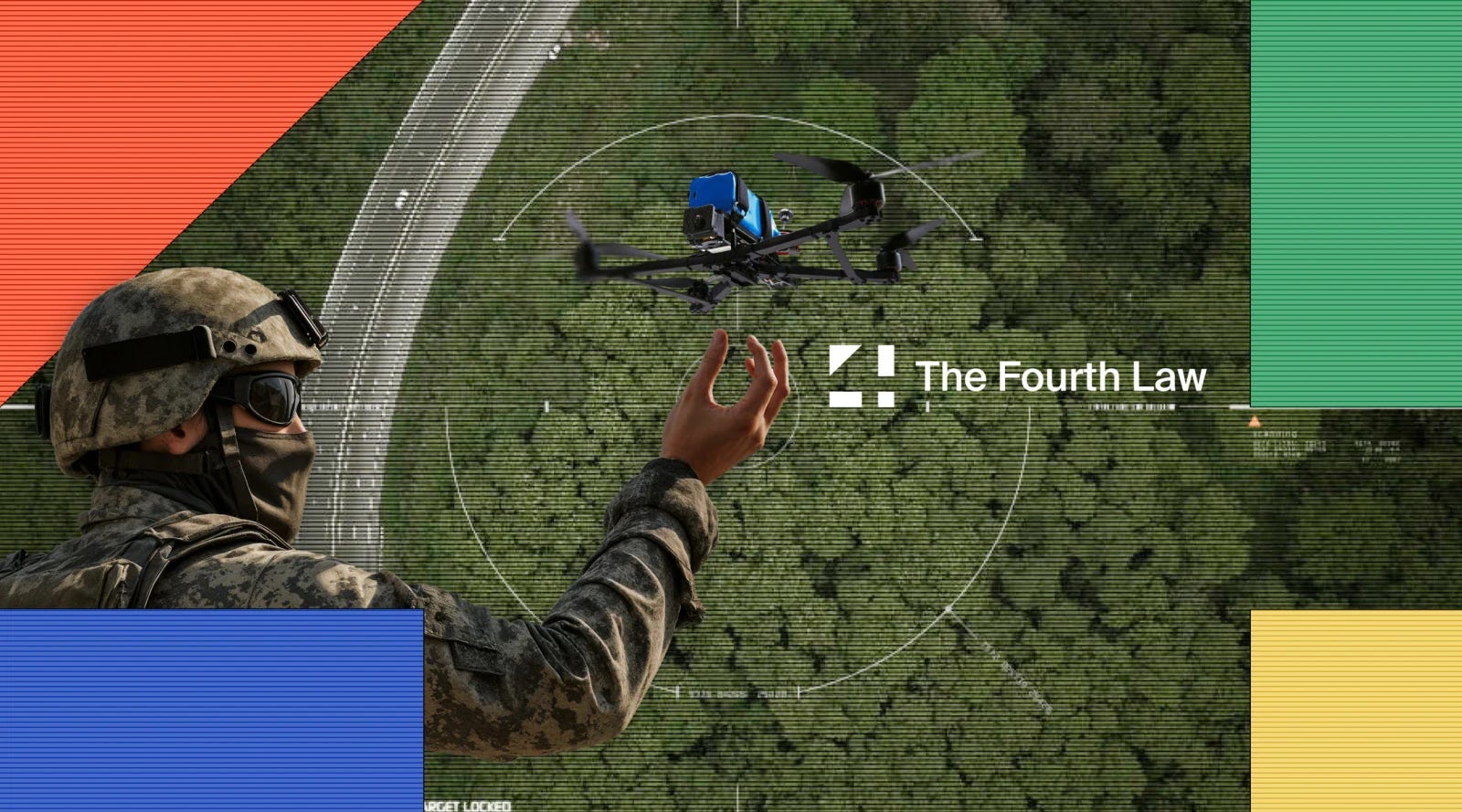
Ukrainian defense tech start-up, The Fourth Law (TFL), announced it has secured funding from a consortium of venture funds and angel investors across the US, EU, and Canada. CEO and Founder, Yaroslav Azhnyuk, also demonstrated the company’s main product, the TFL-1 drone, capable of operating autonomously when closing in on a target.
The firm's initial products, the TFL-1 autonomy module and the Lupinis-10-TFL-1 UAV are designed for both day and night use to enhance FPV drone mission success rates. This is achieved by allowing an onboard computer, equipped with artificial intelligence algorithms, to assume control during the final 500 meters of flight. The approach aims to address challenges such as electronic warfare and radio interference, while supporting pilot effectiveness.
TFL’s multi-level artificial intelligence system can identify stationary or moving targets and guide drones to the center of those targets despite obstacles frequently encountered in operational scenarios. Azhnyuk stated that scalable drone autonomy is a significant advancement in current defense technology.
Colonel Ruslan Shevchuk, commander of the 58th Special Forces Brigade of the Armed Forces of Ukraine, noted that his unit has been using drones with the TFL-1 module since March 2025. He reported that the system helps counter electronic warfare suppression and facilitates effective target engagement in challenging environments, particularly during special missions.
The Fourth Law has indicated plans to manufacture the TFL-1 at high volumes and price points intended to enable installation on most FPV drones. In addition, the company supplies the Lupinis-10-TFL-1 UAV, available as a standalone drone or as a complex composed of 100 10-inch FPV drones with TFL-1 autonomy, a ground control station, and ancillary equipment. These drones have a maximum range of 30 kilometers, can carry loads of up to 1 kg over this distance, and up to 3.5 kg at shorter ranges.
The TFL-1 module has been integrated into drones produced by multiple FPV manufacturers. The company supplies its UAVs and modules to defense forces and government entities, and these modules and licenses are available for third-party UAV manufacturers. The company reports that its products have completed the required codification process and are employed by numerous units within the Ukrainian Armed Forces.
The Fourth Law has outlined five stages of autonomy for defense FPV drones: last mile delivery (TFL-1), guidance for bombing, detection and destruction of targets, navigation without GPS, and autonomous takeoff and landing. Upon completing these stages, the company aims to develop additional products, such as drone swarms, drone carriers, and automated interceptors for various types of enemy drones, including fiber-optic FPV units, Shahed models, and cruise missiles.
The autonomy-enabling software suite includes simulation and modeling tools, computer vision, navigation systems, and fleet management functions, all designed to function independently of satellite navigation via GNSS. This architecture is intended to facilitate cross-platform integration, with planned expansions into fixed-wing aircraft and potential applications in missiles, land-based, and sea-based drones in the future. The Fourth Law also anticipates the eventual adaptation of these technologies for civilian sectors like logistics, manufacturing, and construction.
The Fourth Law was established in Kyiv in 2023 and operates offices in the United States, the European Union, and Ukraine. The company specializes in autonomous robotics, with a primary focus on developing scalable autonomy solutions for defensive FPV drones.