

Ukraine Is Exporting a New Model of Defense Production
Design happens under combat conditions. Production is moving across the United States, Europe, and the Gulf.

“In terms of expertise, no one today can help the way Ukraine can.” That line from Volodymyr Zelensky is not about diplomacy. It is about industrial transformation. Ukraine is no longer just fighting a war. It is converting that war into a defense industrial model that is now scaling across the Middle East, Europe, and increasingly the United States. What began as improvised drone workshops and battlefield adaptation is evolving into a distributed manufacturing network tied directly into Western supply chains.
What Ukraine is exporting is not just capability. It is a different model of how military systems are built. The innovation cycle is no longer tied to the industrial base. Design and iteration happen under combat conditions in Ukraine, while production is increasingly distributed across Europe, the United States, and partner states. That separation between where systems are developed and where they are manufactured is new, and it is beginning to reshape how defense capability is scaled. The shift is happening faster than most expected.
Zelensky’s recent agreements with Saudi Arabia, Qatar, and the United Arab Emirates mark Ukraine’s emergence as a security provider in the Gulf. These ten year partnerships focus on counter drone expertise, joint production, and technology transfer. More than 200 Ukrainian specialists have already deployed to the region, with additional negotiations underway across Oman, Kuwait, and Bahrain. What is being exported is not just equipment. It is a way of fighting. At the same time, Ukraine is embedding itself into European and American industrial systems at a structural level. This is not export in the traditional sense. It is integration.
From Battlefield Innovation to Industrial System
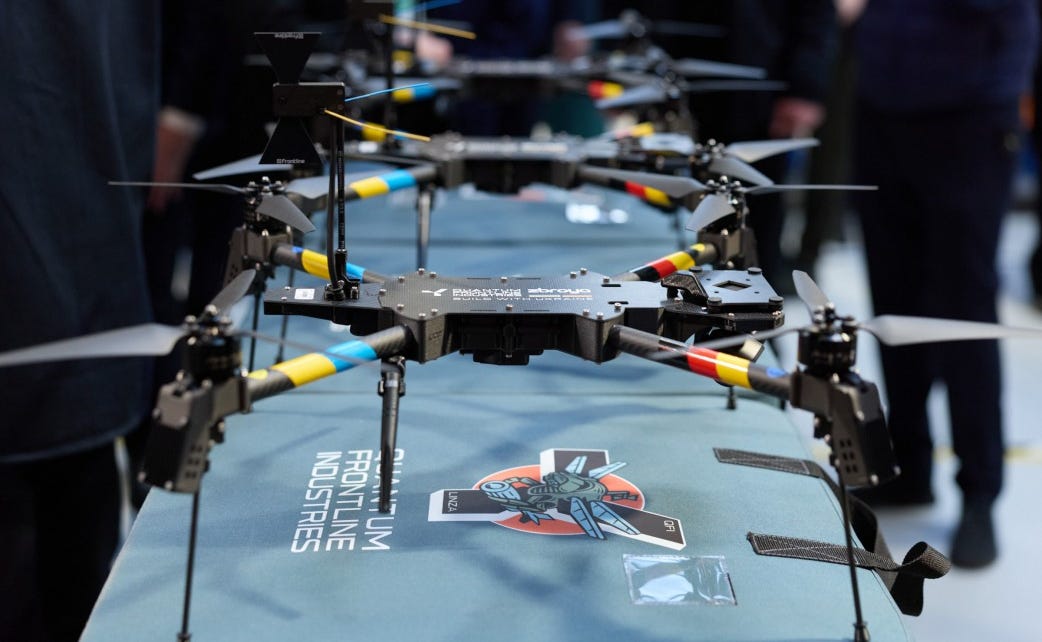
The foundation of this transformation is Ukraine’s experience with mass drone warfare. Since 2022, Ukrainian forces have defended against continuous waves of Iranian designed Shahed drones used by Russia. These systems are cheap, numerous, and designed to overwhelm high end air defenses. Western systems such as Patriot and THAAD remain effective against advanced threats, but they are not economically viable against saturation at scale. Ukraine was forced to solve that problem.
What emerged is a layered approach built around cost discipline. Electronic warfare, decentralized interception, and increasingly, low cost interceptor drones designed specifically to neutralize expendable threats. The objective is not technological superiority in isolation. It is sustainability under pressure. This model is now being exported and, more importantly, produced abroad.
Ukrainian interceptor drone company General Cherry has signed a production agreement with Wilcox Industries in New Hampshire to manufacture its systems in the United States. Parallel agreements in Croatia and Ukraine create a distributed production base that mirrors how these systems are actually deployed. The structure is deliberate. Ukrainian firms retain core intellectual property while leveraging NATO country manufacturing to scale output and meet procurement requirements.
At the center of this effort is the Bullet interceptor. It is engineered for a single purpose. Destroy Shahed class drones at a cost that does not break the defender. With speeds exceeding 300 kilometers per hour and a unit cost of roughly two thousand dollars, it represents a different category of air defense entirely. Not exquisite, but scalable. That distinction is now driving procurement decisions.
The United States Is Pulling Ukraine Into Its Industrial Base
This is no longer a peripheral trend. It is being formalized inside the U.S. defense system. Multiple Ukrainian companies are now competing for or have secured positions within Pentagon programs focused on low cost autonomous systems. SkyFall’s fiber guided drone outperformed all competitors in early testing under the Drone Dominance Program, while Ukrainian Defense Drones Tech was selected among the winners for its strike systems. Other firms are entering through partnerships, including agreements to bring Ukrainian robotic systems into U.S. production and procurement pipelines.
The pattern is consistent. Battlefield validated systems are being pulled into the U.S. industrial base because they solve a problem American programs have struggled with. Cost effective scale.
This is also tied to supply chain policy. Systems that eliminate Chinese components are structurally advantaged in U.S. procurement. Ukrainian firms that can re engineer or already operate without those dependencies are moving faster into contracts and partnerships. What is emerging is not just collaboration. It is selective absorption.
Europe Moves From Buyer to Co Producer
The same shift is unfolding in Europe, but at a larger industrial scale. Ukraine’s relationship with the European Union has moved beyond trade under the Association Agreement and into direct industrial integration. Ukrainian manufacturing is being aligned with European rearmament plans, with increasing access to parts of the EU single market even before formal accession.
Major defense firms are now building inside Ukraine. Rheinmetall is establishing multiple facilities, including ammunition and air defense production. KNDS has created a Ukrainian entity to maintain and eventually produce artillery systems locally. BAE Systems is working on domestic artillery production and sustainment.
At the same time, a second layer of partnerships is forming around unmanned systems and advanced technologies. Ukrainian companies are collaborating with firms across Finland, Denmark, and Croatia to scale drone production and remove reliance on Chinese components. European primes such as Saab and Thales are integrating Ukrainian battlefield data into next generation surveillance, air defense, and electronic warfare systems. What Europe is effectively doing is importing Ukraine’s wartime innovation cycle into its own industrial base.
This Does Not Scale Cleanly
What makes this story more significant is that it is not frictionless. These partnerships sit at the intersection of intellectual property ambiguity, export controls, and wartime risk. Many Ukrainian companies developed technology under state funding or informal battlefield conditions, which complicates ownership and licensing. Export regimes differ across NATO countries, and systems that are effective in Ukraine often require redesign to meet Western certification standards.
There are also supply chain realities. Many early Ukrainian drone systems relied on commercially available components, including Chinese electronics. Re engineering these designs for Western markets is possible, but it takes time and changes cost structures.
Even more fundamentally, Ukraine’s innovation model is built on speed and iteration under combat conditions. Western procurement systems are built on standardization and compliance. Bridging that gap is not trivial. And yet, it is happening.
The Economics Are Driving the Outcome
This entire shift is being accelerated by policy. In February 2026, Ukraine formally opened its defense export market, allowing controlled sales and licensing of military technologies for the first time since the full scale invasion. The decision reflects a basic constraint. Ukraine’s defense industry now has production capacity that exceeds what the state can procure domestically. Rather than reduce output, Kyiv is exporting that capacity.
The strategy operates across three models. Build in Ukraine, where foreign partners invest locally. Build with Ukraine, where Ukrainian technology is produced abroad. Buy from Ukraine, where finished systems are exported directly. Each is now visible in active deals across Europe, the United States, and the Middle East. European funding mechanisms are reinforcing this shift by financing joint production and modernization. This is not aid. It is industrial scaling.
A Distributed Arsenal
What is emerging is a new kind of defense industrial base. It is not centralized within a single country. It is distributed across Ukraine, Europe, the United States, and increasingly the Gulf. Production is geographically dispersed. Technology flows across partners. Systems are continuously adapted based on battlefield feedback. This model is more resilient and more responsive than traditional defense production. It also changes Ukraine’s role within the Western system. Ukraine is no longer just dependent on external supply. It is becoming a contributor to the overall defense architecture. In the Gulf, it provides the missing layer of cost effective drone defense. In Europe, it provides innovation and production capacity. In the United States, it is entering procurement pipelines through competition and partnership.
At the same time, Russia’s alignment with Iran has linked the drone threat across regions. The same systems used against Ukraine are now targeting Gulf infrastructure. Ukraine’s ability to counter them is therefore directly relevant beyond its own battlefield. This creates a feedback loop. Battlefield experience drives industrial production. Industrial production feeds into alliances. Alliances reinforce Ukraine’s position in the war.
From Improvisation to Industry
What Ukraine is building is not just a successful defense sector. It is a new model for how defense innovation scales. The traditional system relies on long development cycles, centralized production, and high cost platforms. Ukraine’s model is the opposite. Rapid iteration, distributed manufacturing, and systems designed for affordability at scale.
That model is now being adopted by others because it works. Yet, there are constraints: regulatory friction, supply chain re-engineering, and political balancing will shape how fast this expands. But these are secondary to the core shift. Ukraine has separated innovation from production geography, compressed the development cycle, and aligned it with allied industrial capacity. That is a structural change and it is already underway.