

Ukraine Aid Becomes a Tool of European Defense Industrial Strategy
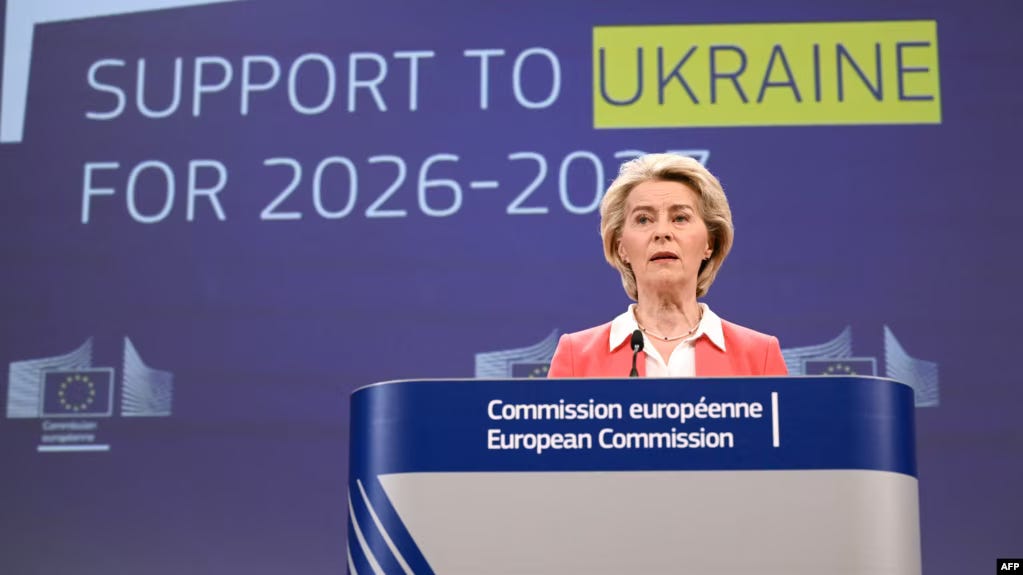
The European Commission has proposed a €90 billion loan facility for Ukraine covering 2026–2027 that would, for the first time, explicitly tie large-scale military assistance to procurement from European defense suppliers. Of the total package, roughly €60 billion would be earmarked for military support, with the remaining €30 billion allocated for general budgetary assistance.
While presented as a continuation of wartime support, the proposal marks a qualitative shift in how the European Union conceives of Ukraine aid. Rather than treating assistance purely as foreign or security policy, Brussels is increasingly using it as an instrument of industrial strategy - seeking simultaneously to sustain Ukraine’s war effort, consolidate Europe’s fragmented defense industrial base, and accelerate Kyiv’s economic integration with the EU.
At the core of the proposal is a European preference clause. Under the Commission’s framework, Ukraine would be required, where possible, to procure weapons and military equipment from EU member states, associated partners such as Norway, Liechtenstein, and Iceland, or from Ukrainian producers. Procurement from third countries would remain permissible when equivalent systems are unavailable within Europe, following what the Commission describes as a “cascade” principle that prioritizes European suppliers without formally closing the market.
Commission President Ursula von der Leyen has framed the package not only as security assistance but as a strategic investment. Large-scale public spending, she has argued, should translate into domestic capacity, employment, and research and development. In effect, Brussels is seeking to ensure that Europe’s financial commitment to Ukraine also strengthens Europe’s own ability to produce and sustain military power.
The logic is not unprecedented. For decades, the United States has tightly linked defense spending and security assistance to domestic industrial capacity through Buy American Act requirements, domestic-content rules in Pentagon contracts, and more recent executive actions prioritizing U.S.-based production in defense procurement and replenishment. What is new is the EU’s willingness to apply similar logic openly and at scale in the context of an external conflict.
Within the Union, the proposal has exposed familiar fault lines. Germany has raised concerns that overly rigid procurement preferences could limit Ukraine’s operational flexibility or slow deliveries at a critical stage of the war. The Netherlands has echoed calls for greater flexibility, emphasizing speed, interoperability, and access to proven systems. France, by contrast, has been a principal advocate of explicit “buy European” provisions, viewing Ukraine support as a catalyst for long-delayed consolidation of Europe’s defense market and a means of reducing long-term dependence on external suppliers.
The financing mechanism itself is equally significant. The loans would be raised through joint EU borrowing under the enhanced cooperation framework, allowing a coalition of willing member states to proceed even if unanimity cannot be achieved across the bloc. This approach is designed to streamline decision-making and reduce exposure to vetoes from dissenting governments, notably Hungary and Slovakia, while testing a model that could later be replicated for broader defense-related financing.
By requiring that a substantial share of European funds be spent within Europe, the Commission argues that the package lowers political risk for participating states and improves long-term sustainability. The loans would be backed by the EU budget, though their ultimate fiscal impact remains contingent on future political decisions. While European officials frequently point to the prospect of Russian compensation or the use of frozen Russian assets as part of a long-term settlement, these remain political objectives rather than legally secured repayment mechanisms.
The proposal now moves to the European Parliament and the Council, where negotiations are expected to focus less on the headline figure than on the scope and flexibility of the procurement rules. The Commission has urged rapid adoption in order to enable initial disbursements by the second quarter of 2026.
Taken together, the package illustrates how profoundly the war in Ukraine is reshaping European governance. Ukraine aid is no longer conceived solely as emergency support for a partner under attack. It has become a lever for industrial policy, an experiment in post-unanimity decision-making, and a vehicle for embedding Ukraine more deeply into Europe’s economic and security architecture.
In that sense, Brussels is doing more than financing a war effort. It is using the conflict to redefine the relationship between security, industry, and integration - and to move the European Union, incrementally but decisively, toward a model of power politics it long resisted acknowledging as its own.