

Turning Nuclear Waste into Strategic Power
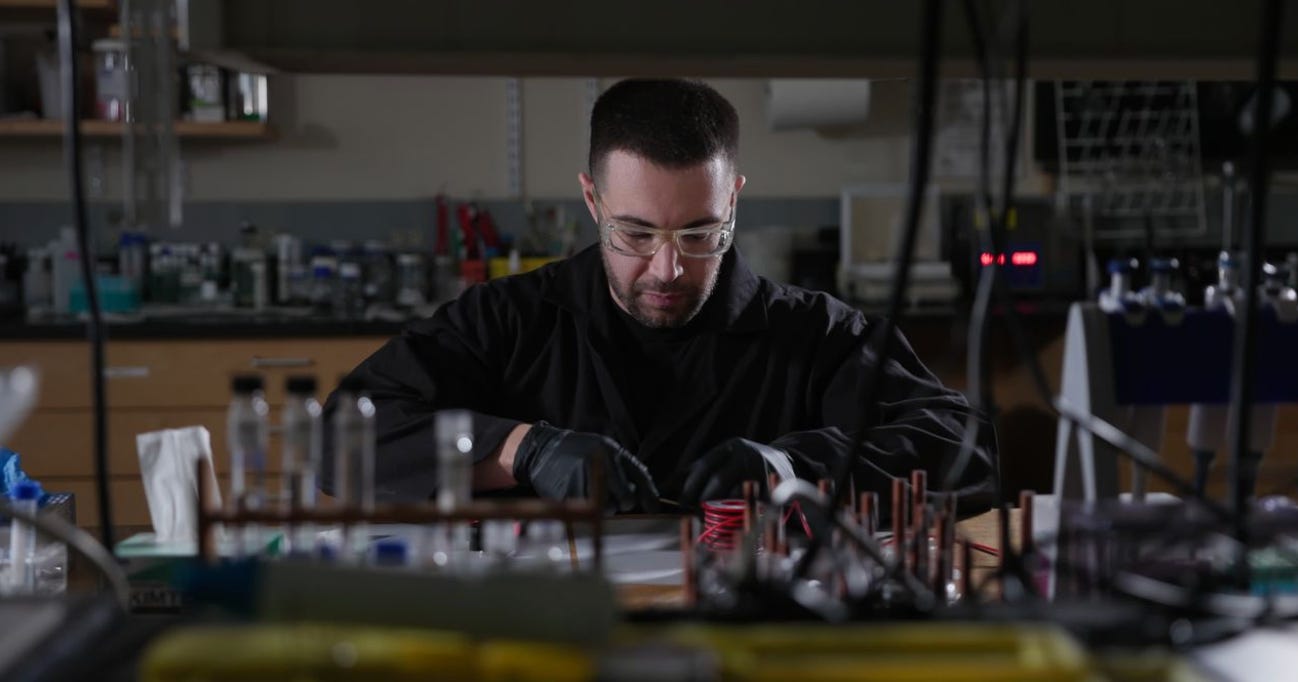
For more than half a century, the United States has treated spent nuclear fuel as waste. Today, roughly 100,000 tonnes of used fuel sit in pools and dry casks at more than 100 sites across the country. The stockpile continues to grow. Yet this material retains more than 90 percent of its original energy content.
Project Omega argues that this is not waste at all, but unrealized infrastructure.
Founded in mid-2025 by Dr. Stafford Sheehan and headquartered in Newport, Rhode Island, the company is attempting to build a commercially viable pathway for recycling used nuclear fuel while converting high-value isotopes into compact, long-duration nuclear power sources. Sheehan officially registered the business in the summer of 2025 after departing his previous venture, Air Company, at the end of 2024. Initial core technology demonstrations were conducted at the company’s Rhode Island laboratory.
On 11 February, Project Omega emerged from stealth, announcing an oversubscribed $12 million seed round led by Starship Ventures. Other participants included Mantis Ventures, Buckley Ventures, Decisive Point, and Slow Ventures. The round signals early investor conviction that nuclear waste, long seen as a political and regulatory liability, may instead represent a strategic asset.
Hugo Peterson, Chief Operating Officer at Starship Ventures, framed the thesis directly: “Spent nuclear fuel may be considered trash for some but we believe it is a treasure, and key to unlocking the next century of US energy leadership. Project Omega is the company with the technology and expertise to make that future real.”
Unlike traditional nuclear recycling efforts, which rely on complex aqueous, water-based chemical separation processes, Project Omega employs a molten salt-based approach. Operating at higher temperatures, the system is designed to simplify separation and cleanup relative to legacy reprocessing infrastructure. Rather than building toward a new fleet of advanced reactors, a pathway that typically implies a decade of planning, another decade of certification, and billions in capital, the company is taking what it describes as a more immediate, product-oriented approach.
The core architecture consists of an isotope radiation source paired with a semiconductor conversion layer that absorbs radiation and converts it directly into electricity. By focusing on alpha and beta emitters rather than gamma radiation, shielding requirements are dramatically reduced, enabling compact form factors. The result is not a conventional “nuclear battery” in the consumer sense, but what the company prefers to call a long-duration power source: a device capable of delivering continuous electricity for decades without recharge cycles. In such systems, electronics degrade before the energy supply does.
Although headquartered in Rhode Island, Project Omega relies on national laboratory infrastructure to validate and test its technology. The company is partnering with Pacific Northwest National Laboratory (PNNL), which has begun testing and evaluation of its system using isotopes such as strontium-90. Within months, PNNL produced a working proof of concept. A team led by senior scientist Dr. David Koch has taken a leading role in supporting the effort as part of broader national priorities in space and resilient energy systems.
The company is also supported by the Department of Energy’s Advanced Research Projects Agency–Energy (ARPA-E) under its Nuclear Energy Waste Transmutation Optimized Now (NEWTON) program. NEWTON seeks to make the reprocessing of U.S. commercial used nuclear fuel economically viable within 30 years. Anthony Pugliese, DOE’s Chief Commercialization Officer and Director of the Office of Technology Commercialization, emphasized DOE’s role in connecting emerging companies with national laboratory capabilities when specialized facilities and expertise are required to advance early-stage technologies.
This institutional alignment matters. Earlier this month, DOE awarded $19 million to five companies pursuing nuclear fuel recycling programs. Most of those efforts are vertically integrated with advanced reactor designs that remain in early development. Sean Hoge, founder of Starship Ventures, argues that model implies decades of lead time before commercial impact. Project Omega’s strategy is different: extract usable isotopes now and deploy them in durable power systems that can enter the market on shorter timelines.
The initial market focus is defense. The company is targeting applications such as persistent ISR sensors, distributed radar nodes, unmanned systems, edge AI compute modules, and wearable electronics. The use of alpha and beta radiation allows compact shielding, enabling deployment in proximity to personnel without exceeding typical background exposure levels. Operationally, this could eliminate battery logistics chains, reduce soldier load, and allow sensors or compute modules to operate for years or decades without maintenance.
Project Omega has been awarded a Department of War contract that is currently being finalized. Sheehan has indicated an interest in supporting “dull, dirty or dangerous missions,” including autonomous systems and remote sensing deployments. Broader consumer applications may follow after scaling and regulatory maturation. “Think about what applications could benefit from a battery that never dies,” he noted.
Sheehan situates the company within a broader structural shift in energy demand. “AI acceleration, electrified manufacturing, and new industrial systems are driving energy demand far faster than today’s grid can provide,” he said. “Nuclear energy remains the only power source capable of matching that trajectory, yet the US has never built the ecosystem required to enable its full potential.” In this framing, recycled nuclear fuel serves not only as feedstock for advanced reactors but as a foundation for distributed, resilient power across defense and industrial systems.
Sheehan’s track record is unconventional. He previously appeared on the Forbes 30 Under 30 list at age 27 for Catalytic Innovations, a startup spun out of his Yale PhD work. He later co-founded Air Company, which converts atmospheric carbon dioxide into jet fuel and consumer products and was last reported valued at $436 million in 2024. After seven years, he departed the company at the end of 2024 and subsequently filed a wrongful termination lawsuit alleging protected whistleblower activity. Air Company disputes the allegations; litigation remains ongoing.
None of that resolves the central question facing Project Omega: execution. Nuclear material handling, regulatory pathways, semiconductor durability under sustained radiation exposure, and scalable isotope separation remain formidable challenges. The United States has avoided commercial reprocessing for decades. Building a new ecosystem will not be trivial.
But the strategic logic is clear. The country is sitting on a century-scale energy reserve. Defense logistics are increasingly contested. AI and electrification are driving exponential energy demand. If Project Omega can translate laboratory proof of concept into manufacturable, certifiable systems, spent nuclear fuel may shift from political liability to deployed strategic infrastructure.
That would represent not just a startup success, but a structural shift in how the United States thinks about energy, resilience, and power projection.