

The World Is Learning From Ukraine’s War - But Not Fast Enough
Ukraine’s battlefield experience is now shaping defense production, partnerships, and doctrine across Europe, the United States, and beyond.
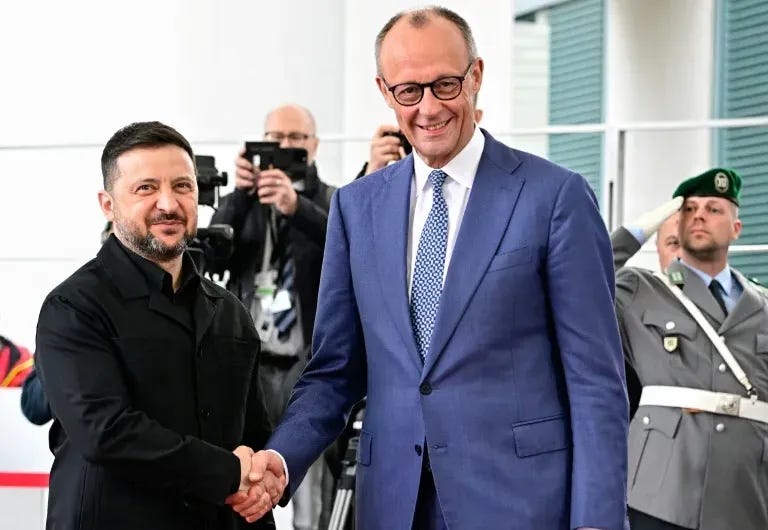
For most of the war, Ukraine has been treated as a recipient of military support. Western governments supplied weapons, funding, and air defense systems, while Ukraine absorbed them under pressure. That framing no longer holds. Over the past year, Ukraine has begun to take on a different role: not just a consumer of defense capability, but an increasingly important producer, partner, and exporter within the global defense system.
The shift is now visible across Europe, the United States, and even the Gulf, where countries are turning to Ukraine for drone production, counter-UAV systems, and operational expertise shaped by real combat conditions. What is emerging is not just a set of bilateral agreements, but a broader recognition that Ukraine has developed a way of fighting- and building military capability - that others are now trying to understand and adopt. The question is no longer whether Ukraine’s way of war matters. That is already clear. The question is whether the rest of the world is catching up fast enough.
From Aid to Industrial Integration
This shift began in late 2025, when Kyiv loosened restrictions on defense exports and actively encouraged foreign industrial partnerships. What followed in early 2026 were the first concrete joint production efforts, including cooperation with German drone manufacturer Quantum Systems and early frameworks with Denmark focused on scaling UAV production. Those initial steps have since expanded into a much broader pattern of long-term defense-industrial integration.
The Agreements Reshaping Europe’s Defense Base
The clearest signal came in April 2026, when Ukraine and Germany signed a 10-year security and defense cooperation agreement valued at roughly €4 billion. The agreement covers air defense, missile production, and joint drone development, while also incorporating battlefield data-sharing and long-term industrial coordination. It is not a short-term support package. It is a structured attempt to link Ukraine’s wartime innovation base with German manufacturing and long-term capability development.
That agreement sits within a growing network across Europe. Ukraine and Norway signed a defense declaration in April 2026 expanding cooperation in drone warfare, operational coordination, and long-term capability development. Bulgaria concluded a 10-year agreement in March focused on joint weapons production, particularly drones. The Netherlands signed a dedicated drone deal with Ukraine in April, including funding for joint manufacturing and long-term industrial collaboration explicitly framed as mutually beneficial. Italy has also committed to expanding cooperation on drone development and defense production, moving toward joint manufacturing arrangements.
The United Kingdom has taken a complementary approach through its Enhanced Security and Defence Industrial Collaboration Declaration, focusing on joint capability development, innovation, and training. While less centered on production, it still embeds Ukraine into long-term British defense planning. At the EU level, discussions are increasingly pointing toward deeper integration of Ukraine into a broader European defense framework, reflecting a recognition that Ukrainian capabilities are not temporary wartime assets, but something that can be incorporated into long-term security architecture.
Industry Integration Across Europe
These state-level agreements are reinforced by direct industry integration. German firm Quantum Systems has established joint ventures with Ukrainian partners to scale drone production. Diehl Defence is working with Ukraine on air defense and missile-related systems. Saab has entered into agreements covering radar and aviation collaboration. Czech firms are transferring licenses to enable ammunition production inside Ukraine, while Polish partnerships are focused on drones, software integration, and joint weapons development. Across Europe, companies are embedding directly into Ukraine’s defense ecosystem rather than simply supplying it.
Ukraine and the United States
At the same time, a parallel dynamic is emerging with the United States. Ukrainian defense technology, particularly in drones, is beginning to move directly into the U.S. industrial base. Ukrainian firms have signed agreements to manufacture drones in the United States, including plans to establish production facilities and integrate Ukrainian designs into American supply chains. Some companies are pursuing U.S. expansion not just to scale output, but to access capital and ensure long-term survivability.
This integration extends beyond manufacturing. U.S. defense programs are increasingly drawing on Ukrainian battlefield experience, particularly in areas such as low-cost drone swarming and scalable autonomous systems. Pentagon initiatives aimed at expanding drone capabilities reflect lessons learned from Ukraine’s operational environment, where speed, cost, and adaptability have proven decisive.
Ukrainian firms are also beginning to access Western capital markets. Drone company Swarmer has moved toward a public listing, part of a broader trend of Ukrainian defense-tech firms seeking international investment and growth pathways. Others are exploring U.S.-based partnerships to embed themselves more deeply in the global defense supply chain.
The Global Demand for Counter-Drone Warfare
The reason for this shift is straightforward. Ukraine has spent years solving problems that other militaries are only now confronting. It has learned to operate under constant drone and missile attack, integrate electronic warfare into routine operations, and adapt systems in real time against a capable adversary. These capabilities have been developed under sustained combat conditions and refined continuously.
That experience is now being exported alongside physical systems. Germany’s agreement includes data-sharing and joint development. U.S. partnerships are focused on integrating Ukrainian designs and operational concepts into existing programs. The value lies not only in what Ukraine builds, but in how it has learned to fight.
This is also driving demand beyond Europe and the United States. Gulf states, including Saudi Arabia, the United Arab Emirates, and Qatar, have begun engaging Ukraine directly for drone and counter-drone expertise. The widespread use of Iranian-designed Shahed drones has exposed vulnerabilities across the Middle East, particularly in defending against low-cost, high-volume threats. Western systems are capable, but expensive and not optimized for saturation environments.
Ukraine has spent years developing practical solutions to exactly this problem, combining electronic warfare, low-cost interceptors, and distributed sensing to counter drones at scale. Ukrainian officials have indicated that this expertise is now being shared with multiple countries facing similar threats.
The Most Combat-Tested Military in Modern Warfare
Underlying all of this is a deeper shift in Ukraine’s military itself. After years of continuous high-intensity conflict, Ukraine now fields one of the most combat-experienced forces in the world. It has operated across domains that are increasingly central to modern warfare - drones, electronic warfare, long-range fires, and distributed command and control - and has adapted continuously under pressure. Few other militaries have had to integrate these elements at scale in a live conflict for this long.
This matters because it changes how Ukraine is perceived. It is no longer simply a frontline state in need of support. It is becoming a source of operational knowledge and capability that other countries are actively seeking out.
Ukraine is not replacing established defense exporters. It does not have the industrial scale to do so. But it is becoming something different. It is emerging as a producer of battlefield-proven systems, a partner in a distributed European defense-industrial network, and an increasingly integrated participant in the U.S. defense innovation ecosystem.
The agreements signed in 2026 mark the beginning of that shift. They show a move away from short-term aid toward long-term integration, from procurement toward co-production, and from dependence toward partnership. They also reflect a growing recognition that the most valuable thing Ukraine offers is not just equipment, but experience - hard-earned lessons from operating in the most demanding combat environment in decades.
That experience is already shaping how others think about drones, electronic warfare, and scalable defense systems. But translating those lessons into doctrine, procurement, and industrial capacity is a much slower process. The world is beginning to catch up to Ukraine’s way of war. Whether it is happening fast enough is far less certain.