

The Tech Figures Quietly Reshaping Washington
The new power brokers at the intersection of tech, defense, and politics.
A decade ago, Silicon Valley liked to imagine itself as outside politics: disruptive, independent, building the future while Washington managed the past. That division no longer holds. The most powerful technology firms are now deeply embedded in the infrastructure of the American state, and their leaders increasingly appear not at the margins of politics, but at its center. Few images capture that shift more clearly than this one.
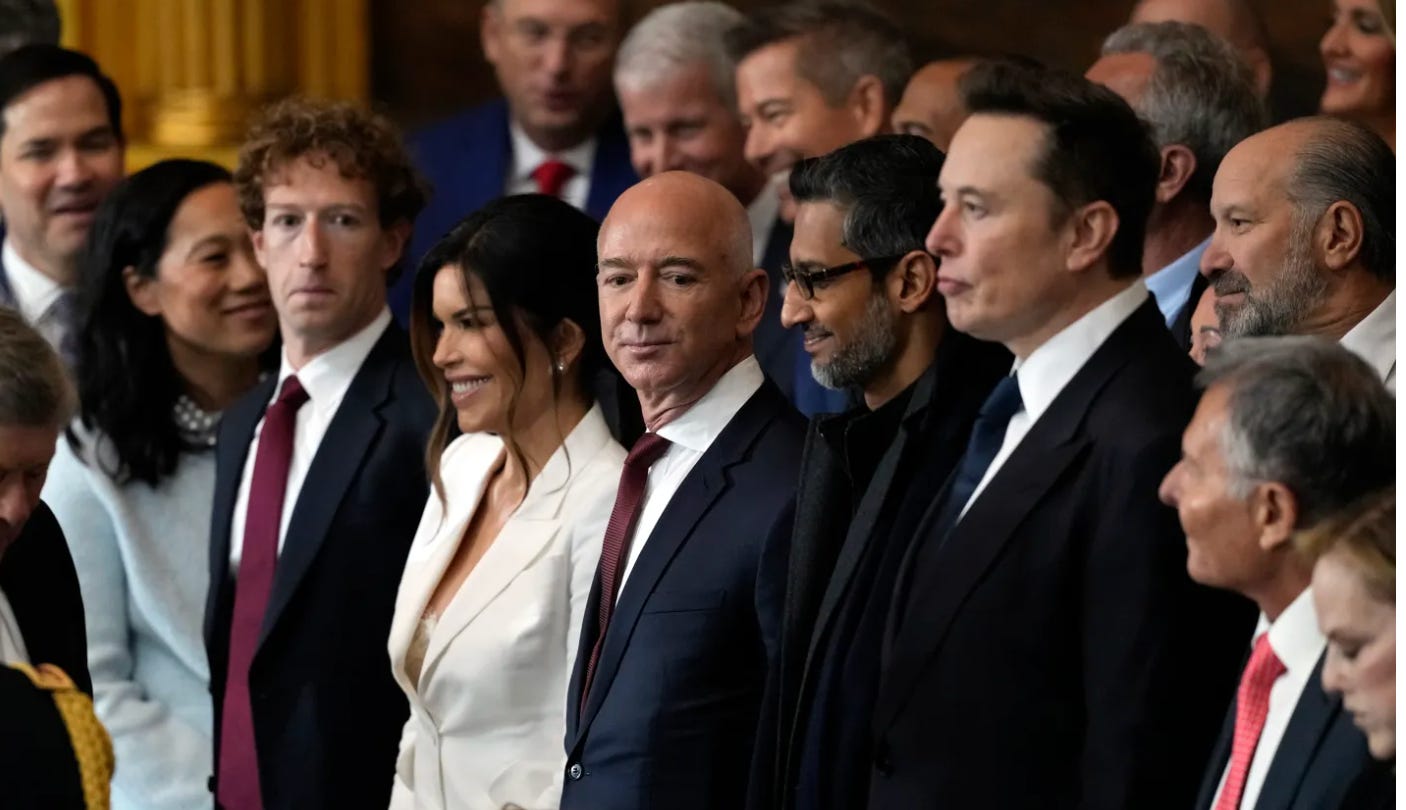
For most of the last twenty years, Silicon Valley and Washington were assumed to be separate worlds. Tech built platforms. Government regulated them. Occasionally the two collided in hearings or scandals, but the basic division remained intact: entrepreneurs built the future, politicians managed the state.
That division is eroding.
The American government is increasingly intertwined with a small group of technology firms and technology figures, and some of those figures now hold forms of influence that go well beyond ordinary corporate lobbying. Tech is no longer simply an industry the state regulates. It is becoming part of how the state functions.
You can see it in the headlines, even if the headlines rarely connect the dots. Elon Musk operates communications infrastructure used in active conflicts. Sam Altman leads OpenAI, whose consumer AI systems are now used by hundreds of millions, while meeting with governments about their strategic future. Palantir’s software sits deep inside the national security apparatus. Peter Thiel exerts influence not only through companies, but through political networks. Crypto entrepreneurs are no longer treated as outsiders. They are increasingly part of policy conversations.
Taken together, this is a new power landscape. The question is no longer whether technology will shape politics. The question is which technology actors will become embedded in the state itself.
Washington runs on cloud now
Silicon Valley used to imagine itself primarily as disruptive and culturally liberal, building consumer platforms while politics remained distant. But once you build infrastructure that governments depend on, you stop being just another private actor. You become strategically relevant, whether you intend to or not.
The real story begins beneath the AI models. “AI in government” does not start with chatbots. It starts with cloud infrastructure. The US government cannot deploy AI at scale without secure compute, compliant systems, and procurement-ready platforms. Those platforms are dominated by firms that have already become deeply embedded inside the federal machine.
Microsoft’s Azure is everywhere across government. Amazon’s AWS has been foundational since intelligence agencies began outsourcing major cloud capacity years ago. Google and Oracle play similar roles. Before you even reach the AI layer, the American state is already running on private technology substrate.
Cloud is not just a market. It is increasingly part of the infrastructure of governance.
Where AI meets the national security state
Defense is where AI stops being a product demo and becomes part of a real operating workflow. In the consumer world, “AI” often means a model that writes text or answers questions. In the defense world, the value is usually less about chat and more about systems that can combine information, flag patterns, support planning, and integrate into existing command-and-control, logistics, and intelligence processes.
That’s why some of the most influential “AI” companies in Washington aren’t the headline model labs. Palantir, for example, has spent years selling software that helps agencies pull together messy data from many sources and use it for analysis and coordination. Whether you love or hate the company, the point is simple: it sits inside the machinery. When organizations start layering AI on top of those systems, the firms already embedded in the workflow often become more important than the firms with the best consumer-facing chatbot.
Anduril is influential for a different reason. It sits closer to the intersection of software and hardware: drones, sensors, surveillance, autonomy, and the ability to iterate quickly compared to traditional defense procurement cycles. Its “AI” story is less about building a general model and more about building systems that can perceive, decide, and act in specific environments.
What’s interesting is that this kind of concentrated, personality-driven influence shows up more clearly in AI and defense-tech right now than in areas like quantum or cybersecurity, which remain more fragmented and less dominated by a single founder-company axis.
Musk and the privatization of strategic infrastructure
No one illustrates this shift more vividly than Elon Musk. Musk is not simply lobbying Washington. He operates assets that governments increasingly rely on.
SpaceX launches national security payloads. Starlink provides communications infrastructure that can be deployed globally, often faster than states can replicate. Ukraine is the clearest example: Starlink terminals became essential battlefield infrastructure, and Musk’s decisions about access carried real geopolitical consequences.
Private capital has always shaped geopolitics indirectly. What is new here is the operational nature of the leverage. This is not influence through lobbying alone, but control over a layer of infrastructure that modern states may depend on in real time.
This is part of why Musk’s integration of xAI into his broader ecosystem is so revealing. SpaceX is profitable, infrastructure-heavy, and deeply tied to the state. xAI is speculative and expensive. Bundling them is not just corporate finance. It is an attempt to build a vertically integrated platform where communications, launch capacity, and AI development sit inside one privately controlled stack.
That raises an obvious question: when critical infrastructure is privately owned, where does sovereignty actually sit?
OpenAI and the new state-adjacent lab
Sam Altman represents a different kind of power. OpenAI began as a quasi-utopian research project. It has become one of the most strategically important firms in the American economy.
ChatGPT is a consumer product, but OpenAI is also becoming a government partner through Microsoft and through direct adoption channels. At the same time, OpenAI sits awkwardly between worlds: nonprofit origins, massive commercial scaling, deep corporate entanglement, and growing political scrutiny.
OpenAI is no longer simply a lab. It is part of the emerging national AI apparatus.
Peter Thiel’s political venture machine
If Musk is the most visible figure, the most structurally interesting figure may be the least visible.
Peter Thiel’s influence is not primarily technological. It is political. Palantir gives him deep embeddedness inside the security ecosystem, but Thiel’s broader project has been building political capacity.
The JD Vance story is instructive. Thiel helped launch Vance’s career after Yale, brought him into his venture orbit, backed his rise, and supported his political trajectory. Vance was not originally a Trump loyalist. His alignment shifted over time, culminating in his selection as vice president.
This is venture-style political entrepreneurship: funding, cultivating, and positioning leaders the way Silicon Valley funds startups. Thiel is not merely reacting to politics. He is shaping it.
Crypto enters the room
Crypto adds another dimension. If digital assets become a meaningful alternative financial layer, then the entrepreneurs shaping that ecosystem will gain political influence as well.
Crypto is moving from insurgency to institutionalization. Washington is no longer treating it as fringe. It is negotiating with it. This is why figures like David Sacks matter: crypto is becoming another pathway through which tech actors enter the machinery of the state.
Trump and the new alignment
Trump’s relationship with Silicon Valley has changed too. In 2016, tech was mostly an external enemy. By the mid-2020s, parts of tech have become strategic allies.
Trump understands leverage more than ideology. He may not care about AI architectures, but he can see where power is accumulating: AI, defense tech, crypto, critical minerals, energy. It is not an accident that Trump-family ventures increasingly cluster around these commanding heights.
Some of this is personal enrichment. But some of it is also alignment with the future structure of American political economy. Industrial barons have always positioned themselves around the industries where the state will inevitably flow.
We are also seeing tech operators move directly into government itself. The language is “efficiency,” “modernization,” “making the state work like a startup.” Sometimes that may strengthen state capacity. Sometimes it may blur the line between public governance and private influence.
How Silicon Valley became political
A decade ago, tech elites largely aligned with the cultural center-left. That has changed.
The pandemic era was a turning point. Platforms were pressured by governments to moderate information under implicit threats of regulation or shutdown. If you run a platform, that is a formative lesson: the state can reach into your system. Neutrality is difficult to sustain.
The rational response is to get closer to power so it cannot be done to you again. Silicon Valley’s political turn is not simply ideological. It is strategic.
America’s digital Gilded Age
None of this is entirely new. America has been here before. The Industrial Revolution produced titans of industry whose economic power translated into political influence. Railroads shaped federal policy. Oil barons shaped geopolitics. Finance shaped regulation.
What is different now is the domain. The critical infrastructure of the 21st century is not steel or oil. It is compute, networks, platforms, and data.
We are living through a digital Gilded Age. The moguls are back. The infrastructure is just different.
The question hiding underneath
Americans should care because the state is increasingly intertwined with private infrastructure. The people controlling satellites, AI systems, cloud platforms, and digital financial networks are no longer just wealthy businessmen. They hold structural leverage over systems the government itself increasingly relies on.
That raises questions of accountability. Does the state become stronger through partnership with private innovation, or does it become dependent on actors it cannot easily regulate or replace?
Europeans should care for an additional reason: Europe is largely absent from this stack. It does not have a hyperscale cloud champion comparable to Microsoft or Amazon. It does not have a Palantir-scale defense AI firm embedded across national security institutions. And it remains dependent on external hardware and platform ecosystems.
Europe’s AI question, in other words, is not only about regulation. It is about sovereignty.
The Musk–Altman drama is not just personal. The rise of Palantir and Anduril is not just procurement. The crypto policy turn is not just financial regulation. These are signals of something larger: the boundary between Silicon Valley and Washington is thinner than it has been in decades.
The United States has always had powerful private actors. The difference today is how directly and visibly today’s tech leaders are embedded in the machinery of government itself - from cloud infrastructure to defense systems to communications networks. This convergence is no longer happening quietly in the background. It is increasingly happening in public, in real time, and often in full view.
That is what this moment reveals. And it is happening faster than most people realize.