

The Spectrum Fight Behind the Satellite Internet Race
The most consequential battles in the satellite internet market are no longer happening in orbit. They are unfolding in regulatory filings, coordination disputes, and spectrum allocation decisions that determine which networks can actually operate at scale. The ongoing clashes between Amazon and SpaceX at the Federal Communications Commission make this shift visible. What appears to be a technical disagreement over interference or orbital design is, in practice, a contest over access to the finite radio frequencies that underpin the entire market.
For most of the past decade, competition in satellite connectivity was defined by deployment. The central question was who could build and launch large constellations. That phase is largely settled. Thousands of satellites are already in orbit, and multiple companies have demonstrated the ability to finance and deploy global systems. The constraint has moved down the stack, into the layer that determines whether these systems can operate at all.
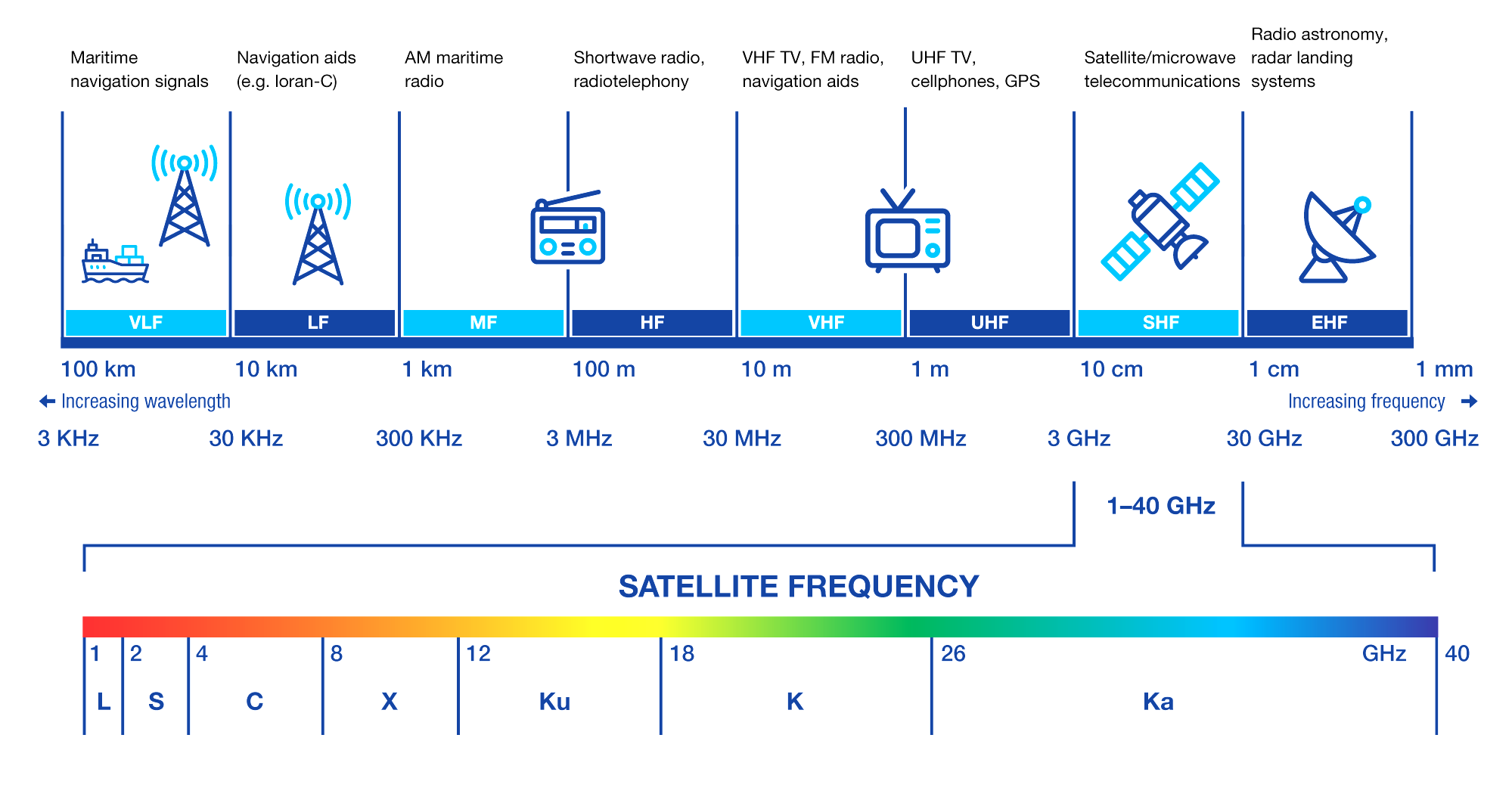
Today, the decisive factor is the ability to secure, coordinate, and defend access to spectrum within a regulatory system that was not designed for this level of scale or complexity. In practice, this means the market is no longer constrained by the ability to deploy satellites, but by the ability to operate them without interfering with everyone else.
How Spectrum Is Allocated Today
Spectrum is governed through a layered system that blends international coordination with national control. The International Telecommunication Union defines global allocations, but in practice, access is determined by national regulators such as the FCC.
Satellite operators enter this system through a process that is both technical and strategic. Companies file for specific frequency bands, orbital parameters, and system configurations. These filings are grouped into processing rounds, which determine priority. Earlier entrants receive protection from harmful interference, while later systems must demonstrate that their operations will not degrade existing networks beyond defined thresholds.
Those thresholds are not theoretical. In current FCC rules, later systems must limit interference to small, measurable impacts on throughput and availability. These protections create a meaningful advantage for early entrants, even if they are not yet fully deployed.
Coordination is where these rules are enforced. Operators are required to negotiate with one another to ensure compatibility. In practice, this process has become a central arena of competition. Technical objections, alternative configurations, and procedural challenges can all influence whether a system moves forward or is delayed.
These protections are also temporary. After a defined period, priority rights sunset and operators are required to share spectrum on more equal terms. Until then, however, early positioning can shape the market.
The Spectrum Wars in Practice
The disputes between Amazon and SpaceX are best understood in this context. Amazon has repeatedly challenged aspects of SpaceX’s Starlink network, arguing that proposed changes would increase interference and complicate coordination. It has also pushed back against expansive filings, including proposals for very large future constellations, framing them as attempts to reserve spectrum without a clear deployment plan.
SpaceX, for its part, has continued to expand aggressively, leveraging earlier approvals and existing deployments to strengthen its position. By combining early filings with rapid execution, it has been able to translate regulatory priority into operational scale.
These disputes are not incidental. They are a mechanism through which companies shape the competitive landscape. Filing early, deploying quickly, and contesting rivals’ applications are all part of a broader strategy to secure durable operating rights. These filings are not just objections. They are attempts to shape the rules of access before the market fully forms.
Where the Bottlenecks Are Emerging
The pressure on the system is concentrated in a small number of critical frequency bands. The 12 GHz band has become the primary workhorse for satellite broadband and the focal point of ongoing disputes. It is where current services operate and where interference concerns are most immediate.
The 17 GHz band represents newly opened capacity structured for shared use. Both incumbent and emerging operators are moving to deploy hardware that can take advantage of this additional bandwidth.
At higher frequencies, including the V band and E band, companies are pushing toward significantly greater capacity. These bands offer the potential for much higher data throughput but introduce new technical and regulatory challenges.
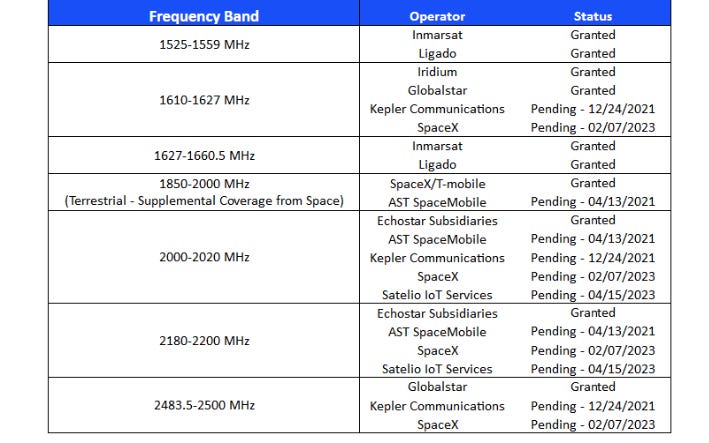
At lower frequencies, the situation is different. Bands used for mobile satellite services are already fragmented across multiple operators, with overlapping claims and a mix of granted and pending licenses. This fragmentation is particularly relevant for direct to device services, which depend on compatibility with terrestrial mobile spectrum.
The result is not a simple shortage of spectrum. It is a fragmented and contested environment in which access is uneven and coordination is increasingly difficult.
Direct to Device Raises the Stakes
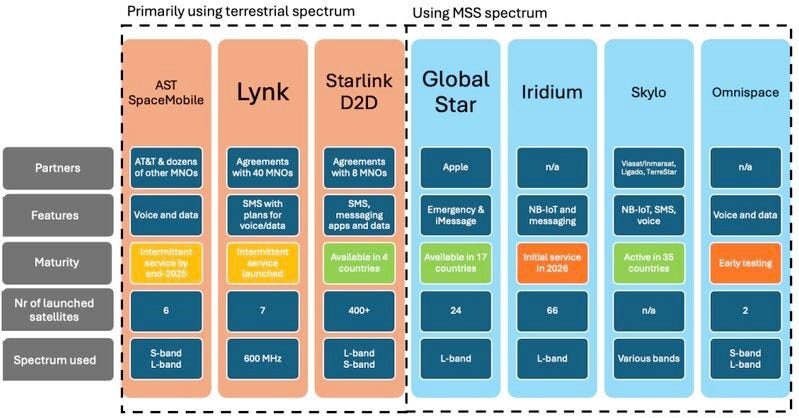
The move toward direct to device connectivity has intensified these dynamics. Unlike traditional satellite broadband, which operates in dedicated frequency ranges, direct to device systems must coexist with terrestrial mobile networks. This requires access to spectrum that is already licensed, tightly managed, and politically sensitive. It also requires coordination across multiple jurisdictions. Each country controls its own spectrum rights, meaning that global service depends on a patchwork of approvals.
This introduces a new layer of constraint. Even when technology is viable, deployment can be slowed or blocked by regulatory decisions. Spectrum access becomes not just a technical issue, but a function of policy and market structure. This is why direct to device is not simply a new product category. It is a direct collision with the most constrained and politically sensitive parts of the spectrum.
A System Under Strain
What is striking is how manual this system remains. Despite governing tens of thousands of satellites and increasingly complex interference environments, spectrum coordination still relies on static filings, fragmented databases, and slow negotiation processes. These mechanisms were designed for a smaller and more predictable industry. They are now being applied to a dynamic environment in which conditions change continuously and the number of interacting systems is growing rapidly.
This mismatch is beginning to produce a new category of solution. Companies such as New York-based startup Airbase are working to automate spectrum allocation and coordination, using software to model interference, resolve conflicts, and manage licensing workflows more efficiently.
The significance of this shift is easy to overlook. Airbase is not building satellites or launching rockets. It is operating at the layer that determines whether those systems can function together at scale. That makes spectrum coordination itself a new category of infrastructure, one that sits between operators and regulators and increasingly determines how efficiently the system as a whole can function.
If that layer becomes more dynamic and software driven, the structure of the market changes. Spectrum is no longer just something that is granted and defended through filings. It becomes something that can be actively managed and optimized in response to real world conditions.
Who Is Ahead
In this environment, early positioning matters. SpaceX currently holds the strongest position. It combined early spectrum filings with rapid deployment, allowing it to translate regulatory approvals into operational scale. Its network is already embedded across a range of commercial and government use cases.
Amazon remains a credible challenger but is operating from a different starting point. Its success will depend not only on execution, but on how effectively it navigates coordination constraints and licensing timelines.
Companies pursuing direct to device connectivity, including AST SpaceMobile and Lynk Global, are advancing new models but remain highly exposed to regulatory friction.
The Strategic Implication
The satellite internet market is no longer defined primarily by who can deploy infrastructure. It is defined by who can operate within a constrained and contested electromagnetic environment - an environment shaped through filings, disputes, coordination outcomes, and increasingly, the ability to manage spectrum more intelligently. The next phase of competition will not be decided solely by satellites in orbit. It will be decided by how effectively companies operate within the constraints that govern them. In that sense, the spectrum fight is not a side story. It is the market. Increasingly, the companies that win will not just be those that launch the most satellites, but those that can navigate, shape, and ultimately manage the spectrum environment those satellites depend on.