

The PLA is Developing a Resilient "Kill Web" Designed To Outperform Current Kill Chains
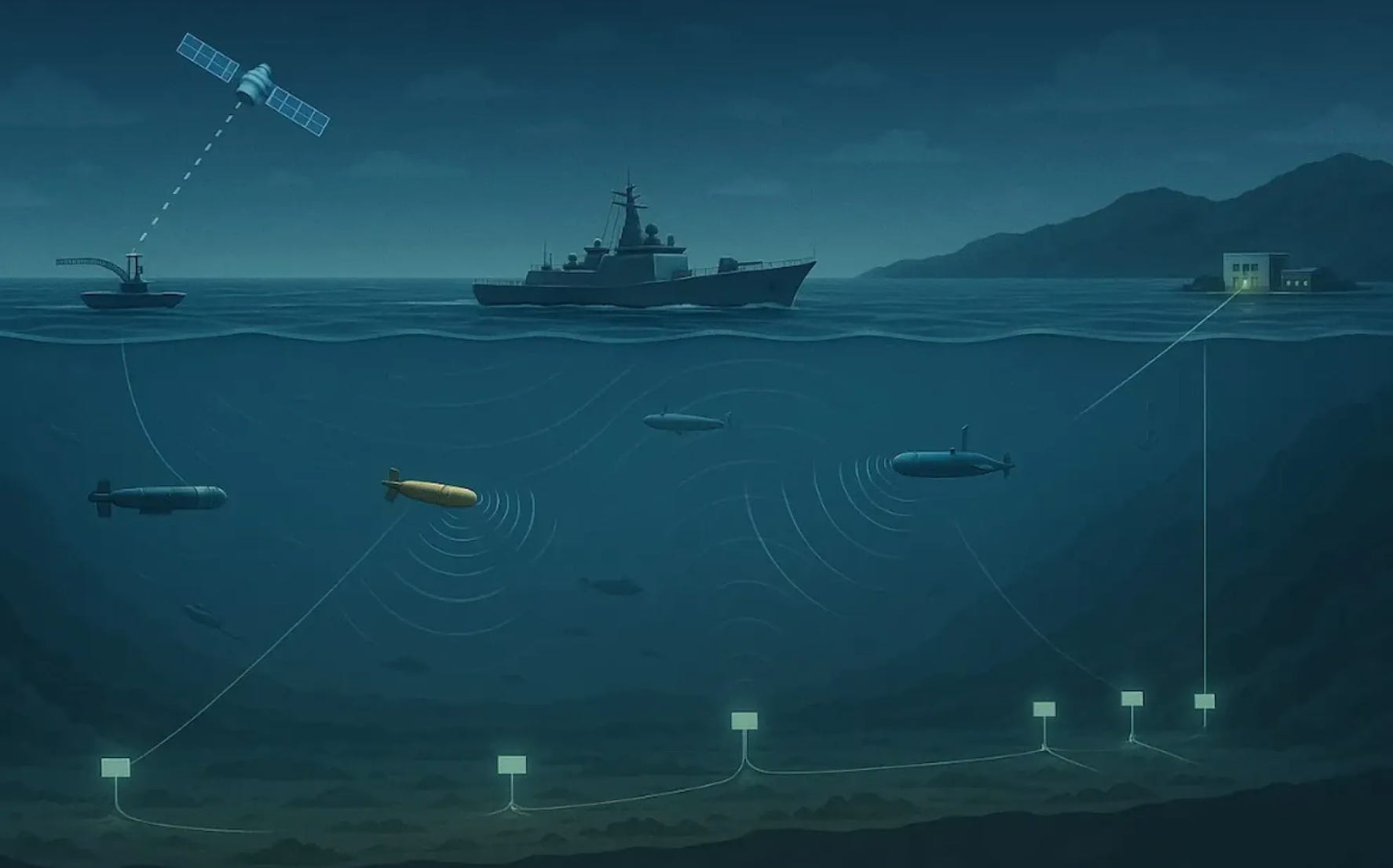
As reported by Defense One, the People’s Liberation Army (PLA) is rolling out an advanced multi-layer sensor system throughout the western Pacific. This framework, called the Transparent Ocean strategy, comprises five distinct levels spanning from the seabed up to space, aiming to challenge U.S. and allied submarine operations.
In August, the effectiveness of this network was demonstrated during the PLA Navy’s Joint Sea-2025 exercises with Russia near Vladivostok. During these joint anti-submarine drills, Chinese and Russian units combined their communications and exchanged real-time data on hydro-meteorological and air-sea tracking. According to Chinese state sources, the goal was to limit deep-diving submarines’ tactical concealment options.
These activities underscored the rise of a robust automated kill web that China plans to expand across several maritime zones. The architecture allows for constant, real-time surveillance over broad regions, utilizing five main layers:
Ocean Star Cluster (space): A constellation of satellites led by the Guanlan radar altimetry and ocean-profiling lidar system, which delivers wide-area scans and directs lower-level assets.
Air-Sea Interface (surface/near-surface): Technologies like smart buoys, wave gliders, and unmanned surface vessels monitor maritime hotspots, sample upper ocean conditions, and relay messages between submerged platforms and land-based systems.
Starry Deep Sea (water column): Autonomous underwater vehicles, deep floats, and long-range gliders navigate beneath the mixed layer, collecting environmental information and supporting acoustic detection.
Undersea Perspective (seabed): Linked by undersea cables, observatories and hubs are fitted with passive sensor arrays, navigation beacons, and docking stations, enabling unmanned vehicles to recharge underwater and operate longer without surfacing.
Deep Blue Brain (data fusion): Serving as the hub, this command center merges various data streams, coordinates sensor deployment, and aids decision-making for tracking and engaging targets.
PLA strategists advocate for a “maritime adaptive kill web” - a mesh-style network that reroutes information if certain nodes fail, ensuring reliable operation. Studies at Dalian Naval Academy have produced algorithms to assess alternate attack routes and rapidly reconfigure strike chains when disruptions occur.
Over ten years, parts of the Transparent Ocean blueprint have evolved, blending civil and military technologies. Noteworthy advances include Zhejiang University’s Zhairuoshan observatory, which achieved real-time undersea connectivity in 2014, and ongoing work by the China Academy of Electronics and Information Technology to build integrated cross-domain maritime networks. Ocean University of China has also launched the Kuroshio Extension observation system, providing thorough monitoring along vital sea routes.
China is also pushing forward with its extra-large uncrewed undersea vehicle (XLUUV) program, backed by initiatives like the “Deep Sea Key Technologies & Equipment” project and Project 912. Recent trials have improved payloads, autonomy, and logistics for deep-sea gliders and surface communication relays.
Upgrades to relay systems feature new buoy models and smarter algorithms, optimizing connections among satellites, cell networks, and acoustic modems to guarantee smooth data transmission from underwater sensors to shore command centers. Partnerships with government agencies further boost data speed and reliability.
Efforts towards power solutions focus on longer missions, thanks to advanced batteries, seawater metal-air cells, and novel seabed recharging techniques. Ongoing research aims to overcome reliability issues brought by changing marine conditions.
In light of these advances, U.S. and allied forces need to adapt by employing “mesh-vs-mesh” strategies, focusing on counter-detection and anti-UUV actions. This calls for updated doctrine, better defenses against electronic threats, and closer teamwork. Regional allies, like Australia with its Ghost Shark and Japanese investments in underwater communications, contribute to collective maritime security.
To stay ahead, partner nations should align procurement and operational standards, emphasize joint deception and autonomous docking exercises, and position counter-UUV patrols in critical areas where PLA sensor grids function.