

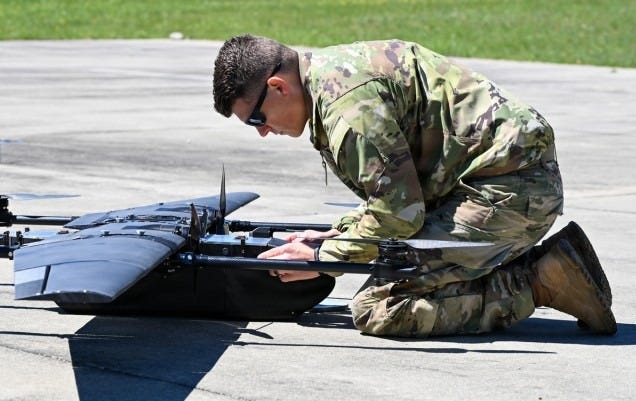
Every defense company that builds hardware eventually has to fly it, fire it or jam it somewhere legal. That somewhere is almost always a government range, because instrumented tracking, segregated airspace, explosives permissions and licensed electromagnetic interference are things states own and companies do not. For an established prime executing a program of record, access is routine. For a fifteen-person startup with no contract and no sponsoring authority, it is the constraint that sets the pace of the whole business, and until last week nobody in the West had published a number describing it.
That absence has become expensive. In August a London and Berlin company called Agon came out of stealth with thirty million dollars raised against the claim that there is almost nowhere in Europe to develop and iterate swarming drones with payloads other than the Ukrainian front line. The proposition is a synthetic arena in which autonomous systems train against adaptive adversaries at a fidelity and repetition rate the physical world cannot supply. Whether that is worth thirty million turns entirely on how badly the physical route is blocked, and there was no public figure to check it against.
On 7 August the United States Army supplied one. Twelve to eighteen months to get a company onto a range. The service intends to cut that to thirty days. The announcement came from Army Secretary Dan Driscoll with a website, a promise and a photograph of a startup’s cruise missile in Morocco. It is the first time any Western defense authority has published a wait time for industry range access. It is also a self-report, issued by the organization that owns the queue, on the day it announced the fix, at a media roundtable convened for the purpose. Both things are true at once, and the second is why the first is more interesting than it looks.
What was actually announced is narrower than the coverage. The US Army Test and Evaluation Command, working with the Michigan and Mississippi National Guard and Africa Command, opened five ranges to industry under a Test Range Expansion Initiative: Dugway Proving Ground in Utah, the West Cibola Range at Yuma Proving Ground in Arizona, Camp Grayling Joint Maneuver Training Center in Michigan, Camp Shelby Joint Forces Training Center in Mississippi, and the Multidomain Training Area at the Africa Multidomain Training and Experimentation Center in Tan-Tan, Morocco. Scope is drones, counter-drone systems, long-range fires and low-cost interceptors. Companies request time through a portal at testrange.army.mil and are assigned what Driscoll called a concierge, one person to walk them through the process.
The most consequential line in the release is easy to miss: private industry does not need a prior US government contract or an existing federal relationship to submit a request. Driscoll’s framing was that a company with a good idea should not need a team of lawyers and a program of record to prove its equipment works. That is a real change. The sponsorship requirement is the gate that has historically kept pre-contract companies off government ranges, and on these five it is gone. What remains is a funding gate. Access is for internally funded research and development, which means the company pays for its own test. That is a lower bar than a program of record and a higher one than nothing, and it lands the benefit on companies that have already raised.
Four of the five ranges are domestic, and none is straightforwardly new. The Army’s release describes West Cibola as a newly opened component of Yuma. ATEC’s commanding general, Maj. Gen. Patrick Gaydon, told reporters the same day that it is an unused part of Yuma already being used for internally funded work at small scale, which the initiative expands. Both statements are official and they do not say the same thing. The other three ranges already existed and already tested these things. Camp Grayling was designated a national range for uncrewed systems by the Department of War in February, after a sustained campaign by Michigan’s congressional delegation and governor, all of whom issued statements welcoming Friday’s announcement. What changed is the front door, not the floor space.
Nor did the underlying law change. Scheduling on the American major ranges runs under a Defense Department instruction that gives priority to Defense Department users, requires commanders to accommodate non-Defense users only to the maximum extent feasible without compromising that primary responsibility, and makes the commander’s decision on scheduling conflicts final. That instruction is intact. The portal sits on top of it.
The Army’s own language is more careful than the headlines. Driscoll’s commitment is that within thirty days of a request, a company capable of getting to a range will get access to one of the domestic ranges or one abroad, and the release adds that submitting a request does not guarantee a vendor’s desired location or timeline given capacity limits. Read plainly, that is a commitment to place a company somewhere available, not to give it the range it wants when it wants it.
The timing has a stated driver. The Associated Press, reporting from Camp Grayling, tied the initiative to munitions expenditure in the conflict with Iran, citing Center for Strategic and International Studies analysis finding that the war has drawn down already diminished American stockpiles of Patriot and THAAD interceptors, and that the shortfall could push the United States and its Middle Eastern allies to accept more risk to conserve air defenses. That is the demand signal behind a thirty-day promise. It is also the most likely thing to break it. If programs of record and primes crowd back onto the same five ranges to replenish those stockpiles, the industry queue is what gets deprioritized, under an instruction that gives Defense Department users priority and makes the range commander’s decision final.
The genuinely useful number in this story is not the Army’s. It has been public since July 2025. The Defense Innovation Unit, working with Northern Command and three services, ran a counter-small-UAS Low-Cost Sensing challenge. It received 118 submissions. It selected ten finalists to demonstrate at Northern Command’s Falcon Peak 25.2 exercise, held that September at Eglin Air Force Base. That is an 8.5 percent conversion from application to instrumented, observed, adversarial test time, in exactly the category this newsletter spends most of its time on, published by the selecting authority, with the finalists named.
It is not a capacity ratio. It was a competitive prize challenge, and the 108 companies that did not advance were not all turned away for want of range days. But it appears to be the only published applicant-to-slot figure anywhere in the alliance, and it establishes an order of magnitude that ministries and services do not otherwise state: demand for this kind of test time runs roughly ten times the supply allocated through any given door.
Two details are worth holding. The challenge launched in May 2025 and the demonstration ran in September, so application to range was about four months. And one of the ten finalists was Squarehead Technology of Oslo, whose passive acoustic Discovair sensor detects and classifies small drones. A European company obtained American range time through an open competition, with no US program office and no sponsoring national authority, inside a single quarter. The eventual winner was MatrixSpace, with Guardian RF, Hidden Level and Teledyne FLIR Defense placing behind it.
The more uncomfortable finding is that the absence of measurement is not a European failing. It is structural, transatlantic and old. On 8 August 1990, thirty-six years to the day before Driscoll’s announcement, the General Accounting Office published a proposed framework for measuring use of the American major ranges, built at congressional request. It found that the Defense Department could not readily identify excess capacity or the need for more; that ranges kept automated records but could not use them to measure test site use on a common basis; and that ranges did not consistently track or report why facilities went unused. It also recorded that the Office of the Secretary of Defense had declined to adopt a departmental proposal for a Range Utilization Measurement System, on the grounds that implementation would be labor intensive and too costly. GAO noted that only minor modifications to existing data collection would have been needed to run its own framework instead. Neither was adopted.
So the claim that range availability answers are missing from European public sources was too narrow. They are missing everywhere, because measuring them would expose allocation decisions currently made at commander’s discretion and declared final. An unmeasured queue cannot be audited. That is not incompetence. It is a property of the system, and it is the reason a private operator selling instrumented time by the hour has a real product: not more acreage, but a price and a date.
The binding constraint is spectrum, not land, and Friday’s announcement quietly concedes it. Second Bend Labs opened in April on the Georgia and Florida border: eight thousand privately owned acres with access to roughly four hundred thousand acres of military operating area near Moody Air Force Base, a range complex built to Defense Department specification, airstrip, hangar, launch pad, water ranges, accommodation for forty-five. It is the closest thing in the West to range capacity as an asset class, and at opening it was reported to be still working on waivers to local and federal rules limiting its ability to replicate jamming and other electromagnetic warfare effects. Private land does not buy the electromagnetic environment. Owning the dirt converts a scheduling dependency into a capital expenditure, as Castelion demonstrated in the Mojave. It does not convert a licensing dependency into anything.
What only a state can do is authorize interference. Camp Grayling’s pitch is a sixty-mile drone corridor, beyond-visual-line-of-sight authority and six thousand available frequencies in clean spectrum. The Army will run an electromagnetic test event for industry there the week of 13 September, intended to recreate Ukrainian battlefield conditions, and says it anticipates repeating it quarterly. That is the part of the announcement with real content, and it is the part hardest to buy privately anywhere.
It is also worth noting which range in the set is least restricted. The Army describes the key feature of the Moroccan site as the ability to operate across the full electromagnetic spectrum. No such claim is made for any of the four American ranges. Driscoll made the same point more bluntly in June: what the United States has not built, he said, and a lot of other nations already have, is places with fewer restrictions.
This produces a finding that matters for anyone underwriting test infrastructure as a business. In April, a private operator opened a range aimed squarely at drone and counter-drone startups. Four months later the same customer segment was offered four government ranges with a thirty-day service commitment, a named human to handle the paperwork, no requirement for a federal relationship, and a quarterly electromagnetic warfare event no private site can currently license. The state did not compete on capability. It competed by decree, overnight, without adding a single instrumented acre.
Range capacity sold by the hour is often described as an unglamorous and highly defensible business. The defensibility half of that needs qualifying. Physical range capacity is defensible against other private operators. It is not defensible against a sovereign that decides to reprice access to assets it already owns, which it can do in an afternoon, and which costs it nothing it was not already spending.
The European inversion of this is the actual transatlantic story. No European ministry can make Friday’s move, and not because none would want to. There is no single authority with standing to issue an alliance-wide access commitment. There are roughly thirty range owners, thirty national aviation authorities running the same ten-step risk assessment on separate timetables, and thirty spectrum regulators. NATO’s DIANA network lists around two hundred test centers and cannot schedule any of them. A European private range operator therefore faces materially less sovereign competition risk than an American one. That is an argument for the trade rather than against it, and it is the opposite of what the news would suggest.
There is a further point that matters more to European readers than to American ones. An open American range is not open to a European company. Nothing announced on Friday touches export control, foreign person access or facility security. The removal of the prior-contract requirement lowers the bar for an American startup and does nothing for a European one, because a European pre-seed company presenting at a US range is a technology transfer question before it is a scheduling question. Neither the concierge, the portal nor the thirty-day commitment addresses it. The initiative widens the gap for European founders rather than narrowing it: American companies now have a front door, European companies still face the same aviation authority queue and the same absent sponsoring ministry. The exception is the competitive route. Squarehead entered through a challenge, not a booking. For a European company with a validated sensor and no US entity, the open solicitation is the door, and it converts at roughly one in ten.
This is a promise with one day of operating history, which argues for a scoreboard rather than a verdict. Four things are checkable by December. Whether the thirty-day figure is still being claimed at ninety days, and whether any company other than Covenant Industries has said publicly that it was met. Whether the range count has moved past five, and specifically whether Aberdeen Test Center, Redstone Test Center or the Electronic Proving Ground join, since ATEC named all three as industry-accessible in a July article under its own byline. Whether the Camp Grayling electromagnetic event of 13 September repeated in the fourth quarter as anticipated. And whether any cost terms appear, because none exist today: American law requires commercial users of the major ranges to reimburse all direct costs plus whatever indirect load the range commander considers appropriate, and no range publishes a rate card, which means a founder still cannot price a test campaign before entering the process.
If those come back positive, the United States has repriced a constraint Europe has not, and the synthetic proposition gets harder rather than easier, because a simulator has to compete with cheap real range time as well as expensive real range time. Abby Denburg, president of Covenant Industries, describing the missile the company fired in Morocco, put the incumbent position plainly: modeling and simulation matter, but they do not replace the engineering knowledge gained from flying real hardware. That is the argument the synthetic case has to beat, and it was made by an executive standing next to a range the company had just used. If they come back negative, 7 August was a communications event, and twelve to eighteen months will have entered the literature as a settled fact about a problem solved by announcing it. Either way the number now exists, which is more than Europe can say. A figure that can be checked is worth more than a gap that cannot.