

By now the Anthropic story has made its rounds: on June 12, the US suspended Claude Fable 5 and its underlying model, Claude Mythos 5, for every foreign national worldwide, including Anthropic’s own foreign employees, three days after release, over a jailbreak claim Anthropic disputed in detail. The argument that followed has been made forcefully and well in more than one place this week: that the AI risk debate has been arguing about the wrong half (capability, alignment, control) when the half that just became real is access; that “good enough and governed” beats “best in the world and borrowed”; that Europe doesn’t need parity, it needs leverage.
What’s been missing from that argument is an inventory. If the thesis is right, the next question is mechanical: what does Europe actually have on the shelf today, what does each piece cost, and what is it actually good for. That’s the gap this piece tries to close.
The scale of the gap is worth stating plainly. Anthropic is valued at $965 billion, OpenAI at $852 billion. Mistral, Europe’s best-funded contender, is valued at $14 billion. The pending Cohere - Aleph Alpha merger comes to roughly $20 billion, and that figure is shared with a Canadian company. H Company has raised $220 million in total. LightOn’s public market cap is $36 million. OpenEuroLLM is running on a €37.4 million EU grant, and Germany’s SOOFI initiative on a separate €20 million government grant. That’s two to three orders of magnitude separating the American frontier from anything Europe has fielded, and it is not closing on European capital in any timeframe that matters. But the objective was never to close it. It was to build something good enough that losing access to any single piece is survivable rather than catastrophic.
Sufficiency, Not Parity
European model sufficiency, not symbolic parity, is the only version of this goal that capital and policy can actually deliver in time. Europe does not need to produce the single best model in the world. It needs a portfolio of models good enough for critical defense and public-sector tasks, hosted on European compute, governed under European law, and backed by a domestic ecosystem of evaluators, integrators, cyber specialists, and defense primes. That portfolio is what gives a government a fallback in crisis, leverage in alliance negotiations, and a base to build classified or mission-specific capability on top of.
Defense is where the absence of that portfolio bites hardest. A ministry running intelligence fusion, operational planning, procurement analysis, code generation, or cyber triage on an American closed model isn’t outsourcing software, it’s placing part of its cognitive infrastructure inside a jurisdiction whose export-control priorities can change on a Friday afternoon. Allies who share values don’t share threat perceptions, escalation thresholds, or domestic politics, and a European military cannot assume the model it relies on in peacetime stays available, unmodified, and legally usable in a crisis.
Open weights help here, but they are not the same thing as sovereignty. A model whose weights can be inspected but whose training pipeline, hosting, security hardening, and updates still run through foreign platforms is only partially sovereign. What open weights buy is options: evaluation by national labs, hosting on European infrastructure, fine-tuning on classified or mission-specific data, red-teaming under local rules, and continued availability even if a provider or a foreign government changes the terms.
None of this addresses the layer underneath the models. Mistral’s own infrastructure build is a useful reminder: the $830 million debt raise it closed in March was to buy roughly 13,800 Nvidia chips for a new data center outside Paris, and ASML’s stake in the company exists because Europe still needs an outside partner to make the silicon in the first place. Every model on this list, European-trained, European-hosted, European-governed or not, runs on American or Taiwanese hardware. Model sufficiency without compute sufficiency is sovereignty at one layer sitting on top of dependency at the layer below it. That’s a different problem from the one this piece is mapping, and a harder one, but it’s the one that decides whether any of the above actually holds up in a crisis rather than just on paper.
What’s Actually on the Shelf
Mistral is the most credible general-purpose contender, and the only one in this list operating at anything close to the scale that matters. Its value lies less in benchmark scores than in deployability: models that run on European-controlled infrastructure, fine-tune for specific languages and missions, and integrate into secure workflows without routing sensitive data through American systems. France’s Ministry of the Armed Forces acted on exactly that logic in January, awarding Mistral a multi-year framework covering the armed services, the CEA, ONERA, and the navy’s hydrographic service, deployed on French infrastructure under the ministry’s AI agency, AMIAD. That contract is the clearest evidence anywhere in Europe that procurement is shifting from buying the highest benchmark to buying governed capability under national authority.
Aleph Alpha offers a different path: not a race to the largest model, but explainability, auditability, and on-premises deployment for high-stakes public-sector environments, the features a commander or civilian authority will actually demand before letting AI near a consequential decision. The complication is that Aleph Alpha merged with Canada’s Cohere in a roughly $20 billion deal announced in April, backed by Germany’s Schwarz Group. The Heidelberg operation, the German government contracts, and the domestic infrastructure backing all remain in place, but a sovereignty pitch now resting partly on a Canadian-owned entity is a real wrinkle, not a footnote. German defense buyers will have to decide whether allied-nation ownership satisfies their sovereignty bar or simply moves the dependency one jurisdiction over. It’s not the first time this pattern has played out either: AMD bought Silo AI, Finland’s largest private AI lab and the maker of the Nordic-language Poro and Viking models, back in 2024.
Germany also has a second, cleaner play running in parallel, with no ownership asterisk attached. SOOFI is a government-funded effort backed by Berlin’s economics ministry with €20 million, built by a consortium of six research institutions and two startups, training a 100-billion-parameter open-source model entirely on German soil on Deutsche Telekom’s Industrial AI Cloud using roughly 130 Nvidia DGX systems. Its stated mandate explicitly includes robotics and other complex industrial tasks alongside healthcare and public administration, which gives it a more direct line to defense-adjacent applications than Aleph Alpha’s enterprise pitch. It’s the smallest line item in this stack by funding, and it won’t ship before mid-2026 at the earliest, but it’s the one entry here that answers the sovereignty question without a caveat.
LightOn, H Company, and OpenEuroLLM aren’t trying to compete for the general-purpose crown, and that’s the point: they fill specific gaps a horizontal model doesn’t cover. LightOn’s document intelligence is built for exactly the kind of doctrine, procurement, intelligence, and maintenance paperwork that buries ministries and armed forces. H Company’s computer-use agents point toward automating interaction with existing software systems, relevant to logistics and command-support tooling. OpenEuroLLM, the EU-funded consortium building open multilingual models, would close a real gap in English-first systems for coalition defense and civil-military coordination, if it delivers. That’s not guaranteed: the project’s own coordinator flagged in March that compute remains a binding constraint heading into its first model release this summer.
Chinese open-weight models are not a shortcut around any of this. Some are genuinely strong on multilingual and coding benchmarks, but swapping dependence on American closed systems for dependence on Chinese open weights doesn’t solve the sovereignty problem, it just makes it harder to audit: provenance, training data exposure, embedded behavior, and political leverage all get murkier, not clearer. In defense, the cheapest available capability is not necessarily usable capability.
What Brussels Has Put on the Table
On June 3th, three weeks before the Fable suspension, the European Commission proposed the European Technological Sovereignty Package: two legislative proposals, the Chips Act 2.0 and the Cloud and AI Development Act (CADA), alongside a new EU Open Source Strategy. It is the most concrete policy architecture yet aimed at the exact gap this piece is mapping, and it arrived before the Anthropic episode made the case for it more vividly than any white paper could.
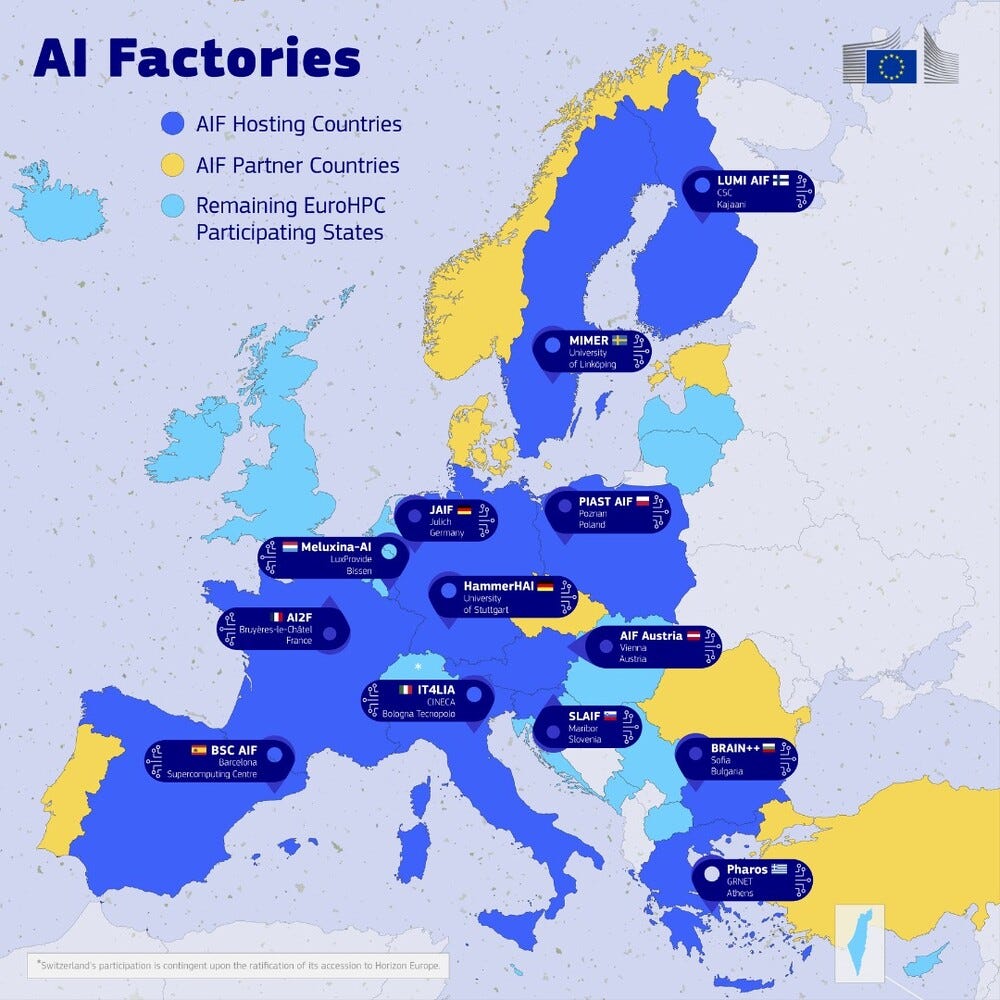
CADA matters most for the model layer specifically. It introduces a single EU-wide framework to assess cloud and AI sovereignty, builds in data center acceleration zones, and writes public procurement preferences for open and secure European cloud and AI solutions directly into law: the same shift from buying the best benchmark to buying governed capability that AMIAD is already executing in its Mistral contract, but as a horizontal EU rule rather than one ministry’s choice. Chips Act 2.0 attacks the layer underneath. It leans on demand-side tools this time, building explicitly on the existing network of EuroHPC AI Factories already running across Finland, Germany, France, Spain, Poland, and elsewhere, to anchor a planned call for AI Gigafactories, larger purpose-built AI training facilities, expected in July. OpenEuroLLM’s own compute allocation already draws on two of those Factories, LUMI and Leonardo. The infrastructure layer this piece flagged as the real constraint underneath the model layer is not a hypothetical policy goal; it already exists and Brussels is now trying to scale it.
The honest caveat: these are proposals, not law. Both Chips Act 2.0 and CADA still need European Parliament and Council approval, and the original 2023 Chips Act took roughly two years from proposal to adoption. CADA in particular touches the politically sensitive question of sovereignty versus open markets with trading partners, exactly the kind of file that drags. The architecture for model and compute sufficiency is formally on the table in Brussels now. Whether it clears the legislative process before the next access shock is the same race this piece has been describing throughout, just moved up a level, from company balance sheets to the Council’s calendar.
What Has to Change
CADA gives Brussels the legal framework. It doesn’t by itself give individual defense ministries the habit of using it, and a procurement preference written into EU law only works if someone actually exercises it. European governments have largely treated artificial intelligence as an IT service to buy once it matures, rather than a strategic capability to shape through demand. Defense ministries need to become demanding early customers: funding evaluations, classified testbeds, secure fine-tuning environments, operational pilots. Procurement should reward openness where it increases auditability, domestic hosting where it increases resilience, and modular architecture that lets a ministry switch models without rebuilding the system around them.
The same logic applies to research. Universities, public labs, and non-profit research groups should not be peripheral to defense AI; they’re the source of the methods, benchmarks, datasets, and red-team practices that make sovereign deployment credible in the first place. The goal isn’t to militarize academic research wholesale, it’s to make sure European institutions aren’t stuck choosing between opaque foreign frontier systems and underpowered domestic substitutes. Open research is what makes a middle path viable: transparent enough to inspect, capable enough to use, European enough to control.
Alliance Is Not Ownership
The G7 summit in Évian-les-Bains, which ran through June 17, days after the suspension, is the clearest evidence yet of why model sufficiency can’t wait on diplomacy. Leaders discussed a “trusted partners” scheme there: a list of allied nations or companies that Washington would grant special access back to the restricted models, closer to a security clearance than a treaty. Macron pushed for inclusion, arguing no one will buy American AI if it can be switched off without warning. A European Commission spokesperson pushed back even more directly, insisting Brussels already qualifies as a trusted partner and challenging anyone to name a more reliable one. As of this writing the scheme remains undefined, with no agreed framework and no timeline from Washington. But follow the logic even if it succeeds. A trusted-partners list is still a list Washington controls, can redraw, and can remove a name from on terms nobody outside Washington sets. Getting on it converts an emergency into a standing arrangement. It does not convert dependency into ownership.
None of this argues for retreating from allied cooperation or rejecting American technology. NATO interoperability and transatlantic industrial links stay essential regardless of how this plays out. But alliance is not ownership, and a continent that cannot run, inspect, adapt, and preserve access to its own AI systems carries a structural vulnerability into every future crisis, no matter how good its alliances are on paper, and no matter whose list it’s on.
Mistral, Aleph Alpha, SOOFI, LightOn, H Company, and OpenEuroLLM are not a complete answer yet. They’re the beginning of one, and the gap between “beginning” and “stack” is now a question of capital allocation and procurement discipline, not invention. That’s a problem Europe has actually solved before, in other sectors, on tighter timelines than this one allows.