

The Cost of Shipyard Delays
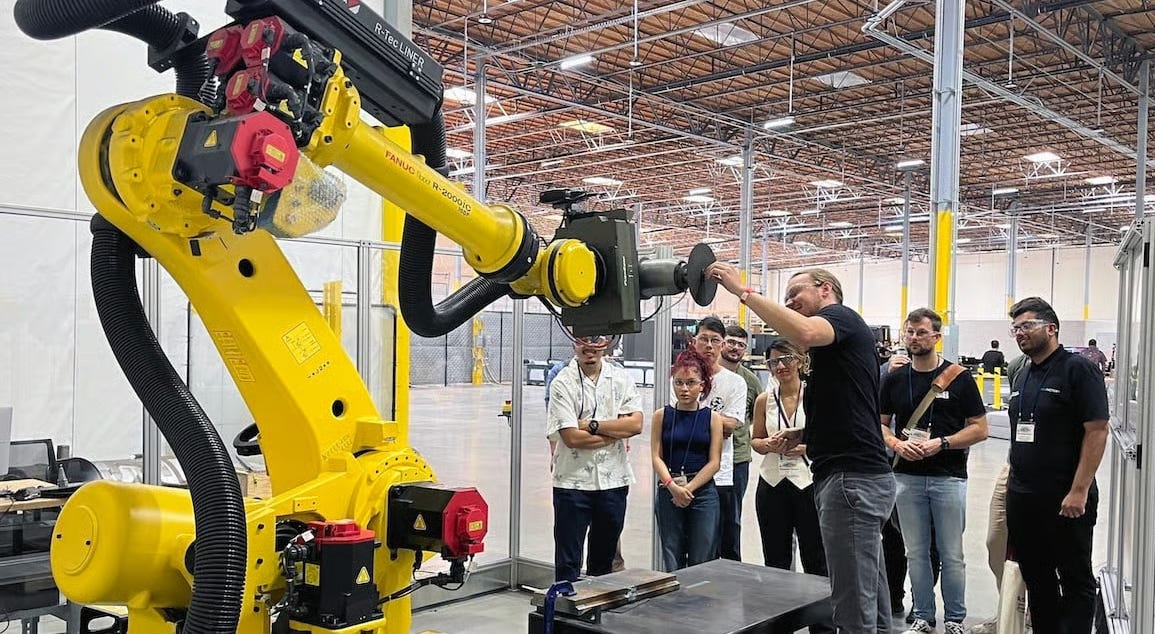
Huntington Ingalls Industries (HII) is bringing a new set of tools into the shipyard. This week, the company announced a partnership with GrayMatter Robotics to introduce AI-enabled robotic systems into parts of the shipbuilding process that are typically manual, including surface preparation, grinding, coating, and inspection.
The focus is not on new platforms or advanced systems, but on the slower, labor-intensive steps that shape how long it takes to build and maintain ships. GrayMatter’s technology combines machine learning with robotic execution, allowing operators to present a part to the system, generate a model using 3D sensing, and carry out tasks without extensive programming. The aim is to reduce the time required for processes that are precise, repetitive, and difficult to staff.
HII has already taken a similar approach in other areas. Earlier this year, the company partnered with Path Robotics to introduce automated welding into shipbuilding operations. Together, these efforts point to a broader attempt to improve throughput by targeting specific steps in production and maintenance.
That focus reflects a wider set of challenges. The Navy continues to face delays in both ship construction and repair, with maintenance periods frequently extending beyond planned timelines. Submarines and surface ships alike spend longer in yards than expected, reducing the number of vessels available for deployment at any given time.
Much of the delay originates in the shipyard itself. Facilities are being modernized and funding for infrastructure has increased in recent budgets, but many yards remain constrained by layout, equipment, and the complexity of the work being performed. These constraints show up not in a single failure point, but across multiple stages of the process.
At the same time, shipbuilding and repair depend on skilled workers performing physically demanding and highly precise tasks. These roles are difficult to fill and take time to train, which makes it challenging to expand capacity quickly even as demand increases.
The result is a mismatch between strategic intent and industrial output. The Navy is moving toward a more distributed force structure, combining large platforms with smaller and increasingly unmanned systems, shaped by operational demands from regions like the Indo-Pacific and the Middle East. But these concepts depend on the ability to generate and sustain ships at a consistent pace.
Partnerships like HII’s with GrayMatter Robotics sit within that gap. The value is in reducing the time required for specific tasks that sit on the critical path of production and maintenance. Processes like grinding, coating, welding, and inspection are not peripheral - they influence how long ships remain in construction or overhaul.
GrayMatter Robotics, founded in 2020, focuses on applying AI to these kinds of environments, where variability and precision have historically limited automation. Its systems are designed to adapt to the part in front of them rather than rely on fixed programming, making them more applicable to shipyard conditions.
Other companies are approaching similar problems from different angles. Gecko Robotics, for example, is working on inspection and maintenance systems, while other firms are focused on fabrication and production workflows. What is emerging is not a single solution, but a set of incremental improvements across different parts of the shipyard.
The significance of these efforts is cumulative. Shipbuilding and repair timelines are shaped by many small steps, each of which can introduce delay. Improving throughput depends on reducing friction across those steps rather than solving for one constraint in isolation.
The broader implication is straightforward. The effectiveness of the Navy’s evolving force structure will depend not only on what is procured, but also on how quickly ships can be built, repaired, and returned to service. As long as timelines remain extended, fleet size will not translate directly into operational availability. To this end, the HII and GrayMatter Robotics partnership reflects a more practical shift in defense innovation. Rather than focusing only on new platforms, it targets the processes that determine how the existing system performs.