

Study Finds NASA's Launch Costs are Rising
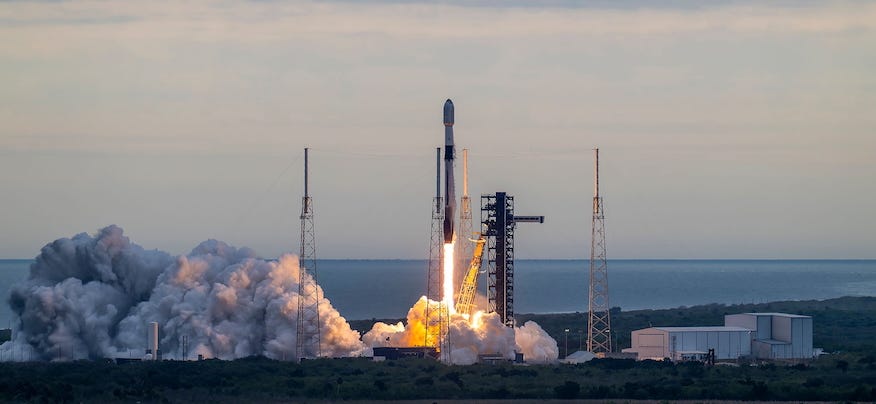
In an era of reusable rockets, launch operations becoming more routine, and frequent access to space, NASA is still paying more than it did 30 years ago to launch missions into orbit, according to a study soon to be published in the scientific journal Acta Astronautica.
Space launch is primarily a private sector domain in the United States today. The Commercial Space Launch Act of 1984 acknowledged the capability of the private sector to develop space launch vehicles, fostering industry growth and creating business opportunities for private companies to develop and manufacture launch vehicles. Following the passage of the 1984 Act, the United States government enacted several laws and policies, including the Commercial Space Act of 1998, the Commercial Space Transportation Competitive Act of 2000, and the National Space Policies of 1980, 1996, 2010, and 2020, to further promote the growth of the private space sector. Additionally, the retirement of the Shuttle program in 2011 led NASA to fully rely on the private sector for payload deliveries.
An anticipated benefit of privatization was the efficient delivery of goods and services facilitated by competitive market forces. For the launch industry, privatization was expected to result in more efficient resource allocation, leading to lower launch prices and increased launch demand. Through economies of scale coupled with competitive market forces among launch service providers, the commercial launch industry was expected to deliver cost savings for government customers such as NASA.
The economic factors underlying these policies present two intended effects on cost. The first is the effects of privatization, assessed by comparing NASA's costs of commercial launch services and government-owned launches. Although the Shuttle, designed for crewed missions, is not directly comparable to non-crewed commercial launch services, it was the only government-owned vehicle in regular operation from the early 1980s until its retirement in 2011, making it the best available comparison. The cost of a Shuttle flight ranges from $408 million (marginal cost) to $775 million (average cost), with the lower end surpassing the highest publicly available contract values NASA has awarded to private launch services since the early 2010s. Previous analysis from NASA indicates that transitioning from the Shuttle program to commercial launch services resulted in cost savings. This effect represents the one-time cost reduction from shifting the launch service provider role from the public sector to the private sector.
The second effect is the impact of a competitive market. With privatization, the industry was expected to be subject to competitive market dynamics, prompting companies to continually innovate for cost efficiency. Unlike the one-time effect of privatization, the effects of a competitive market continue over time as the industry evolves and reaches an equilibrium. Analyzing this second effect in the launch industry is often limited by the lack of accessibility to relevant data.
Financial data from NASA, as revealed in the Acta Astronautica report, indicates the agency's payments for launch services are increasing. Adjusted for inflation, the prices NASA pays for launch services have risen at an annual average rate of 2.82% from 1996 to 2024. Additionally, there is no indication of a change in the trend of the cost of launch services, following the entry of a new launch service provider in 2016: SpaceX.
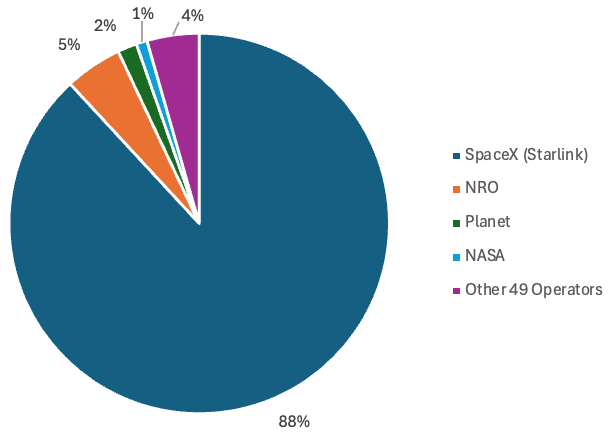
SpaceX alone has sufficient capacity to launch the few science missions NASA places into space each year. The company already handles more launches for NASA than any other rocket company. However, NASA is just one of numerous customers competing for a position on SpaceX's launch manifest. SpaceX frequently deploys batches of Starlink Internet satellites to orbit, while other types of missions fill up the remainder of SpaceX's launch schedule. The US military, which is also conducting more missions than ever before, also counts SpaceX as its top launch provider.
Commercial satellites and SpaceX's own Starlink missions intensify the demand for launch slots. So far this year, over 70% of SpaceX's launches have deployed Starlink satellites or Starshield spacecraft, a military variant of the Starlink platform for the US government. Thus, demand remains high even though NASA's missions account for only a fraction of SpaceX's launch activities.
NASA's Launch Services Program, which arranges rocket launches for the agency's science missions, utilized a Falcon 9 rocket for the first time in January 2016. Prior to that, United Launch Alliance was the sole provider capable of transporting NASA's heaviest satellites to orbit. The Launch Services Program brokers launch contracts for NASA's interplanetary probes, space telescopes, and climate research satellites, while launches for crew and cargo transport to the International Space Station are managed through a separate account. For nearly 40 years, NASA's policy has been to launch its robotic science probes on commercial rockets whenever possible. Government officials realized in the 1980s that NASA's Space Shuttle would be more expensive to operate than anticipated. Following the Challenger accident in 1986, NASA transitioned to launching most of its satellites on expendable rockets, like Atlas, Delta, and Titan vehicles.
New participants entered the launch market in the 1990s. Orbital Sciences introduced its air-launched Pegasus vehicle, which became the first privately developed rocket to achieve orbit.
SpaceX debuted its small liquid-fueled Falcon 1 rocket in the 2000s, followed by the larger Falcon 9 and Falcon Heavy rockets in 2010 and 2018. The Falcon 9 and Falcon Heavy are partially reusable, promising significant reductions in launch costs. SpaceX is the pioneer in recovering and reusing an orbital rocket's first stage booster and payload fairings, which constitute approximately 70% of a Falcon 9 launcher’s total costs. Reusability and processing enhancements at SpaceX's factory and launch sites have substantially lowered the cost of each Falcon 9 launch. "At one point, SpaceX had publicly said that it was $28 million," stated Caleb Henry, director of research at Quilty Space. "We believe today that they are below $20 million per launch and actually lower than that... I would put it in the mid-teens for how much it costs them internally."
SpaceX recently launched a Falcon 9 booster for a record 27th mission. "As they can amortize the cost of the booster over a greater number of missions, that only helps them with their business case," Henry added. Note, the costs incurred by launch providers for each flight are proprietary.
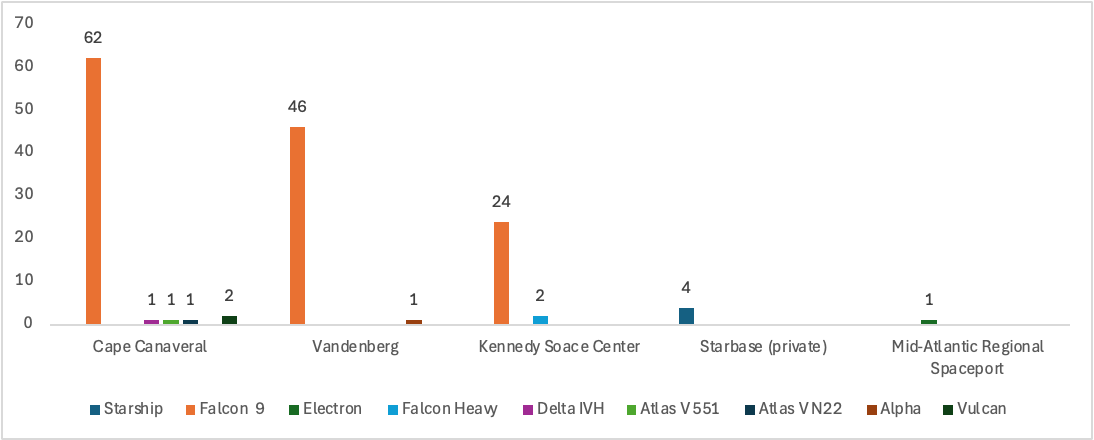
For the launch industry, privatization was expected to lead to more efficient resource allocation, resulting in lower launch prices and increased launch demand. These efficiencies include economies of scale, enhanced production, and competitive pressures, all anticipated to drive down prices as the industry reached an "equilibrium." However, these expectations never materialized. The results of the Acta Astronautica report indeed indicate that NASA's launch service cost is not decreasing. Furthermore, the report indicates limited effects of the competitive market on launch prices and recommends that NASA reassess its policies to foster more competition.
Over recent years, SpaceX has attributed steady increases in the price of dedicated Falcon 9 launches—from $62 million to $67 million and now to $70 million—to inflation. This suggests SpaceX is selling launches at a significant markup, although the Falcon 9's list price remains competitive against rival companies.
Companies charge the US government higher prices for launch services compared to commercial clients. By paying more, NASA and the Space Force secure priority on launch schedules, and government engineers gain access to internal company data for oversight purposes. NASA and Space Force missions sometimes require special provisions, such as stringent payload cleanliness specifications or modifications for placing satellites into unique orbits, often precluding rideshare missions, which offer discounted rates.
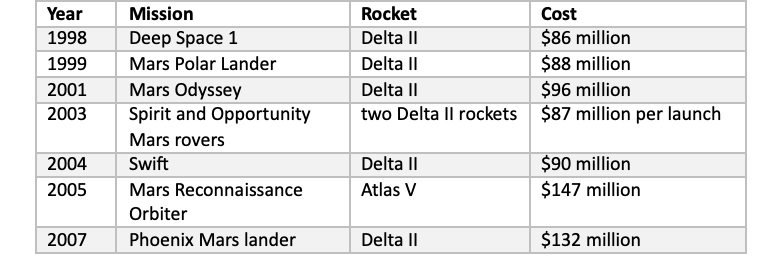
Although launch prices for every NASA mission since 1996 are not publicly accessible, launch prices paid by NASA for most medium and large science missions from the late 1990s through the mid-2000s are available open source. Today, these missions would likely launch on SpaceX Falcon 9 rockets. Below is a sample with contract values adjusted for inflation to reflect 2025 dollars:
NASA mission launch prices surged after the late 2000s, following the formation of United Launch Alliance through the merger of Lockheed Martin and Boeing's Atlas and Delta rocket programs. This merger eliminated competition for most NASA launch contracts until SpaceX's Falcon 9 became available for NASA science missions in the mid-2010s. Below is a sample illustrating rising costs, with contract values adjusted for inflation to reflect 2025 dollars:
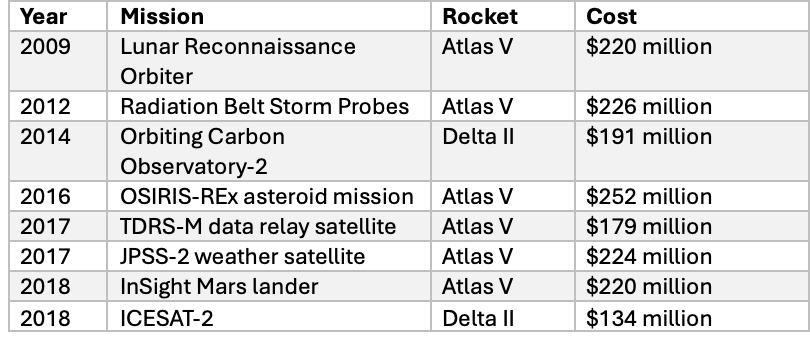
Again, the missions listed above would likely launch on SpaceX's Falcon 9 rockets if NASA awarded these contracts today. So, how do SpaceX's more recent Falcon 9 prices compare? In the below table, contract values are adjusted for inflation to reflect 2025 dollars:
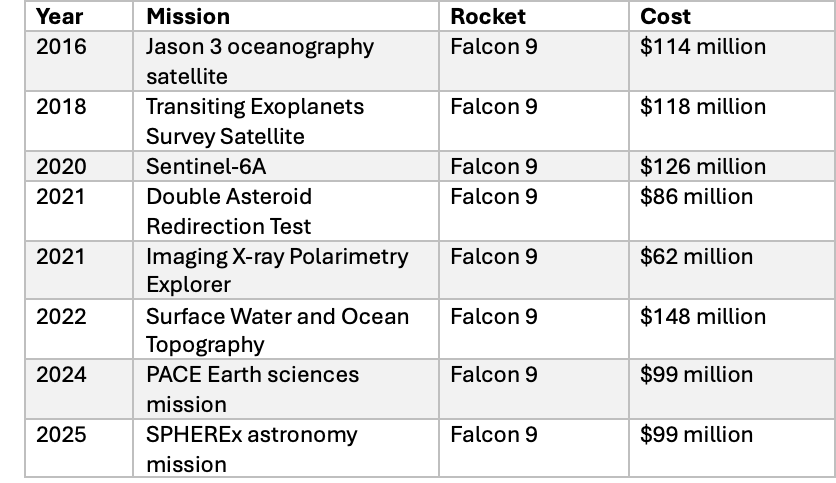
Here are a few upcoming launches NASA has scheduled with SpaceX's Falcon 9 rocket. Some of these contracts were awarded within the last year and have not been adjusted for inflation, while others reflect 2025 dollars:
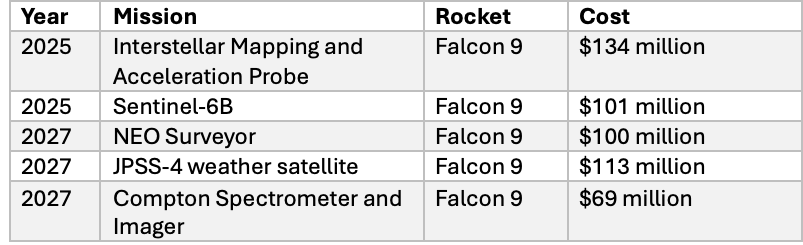
Several key points emerge when analyzing NASA's launch prices. One notable aspect is that SpaceX's Falcon Heavy, used for NASA's heaviest missions, incurs higher costs compared to the Falcon 9 rocket. For instance, two identical weather satellites launched in 2022 and 2024 on ULA's Atlas V and SpaceX's Falcon Heavy rocket for $207 million and $178 million, respectively, both adjusted for inflation. Additionally, comparing NASA's launch prices for the agency's three latest nuclear-powered space missions reveals significant expenditures. These spacecraft employ plutonium power generators, necessitating additional safety certifications for their launch vehicles.
NASA compensated ULA the equivalent of $307 million (adjusted to 2025 dollars) for the Curiosity Mars rover launch in 2011. The Perseverance Mars rover's 2020 launch via Atlas V rocket under a contract valued at $323 million (adjusted to 2025 dollars). NASA's Dragonfly helicopter, slated for launch to Saturn's moon Titan in 2028, received a $257 million award last year to be launched aboard a SpaceX Falcon Heavy rocket.
NASA's payments to SpaceX for recent missions are less than what the agency would have paid ULA for similar launches a decade ago, representing positive news. Nevertheless, despite SpaceX's expertise in rocket reuse, NASA's costs for future Falcon 9 launches remain comparable to past charges—an average of $103 million for upcoming launches versus $107 million over the previous decade. Moreover, current average Falcon 9 prices for NASA exceed those of the expendable Delta II rocket more than 20 years ago. ULA has not conducted a NASA science mission since 2022 and has not secured a contract with NASA's Launch Services Program since 2019. ULA's Atlas V rocket is approaching retirement, and its successor, Vulcan, only became eligible to compete for NASA launch contracts last year.
Consequently, NASA has experienced limited competition among US launch providers in recent years. ULA's Vulcan and Blue Origin's New Glenn rockets are now operational, potentially contesting SpaceX for NASA contracts. However, Vulcan and New Glenn lack the established reliability record of SpaceX's Falcon rockets, and their pricing remains uncertain.
Available data on ULA's Vulcan launch prices derives from the US Space Force. Between 2020 and 2023, the Space Force awarded numerous launch contracts to ULA and SpaceX, averaging $120 million for ULA and $114 million for SpaceX. Recently, the Space Force allocated nine additional launch orders, averaging $214 million for ULA and $121 million for SpaceX. These figures correspond to NASA's recent launch prices and likely indicate trends for SpaceX and ULA pricing through the remainder of the decade. Despite the prospect of competition, NASA may await the emergence of next-generation launchers like SpaceX's Starship to achieve further reductions in launch prices.
Related:
Counting stars and costs: An empirical examination of space launch cost trend at NASA
Rivals are rising to challenge the dominance of SpaceX
SpaceX and the categorical imperative to achieve low launch cost