

Skana Robotics Unveils Autonomous Amphibious Vessel for Europe’s Maritime Grey Zones
Europe’s surrounding seas are no longer peripheral to its security calculus. From the Baltic and North Sea to the Black Sea and Eastern Mediterranean, maritime space has become a primary arena for strategic competition, coercion, and ambiguity. Russian shadow fleet tankers operating under opaque ownership, unexplained damage to subsea energy and data infrastructure, and persistent harassment of commercial shipping have underscored how exposed Europe’s coastal waters are to deniable, asymmetric activity.
These pressures are revealing a structural gap in European maritime posture. Large, high-value naval vessels are poorly suited for sustained presence in shallow, congested littoral zones, while shore-based assets often lack the reach and persistence needed to respond quickly. Recent crises, ranging from missile and drone attacks disrupting global trade routes to covert operations targeting ports and subsea cables, highlight a growing mismatch between emerging threats and the platforms traditionally used to counter them.
It is within this evolving security environment that Skana Robotics, a Tel Aviv-based defense startup founded by naval special operations veterans and robotics engineers, is introducing a new operational concept. Its flagship platform, the Alligator, is designed not as a conventional naval vessel, but as a flexible amphibious system purpose-built for the grey zones increasingly defining Europe’s maritime frontier.
From Grey Zone Exposure to Persistent Presence
Skana’s approach reflects a broader shift underway in European defense thinking. Rather than focusing exclusively on high-intensity naval conflict, maritime forces are prioritizing persistent presence, rapid response, and deterrence through distributed visibility in ambiguous environments. The challenge lies in operating where civilian and military activity overlap, where critical infrastructure is exposed, and where escalation must be carefully managed.
Recent incidents along Europe’s coasts have made these vulnerabilities difficult to ignore. Disruptions to commercial shipping have demonstrated how distant instability can ripple directly into European supply chains. Strikes on Black Sea ports have reinforced the fragility of maritime logistics in contested regions. Meanwhile, unexplained damage to subsea cables in the Baltic and North Sea has highlighted how little protection exists beneath the waterline.
According to Skana co-founder and CEO, Idan Levy, traditional responses to such incidents are often too slow, too costly, or too risky in shallow or congested waters. Deploying large manned vessels exposes valuable assets and crews, while reliance on ports and fixed infrastructure can constrain response options when facilities are damaged, denied, or politically sensitive. The result is a persistent gap between detection and response at precisely the moment when speed and discretion matter most.
A New Class of Maritime Platform
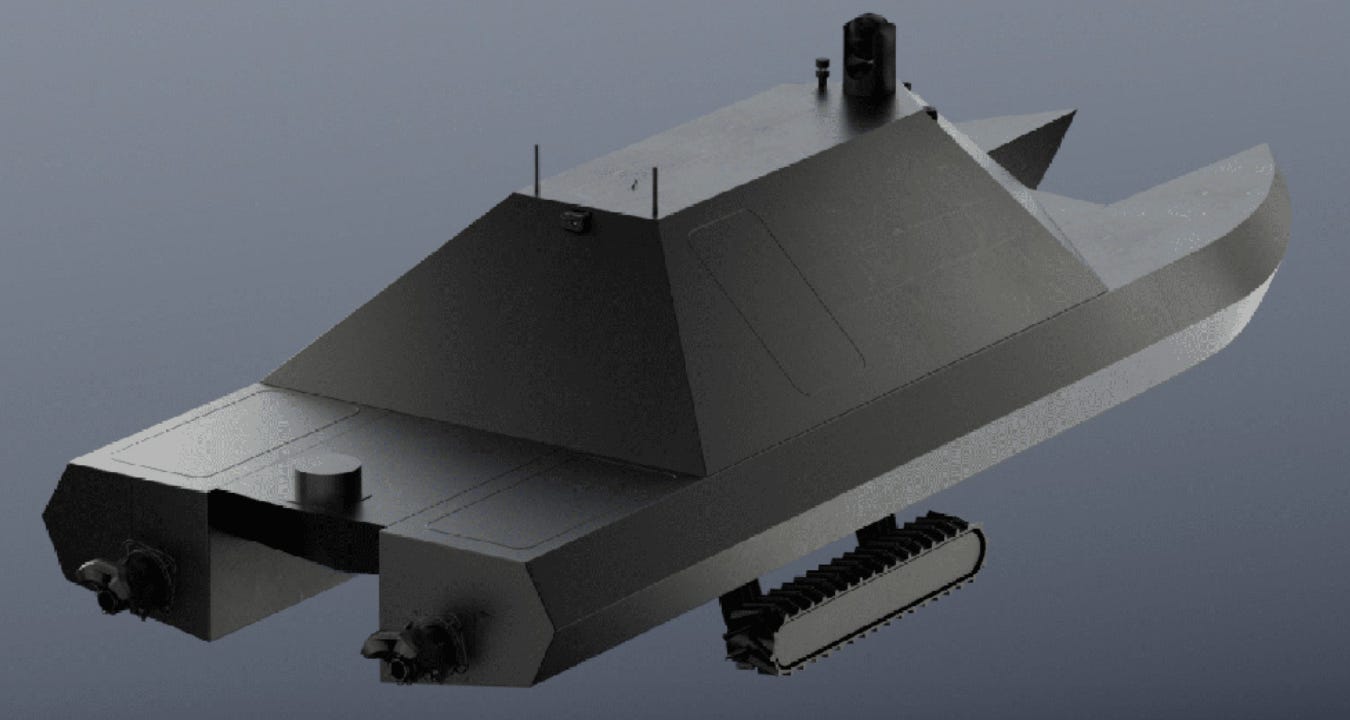
The Alligator is engineered to address that gap. Unlike conventional naval craft, it requires no dock or crane for deployment. The platform can self-deploy from land, traverse beaches, debris, and damaged shorelines, and transition directly into open water. This reflects a realistic assessment of crisis environments, where ideal infrastructure is rarely available.
Operationally, the Alligator can operate in either crewed or autonomous modes. Its autonomy model is deliberately supervised rather than fully independent. Routine navigation and time-sensitive maneuvers are handled by onboard systems, while humans retain control over mission objectives, escalation decisions, and engagement rules. Autonomy is used to manage complexity and tempo, not to replace human judgment.
Functionally, the Alligator does not fit neatly into existing naval categories. It is neither a traditional landing craft nor a standard unmanned surface vessel. Skana describes it as a Littoral Autonomous Amphibious Tender, a platform designed to operate seamlessly across land, surf, surface waters, and subsea interfaces. This enables missions ranging from logistics resupply and sensor deployment to underwater drone operations and maritime security tasks in complex coastal environments.
Technically, the vessel measures 10.5 meters in length with a 3-meter beam and a shallow 0.4-meter draft. It can carry up to 1,500 kilograms of payload over approximately 300 nautical miles, reaching speeds of up to 35 knots at sea and around 5 kilometers per hour on land. Twin waterjets provide marine propulsion, while a hydraulic drive enables terrestrial movement. A modular payload bay allows rapid reconfiguration for cargo, sensors, or autonomous vehicles.
While the initial public configuration will be uncrewed, Skana is also developing a fully manned variant with dedicated crew accommodations, signaling an intent to offer a family of platforms adaptable to different risk profiles and mission requirements.
Integrated Command and Underwater Connectivity
Beyond the platform itself, Skana’s broader proposition lies in system integration. Its fleet operates on two software layers. SeaSphere serves as the centralized mission planner and fleet coordinator, while Vera functions as the programmable command core responsible for local execution and real-time adaptation. Together, they enable coordinated operations across mixed fleets of surface, subsurface, manned, and unmanned assets.
This architecture reflects another emerging trend in European maritime doctrine. Rather than treating unmanned systems as isolated tools, navies are seeking unified command frameworks that integrate diverse platforms into a single operational picture. SeaSphere allows commanders to assign patrol, dive, scouting, and payload tasks across different systems, while Vera dynamically adjusts execution as conditions evolve.
Crucially, this is not a swarm model built around large numbers of identical units. It is a heterogeneous network in which each asset performs a distinct role. As Levy notes, naval commanders require unified control across diverse platforms, something legacy systems were never designed to deliver. The advantage lies not in autonomy alone, but in orchestration.
A recent update further strengthens this approach. Skana has enabled autonomous underwater vehicles operating within its ecosystem to communicate with one another over long distances while remaining fully submerged. This addresses a longstanding limitation in underwater operations, where traditional communications either require surfacing or suffer from severe range constraints.
The capability allows underwater fleets to share intelligence, adapt missions dynamically, and coordinate behavior without compromising stealth. For European navies and infrastructure operators increasingly focused on subsea security, this significantly improves underwater domain awareness and operational tempo while reducing exposure risk.
From Startup to Strategic Signal
Founded in 2023, Skana has raised approximately $4.3 million in pre-seed funding and plans a larger seed round in 2026 as it transitions the Alligator from prototype to production. Alongside the Alligator, the company is developing the Bullshark surface patrol drone and the Stingray underwater reconnaissance drone, both currently undergoing trials with international partners.
Taken together, these developments point to a broader shift in how maritime power is being conceived. Instead of relying on a small number of highly capable but highly visible vessels, navies are moving toward distributed presence, redundancy, and persistence. Networks of lower-profile platforms can monitor, deter, and respond across wide areas while reducing political and operational risk.
For Europe, this shift is especially significant. Its maritime environment is dense, shallow, and economically critical. Ports, pipelines, cables, and shipping lanes form an interconnected system where disruption can have outsized consequences. As grey zone activity becomes more frequent, the ability to maintain continuous awareness and rapid response without constant escalation will be central to maritime resilience.
The Alligator and its supporting ecosystem do not solve these challenges on their own, but they illustrate how new platforms are being shaped by the realities of contemporary maritime competition. Flexibility, supervised autonomy, and seamless integration across land, surface, and subsurface domains are becoming as important as speed or firepower. In Europe’s contested littorals, the future of maritime security may depend less on control of the open ocean and more on the ability to persist, adapt, and respond in the spaces in between.