

Shield AI’s Drone Fighter Jet Designed for Solo and Wingman Roles
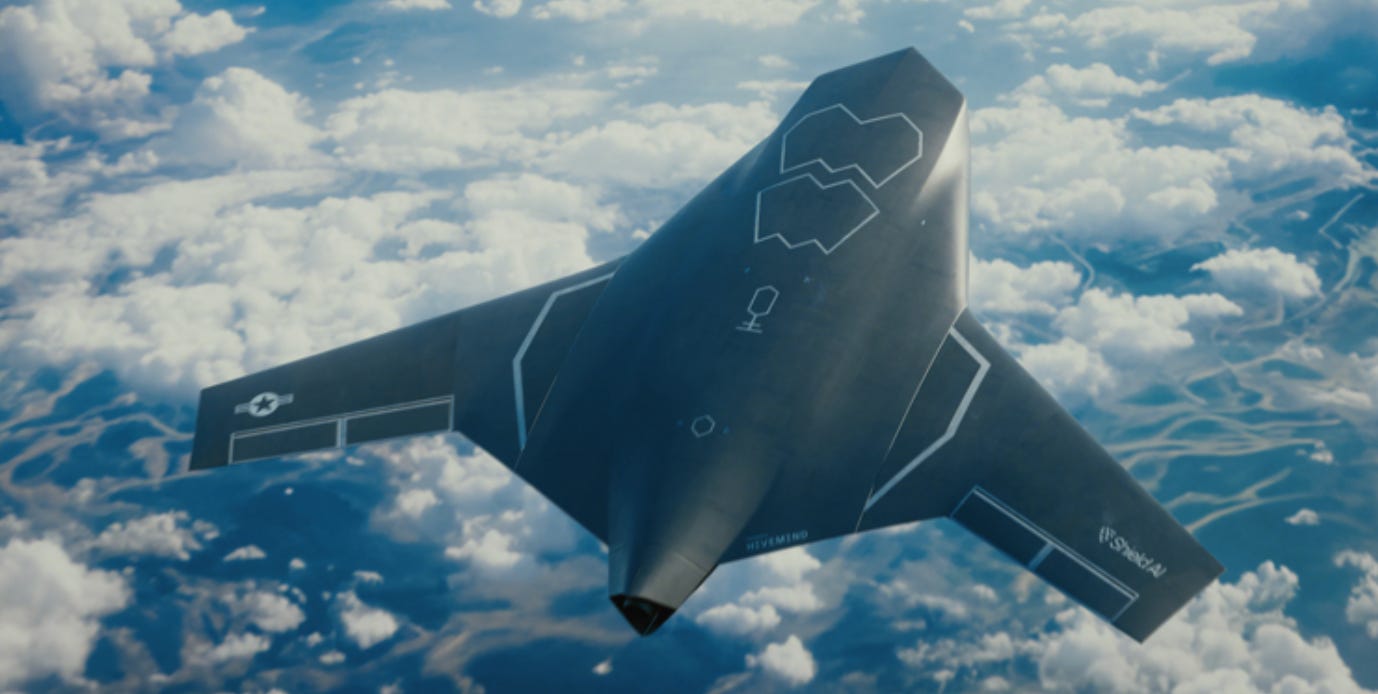
Artificial intelligence startup Shield AI has announced its plans to expand further into military hardware by unveiling a new fighter-drone concept, the X-BAT, which will incorporate the company’s proprietary autonomy software.
The X-BAT is classified as a Group 5 unmanned aerial vehicle, denoting the largest category of drones within Pentagon designations, and is capable of vertical takeoff and landing. Released images depict testing with a sizeable jet engine and an airframe designed for reduced radar visibility. “This aircraft represents an impressive advancement,” said Shield AI President and Co-founder Brandon Tseng during the drone’s debut in Washington, where a static display was presented to industry and government representatives.
While Shield AI serves as the principal designer, company officials clarified that they intend to collaborate with a partner for the production phase to be disclosed in the coming weeks. Similarly, details regarding the propulsion vendor are expected soon.
Harris described the X-BAT as operating with an engine comparable to the F-16 class, featuring afterburner capability and a thrust vectoring nozzle originally developed for a late-1990s F-15 program. Multiple engine options are currently under consideration.
Shield AI is positioning the X-BAT as a comprehensive platform, with their “Hivemind” computer pilot at the core to ensure operational effectiveness in communication-denied environments. Although Hivemind is the default autonomous system, the platform supports third-party autonomy solutions as well.
The company anticipates initial vertical takeoff and landing capabilities as early as fall 2026, with complete flight testing and operational validation set for 2028. Harris noted that pricing would be consistent with other Collaborative Combat Aircraft (CCA) platforms.
The X-BAT reportedly has a range exceeding 2,000 nautical miles, features an internal weapons bay, external hardpoints for munitions, and a modular construction allowing payload swaps for missions such as surveillance or electronic warfare. Launch and recovery operations are enabled via a dedicated vehicle, similar in approach to Shield AI’s MQ-35 V-BAT but scaled for a larger aircraft. The X-BAT is designed to operate independently or alongside manned aircraft as a wingman.
The official announcement, previously alluded to during the Paris Air Show, comes as the U.S. Air Force continues to define future requirements for the CCA program, considering a spectrum of design options. Shield AI was selected in the initial phase of the CCA program to provide autonomous piloting systems for one of two Air Force prototypes currently in development.
Interest in unmanned systems extends across multiple service branches including the Navy, Marine Corps, and Army, each at varying stages of exploration. The Navy has awarded conceptual contracts for carrier-based drone designs.
Various firms have offered proposals for the second phase, or “increment,” of the CCA program, with contract awards anticipated in the near future. Dave Alexander, president of General Atomics Aeronautical Systems, indicated that the company’s LongShot drone, developed with DARPA, could align well with the CCA increment, while Lockheed Martin has proposed its new “Vectis” unmanned concept as another option for high-survivability missions.
“We believe multi-role capability is essential,” Harris explained regarding the rationale behind selecting a sophisticated design for the X-BAT despite ongoing discussions about CCA requirements. He cited the F-16’s global success as evidence that balancing capability and cost leads to effective platforms: “We think we’ve achieved the right balance with the X-BAT.”