

Saronic and the Return of American Maritime Industrial Power
The rescue of an Apache crew in the Strait of Hormuz offered a glimpse of something larger: how autonomy, shipbuilding, and industrial capacity are converging to reshape the future of U.S. naval power
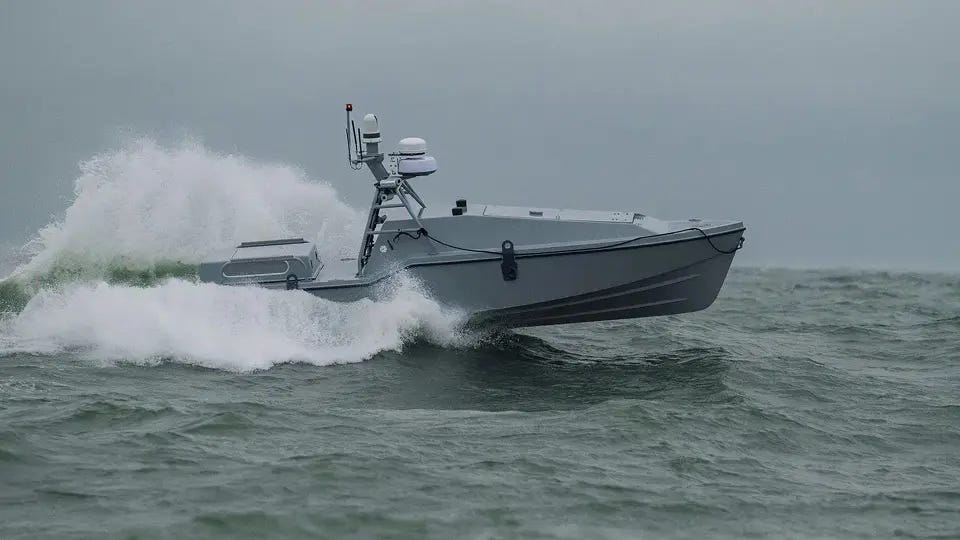
On June 9th, an autonomous vessel built by Austin-based defense technology startup Saronic, participated in the rescue of two U.S. Army aviators after an AH-64 Apache helicopter made an emergency water landing near the Strait of Hormuz. According to U.S. Central Command, the company’s Corsair autonomous surface vessel helped recover the aircrew before they were transferred to a U.S. Coast Guard vessel and subsequently extracted by helicopter. While autonomous systems have participated in military exercises and demonstrations for years, the incident represents one of the clearest public examples to date of an autonomous surface vessel contributing directly to an operational mission involving U.S. military personnel.
Military history is filled with technological developments whose significance becomes apparent only in retrospect. The rescue itself was notable, but its broader implications may prove far more consequential. For years, defense technologists, military planners, and investors have debated when autonomous systems would move beyond experimentation and become capabilities operators genuinely trust. The rescue in the Gulf suggests that maritime autonomy may be approaching that threshold. More importantly, it provides a useful lens through which to examine a larger transformation underway across the U.S. Navy, the defense industrial base, and the venture capital ecosystem increasingly financing national security innovation.
At the center of that story is Saronic. Founded in 2022, the company emerged at a moment when American naval strategists were confronting a difficult reality. Although the U.S. Navy remains the world’s most capable maritime force, it faces mounting challenges in fleet capacity, shipbuilding throughput, maintenance delays, and industrial readiness. At the same time, China’s naval expansion and shipbuilding dominance have become defining features of the global strategic landscape. The challenge facing American policymakers is not simply maintaining technological superiority, but ensuring that technological advantage can be translated into operational capacity at sufficient scale.
For decades, American maritime superiority rested on a relatively small number of highly capable and increasingly expensive platforms. Aircraft carriers, destroyers, submarines, and amphibious ships formed the backbone of U.S. naval power. Yet advances in precision strike weapons, inexpensive drones, pervasive sensing networks, and anti-access systems have altered the economics of maritime competition. Concentrating combat power into a limited number of exquisite platforms now carries greater risk than at any point since the Cold War. In response, the Navy has increasingly embraced a more distributed force architecture in which traditional crewed vessels are complemented by large numbers of autonomous and unmanned systems.
This shift is increasingly reflected in the Navy's force design and shipbuilding plans. Recent proposals envision a fleet approaching 450 battle force, auxiliary, and unmanned vessels by FY31, reflecting the growing recognition that future conflict, particularly in the Indo-Pacific, will require greater maritime presence, persistence, and capacity than today's force structure can provide.

Yet, achieving those numbers through traditional shipbuilding alone presents a formidable challenge. Modern warships require years to construct and billions of dollars to procure. Workforce shortages, aging infrastructure, and maintenance backlogs continue to constrain industrial output. The challenge confronting naval planners is therefore not simply one of fleet design. It is fundamentally a question of maritime mass.
The urgency behind this challenge stems from the Navy’s strategic reorientation toward the Indo-Pacific. Over the past decade, American defense planning has increasingly focused on long-term competition with China, whose naval modernization has transformed the balance of maritime power in Asia. The People’s Liberation Army Navy is now the world’s largest navy by number of ships and continues to expand both its fleet and the industrial base that supports it.
For the United States, the challenge is not simply matching China’s fleet size. Geography matters. The Indo-Pacific spans thousands of miles of ocean and requires persistent presence across vast distances. Any future contingency involving Taiwan, the South China Sea, or broader regional security would place extraordinary demands on U.S. naval forces. Maintaining situational awareness, sustaining logistics, protecting sea lines of communication, and projecting combat power across such distances requires a level of capacity that traditional force structures alone may struggle to provide.
This reality has led naval planners to embrace concepts such as Distributed Maritime Operations and hybrid fleets composed of both crewed and uncrewed systems. Autonomous vessels are increasingly viewed not as substitutes for destroyers or submarines, but as force multipliers capable of extending the reach, persistence, and effectiveness of existing fleets. In strategic terms, they offer a way to increase maritime presence and operational capacity without bearing the full cost of additional major surface combatants.
This challenge increasingly points toward autonomy. The Navy’s emerging vision of the future fleet includes autonomous surface and subsurface systems operating alongside traditional warships to conduct surveillance, communications relay, logistics support, force protection, and potentially strike missions. Such systems offer the prospect of expanding fleet capacity at lower cost while increasing operational flexibility across vast maritime theaters.
Viewed through the lens of Indo-Pacific competition, Saronic is not simply building autonomous vessels. The company is helping develop the technologies and industrial capacity required to support a more distributed, scalable, and resilient naval force. In many respects, companies such as Saronic represent the industrial manifestation of the Navy's future fleet architecture, translating strategic concepts around distributed operations and unmanned systems into deployable capability.
The rescue mission itself underscores this evolution. The Corsair was operating as part of U.S. Naval Forces Central Command’s Task Force 59, the Navy organization established to accelerate the integration of unmanned and artificial intelligence-enabled systems across the Middle East. Over the past several years, Task Force 59 has become the Navy’s leading proving ground for maritime autonomy. The Apache rescue demonstrated that systems initially fielded for surveillance and security missions are beginning to evolve into trusted operational assets.
Saronic’s mission is often described in terms of autonomous vessels, but the company’s broader objective is more ambitious. It seeks to restore American maritime advantage through a combination of software-defined platforms, advanced manufacturing, and scalable production. In this framework, autonomy is not the end state. It is an enabling technology for rebuilding maritime capacity in an era when naval power increasingly depends upon both innovation and industrial output.
At its core, Saronic is applying a software mindset to a traditionally hardware-centric industry. Autonomous vessels allow capabilities to be updated, improved, and adapted through software rather than solely through costly hardware modifications. The result is the potential emergence of a software-defined fleet capable of evolving more rapidly than traditional maritime platforms.
What ultimately distinguishes Saronic from many defense technology startups is its emphasis on manufacturing. Through its acquisition of Gulf Craft and plans to transform a Louisiana shipyard into a production hub for autonomous maritime systems, the company is pursuing a strategy of vertical integration that mirrors broader trends across the defense technology sector. Rather than relying exclusively on legacy industrial partners, Saronic appears intent on controlling a larger portion of the design, manufacturing, and delivery process. The approach reflects a growing recognition that industrial capacity itself has become a source of strategic advantage.
This shift is particularly significant because the debate surrounding American military competitiveness has evolved. The United States continues to produce world-leading software, artificial intelligence, aerospace technologies, and defense systems. The more pressing question is whether it can manufacture sufficient capability, rapidly enough and affordably enough, to deter and, if necessary, prevail in a prolonged conflict against a peer competitor.
Shipbuilding illustrates the challenge vividly. China possesses the world’s largest shipbuilding industry and has steadily expanded both its commercial and military production capacity. By contrast, American shipbuilding continues to struggle with workforce shortages, aging infrastructure, rising costs, and production delays. Industrial capacity has once again emerged as a strategic variable rather than a purely economic concern.
Saronic’s proposed Port Alpha shipyard reflects this reality. The initiative is not simply about building autonomous vessels. It represents an effort to rethink how maritime systems are designed, manufactured, and delivered. Perhaps the most important aspect of the company’s evolution is that it reflects a broader shift in defense innovation itself. For much of the past decade, venture-backed defense technology focused primarily on software, artificial intelligence, and autonomy. Increasingly, however, investors and policymakers have concluded that technological superiority alone is insufficient. The ability to build ships, produce autonomous systems, train skilled workers, and scale manufacturing has become inseparable from military readiness.
That ambition helps explain why investors have gravitated toward the company. Venture capital’s growing interest in defense technology is often described as a bet on artificial intelligence or autonomy. Increasingly, however, the more consequential investment thesis is industrial revitalization. Companies such as Anduril have demonstrated how software, hardware, and manufacturing can be integrated into scalable defense businesses. Saronic is attempting to apply a similar model to the maritime domain.
Skeptics will rightly note that autonomy alone cannot solve the Navy’s shipbuilding challenges. Aircraft carriers, submarines, destroyers, logistics vessels, and the broader industrial ecosystem that supports them will remain indispensable components of American naval power. Nor is it yet clear whether autonomous maritime systems can be produced, integrated, and sustained at the scale envisioned by their advocates. Yet the strategic importance of companies such as Saronic lies not in proving every answer today, but in demonstrating a plausible path toward addressing challenges that the traditional defense industrial base has struggled to solve for years.
Ultimately, the significance of Saronic extends beyond any individual vessel, rescue mission, or funding round. The company sits at the intersection of three forces reshaping American national security: the rise of autonomy, the return of industrial competition, and the growing role of venture capital in defense innovation. For much of the post-Cold War era, the United States assumed that technological superiority would offset limitations in industrial capacity. Increasingly, policymakers, military leaders, and investors are reaching a different conclusion. Technological advantage remains essential, but it must be paired with the ability to manufacture capability at scale.
This realization is driving a new generation of defense companies that seek not merely to build products, but to rebuild industries. Viewed through such a lens, the rescue in the Strait of Hormuz was more than an operational success. It was an early indication that autonomous maritime systems are becoming trusted military assets and a reminder that the future of naval power will depend as much on factories, shipyards, and production capacity as on algorithms and software.
The most consequential defense companies of the next decade may not be those building the most sophisticated platforms. They may be those enabling the United States to generate maritime capacity, industrial output, and operational mass at a scale that traditional procurement alone cannot achieve. If the Navy’s vision of a larger, more distributed, and increasingly autonomous fleet becomes reality, companies like Saronic will not simply supply that transformation. They will help define it.