

Quantum Systems Acquires FERNRIDE
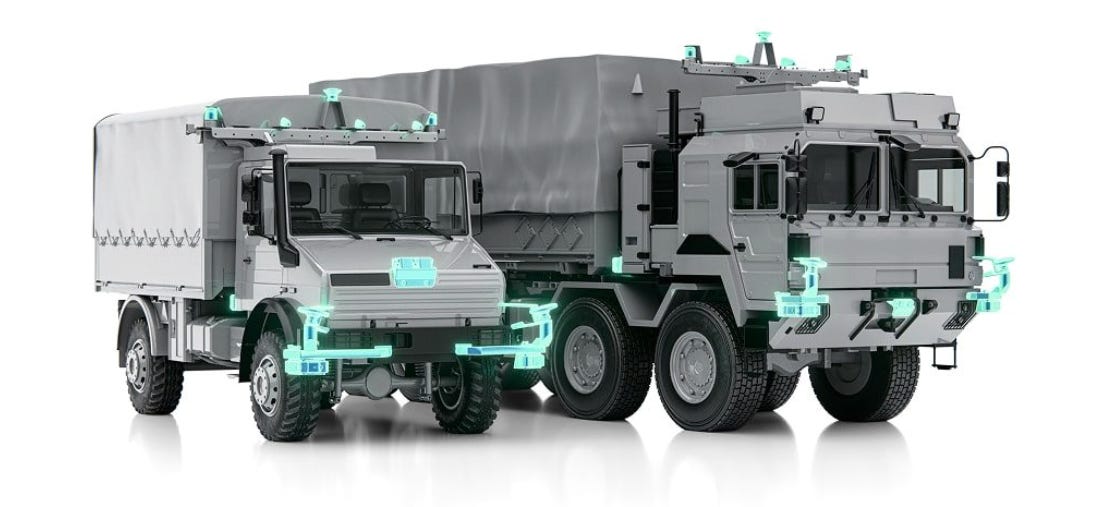
Quantum Systems has acquired Munich-based ground autonomy company FERNRIDE, marking the German drone leader’s most strategically significant move yet in its aggressive 2025 expansion. The acquisition extends Quantum’s domain expertise beyond aerial systems into autonomous ground mobility, creating an integrated cross-domain platform for unmanned systems at a critical inflection point for European defense technology.
The timing reflects geopolitical reality more than business strategy. Coming approximately one month after Quantum closed a €180 million funding round in late November and the same week the company announced a joint venture with Frontline Robotics, the FERNRIDE acquisition signals how the Ukraine conflict has accelerated European defense tech consolidation. Development cycles that might typically unfold over 5-10 years are compressing into 18-36 month timelines, driven by the urgent recognition that Europe’s sovereign defense capabilities have dangerous gaps. The strategic thesis is clear: Europe’s defense tech winners will need to be platform companies capable of delivering integrated, multi-domain solutions rather than point products, and they need to build these capabilities with wartime urgency.
FERNRIDE’s Strategic Value
Founded in 2019 by Hendrik Kramer, Maximilian Fisser, and Jean-Michael Georg following a decade of research at the Technical University of Munich, FERNRIDE initially focused on civilian logistics automation. The company’s proprietary autonomy stack retrofits existing vehicle fleets, such as trucks in logistics yards and container ports, for autonomous operation, a technically challenging approach that demonstrates robust engineering capability.
What makes FERNRIDE particularly valuable for defense applications is its dual-use pedigree. The company became the first ground autonomy company in Europe to receive TÜV approval for autonomous trucks, a regulatory milestone that translates directly to military vehicle certification pathways. Having raised over €75 million and trialed solutions with the German Armed Forces alongside commercial partners including Muuga Port (Estonia), DB Schenker, and Volkswagen, FERNRIDE brings both technological maturity and operational credibility.
In recent years, FERNRIDE pivoted toward defense logistics, the unglamorous but mission-critical backbone of military operations. Heavy logistics vehicles represent a significant operational vulnerability (exposure to attack, personnel requirements, supply chain bottlenecks) that autonomous systems can directly address. FERNRIDE’s existing commercial validation provides Quantum with a tested technology stack and accelerated deployment timeline.
The Multi-Domain Thesis
Quantum Systems positions the acquisition as operational necessity informed by Ukraine. The integration of aerial and ground robotics delivers multiplicative rather than additive capabilities: drones provide reconnaissance and targeting data while autonomous ground vehicles execute logistics, resupply, and potentially direct action missions in contested environments.
FERNRIDE’s technology will integrate into MOSAIC UXS, Quantum’s autonomous mission software platform designed to coordinate unmanned systems across domains. Martin Karkour, Quantum’s Chief Revenue Officer, articulated the vision clearly: “By integrating this technology into MOSAIC UXS, we are consistently implementing our vision of creating a connected ecosystem in which unmanned systems think, move, and act as a single entity across different dimensions.”
This software-centric approach of building a unified operating system for autonomous systems rather than selling discrete hardware represents one of the most defensible business model in defense tech. It creates switching costs, enables continuous capability upgrades, and positions Quantum to capture recurring revenue as the platform scales.
For FERNRIDE, the acquisition provides access to defense sector distribution and accelerated scaling. “Europe urgently needs sovereign autonomy solutions,” said Hendrik Kramer, FERNRIDE’s CEO. “By joining forces with Quantum Systems, we can take our technology to a new level. Together, we are accelerating deployment of our platform in the European defense sector, which is currently the most urgent environment globally for scaling autonomous ground systems.”
2025 Acquisition Spree: Building Capability Under Pressure
The FERNRIDE acquisition is one piece of a broader consolidation strategy executed at remarkable speed. Quantum has acquired or taken majority stakes in multiple companies in 2025 alone:
AirRobot GmbH: Compact, ruggedized UAV manufacturer expanding Quantum’s hardware portfolio
Nordic Unmanned UK: UK-based drone producer providing British market access, with Quantum committing up to €50 million investment in UK operations over five years
Spleenlab GmbH: German AI firm specializing in autonomous perception and machine learning
EFT Mobility: Powertrain development specialist (majority stake acquired January)
The pattern is clear: Quantum is systematically acquiring capabilities across the autonomous systems value chain, including: hardware diversity, AI/ML, propulsion, and now ground mobility, at a pace that would be considered aggressive in peacetime. Five significant transactions in a single year reflects the compressed timelines Europe now faces. Each acquisition integrates into the MOSAIC platform, compounding technological advantage while racing against capability requirements driven by an active conflict on Europe’s doorstep.
Notably, Quantum Systems CEO Florian Seibel founded STARK, an unmanned weapons company, in 2024 (though he no longer oversees daily operations). STARK recently unveiled unmanned surface vehicles (USVs), suggesting aligned multi-domain ambitions across the broader ecosystem Seibel influences. Early military trials of STARK’s systems encountered technical difficulties, though more recent tests have reportedly shown significant improvements, illustrating the challenging path from development to operational deployment that all defense tech companies navigate.
What This Means for European Defense Tech
The Quantum Systems playbook represents a template for how European defense tech companies can achieve scale in a fragmented market, but more importantly, it demonstrates how companies are adapting to geopolitical necessity rather than pursuing opportunistic growth. The compressed timeline of five acquisitions in a single year reflects the urgency Europe faces in building sovereign defense capabilities while conflict rages in Ukraine.
First, build platform architecture from day one. Quantum’s MOSAIC software provides the integration layer that makes acquisitions accretive rather than dilutive. Without this foundation, buying companies creates a conglomerate rather than a platform. In a threat environment demanding rapid capability deployment, platform architecture enables faster integration of acquired technologies into operational systems. Critically, by building around autonomy as an enabling technology rather than specific hardware, Quantum can scale horizontally across multiple domains (air, ground, surface) rather than vertically within a single platform category.
Second, embrace cross-border consolidation. Quantum’s acquisitions span Germany, UK, and broader Europe, building a genuinely pan-European capability base rather than remaining confined to national markets. This matters enormously for competing with American and Chinese defense tech platforms operating at continental scale, and for Europe’s ability to field sovereign capabilities independent of external dependencies.
Third, maintain dual-use credibility. FERNRIDE’s commercial validation with Volkswagen and DB Schenker provides both technical proof points and potential revenue diversification, though the defense-to-commercial revenue ratio for autonomous systems remains heavily tilted toward defense given current procurement urgency. Dual-use capability makes technology more defensible through broader validation and potentially more attractive to investors seeking revenue diversification, though whether commercial markets will materialize at comparable scale to defense remains uncertain for many autonomous systems.
Fourth, move fast on strategic M&A. Quantum closed five significant transactions in 2025 alone, demonstrating the urgency required in an environment where capability gaps represent real security threats, not just market opportunities. The company is clearly deploying its €180 million raise aggressively to consolidate market position before competitors can respond, and more importantly, to build capabilities Europe needs now rather than in five years.
For investors, Quantum’s strategy validates several key theses emerging in European defense tech: platform business models appear positioned to dominate over point solutions, software-defined systems enable more sustainable competitive advantages, and cross-border consolidation is increasingly necessary for achieving scale in fragmented European markets. Whether these patterns prove deterministic or merely represent one successful approach remains to be seen as the market matures.
More fundamentally, the acquisition underscores autonomy’s critical importance to future military operations. Modern warfare is transitioning from individual platform superiority to decentralized, networked systems where autonomous units coordinate in real-time across domains. Quantum’s business is built around autonomy as a critical enabling technology, comparable to AI or quantum computing in its applicability, that can be deployed across diverse hardware platforms rather than being locked to specific vehicles. This horizontal scalability fundamentally differentiates technology enablers from traditional hardware manufacturers. Where legacy defense companies scale by producing more units of the same platform, companies built around enabling technologies like autonomy, AI, or quantum can theoretically scale across multiple hardware categories simultaneously, though few have yet proven this at scale. Quantum’s multi-domain approach, integrating aerial, ground, and software layers, positions the company to test this thesis, where military advantage increasingly comes from system-level coordination rather than isolated capability.
The FERNRIDE acquisition specifically highlights growing recognition that logistics autonomy, less glamorous than counter-UAS or AI targeting, represents a massive addressable market with immediate operational pull from militaries struggling with personnel shortages and force protection requirements.
For competing startups, the message is equally clear: build toward acquisition or build toward platform-level competition. The middle ground, standalone point product companies, faces increasingly challenging paths to scale as platform players like Quantum use M&A to absorb capabilities and talent.
What makes Quantum’s approach notable is how few European defense tech companies are executing similar strategies. While the market remains highly fragmented with hundreds of point-solution startups, only a small cohort of well-capitalized players, Quantum, Helsing, and perhaps a handful of others, are pursuing platform-level consolidation plays backed by significant capital and operational discipline. Whether this consolidation model proves deterministic or represents one of multiple viable paths to scale remains an open question as the European defense tech market matures over the next 3-5 years.
Quantum Systems, backed by €340 million raised in 2025 alone and executing a methodical platform strategy, is testing whether aggressive M&A combined with software-centric integration can create category-defining companies in European defense tech. The company’s rapid accumulation of capabilities, five acquisitions plus a joint venture in a single year, represents a high-conviction bet on platform economics and multi-domain coordination as the winning strategic model. Whether the rest of the European ecosystem follows this playbook, pursues alternative paths to scale, or positions for eventual acquisition by platform consolidators will largely determine the market structure that emerges. What’s clear is that Quantum has established a significant early-mover advantage in executing a strategy that, if successful, could reshape expectations for how European defense tech companies are built.
Related:
Quantum Systems Wins Contract to Supply Twister Drones as Successor to Bundeswehr’s ALADIN System
Quantum Systems and ADV Defense Sign MoU to Strengthen German-Lithuanian Defence Cooperation