

Pentagon Launches Drone Dominance Program as U.S. Pushes to Rebuild Domestic Drone Production
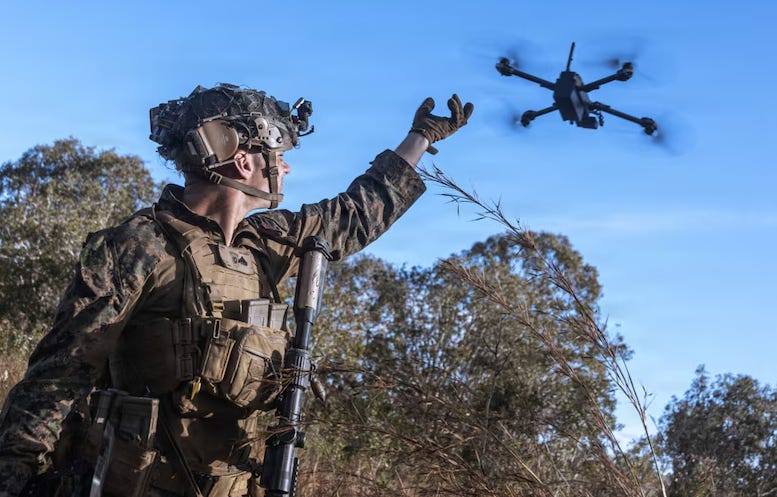
The Pentagon has launched the first phase of its Drone Dominance Program, selecting 25 companies to compete for up to $150 million in delivery orders for one-way attack drones. While framed as a rapid procurement initiative, the program also reflects a deeper strategic recalibration, one shaped by wartime lessons from Ukraine, growing restrictions on foreign drone technology, and an urgent effort to rebuild U.S. production capacity in a domain long dominated by China.
The program’s opening evaluation phase, known as “Gauntlet I,” begins February 18th at Fort Benning, Georgia. Military drone operators will test and operate vendor systems through early March, after which the Department of Defense plans to place approximately $150 million in prototype delivery orders, with deliveries expected over the following five months.
This initial phase marks the beginning of a four-stage effort that could ultimately exceed $1 billion in total investment. Pentagon leadership has stated its goal plainly: field hundreds of thousands of weaponized, one-way attack drones by 2027.
Regulation, Supply Chains, and the Quiet Return of Industrial Policy
While the program is not formally governed by the Build America, Buy America Act, its emphasis on domestic production, supply-chain security, and U.S.-based manufacturing aligns closely with the Act’s broader intent. For years, Chinese manufacturers have dominated the global small-UAS market through unmatched scale, vertically integrated supply chains, and aggressive pricing. U.S. policy has increasingly treated that dominance as a strategic vulnerability.
The result has been an awkward gap: foreign systems are restricted, but domestic alternatives have struggled to match cost, availability, and production volume. The Drone Dominance Program is an attempt to close that gap through guaranteed demand, compressed timelines, and direct operator feedback, essentially using military procurement to force the emergence of a viable domestic drone manufacturing base.
The vendor list reflects this intent. Many of the selected firms are relatively young, venture-backed, or spun out of adjacent defense or robotics sectors. Rather than relying on traditional primes, the Pentagon is placing a bet on an ecosystem model that prioritizes speed, iteration, and manufacturability.
Ukraine’s Influence - and Its Limits
Several Ukraine-based firms were selected for Gauntlet I, a notable development given the bureaucratic friction these companies have often faced when exporting systems to Western militaries. Ukrainian drone manufacturers have spent years operating under intense combat conditions, iterating designs in near-real time based on frontline feedback.
That experience has made Ukrainian systems among the most operationally proven in the world. However, their inclusion should not be overstated as evidence of a strict “U.S. versus Ukraine” design divide.
In practice, the difference is less about philosophy and more about operating environment. Ukrainian drones are optimized for rapid adaptation, minimal unit cost, and immediate battlefield utility under existential pressure. U.S. systems are shaped by certification requirements, supply-chain security, interoperability standards, and long-term sustainment considerations. Those constraints slow iteration, but they also enable scale within alliance structures.
The Gauntlet is therefore less a clash of philosophies than a test of whether U.S. procurement processes can absorb wartime lessons.
Implications Beyond the United States
For European and NATO allies, the Drone Dominance Program carries important second-order effects. Many European militaries face the same dilemma as the U.S.: reliance on restricted foreign systems, limited domestic production capacity, and procurement processes ill-suited to fast-moving drone warfare.
If the U.S. succeeds in building a scalable, compliant, low-cost drone ecosystem, it could become a de facto supplier and standard-setter for allied forces. If it fails, Europe may increasingly look to hybrid solutions, combining domestic assembly, licensed production, and operational lessons drawn directly from Ukraine.
Either outcome underscores a broader reality: small drones are no longer niche capabilities. They are becoming core military infrastructure, and alliance cohesion will increasingly depend on shared production capacity, not just shared doctrine.
What the Gauntlet Really Measures
Gauntlet I is evaluating more than hardware. It is testing whether the Pentagon can:
Buy at speed without collapsing under compliance requirements
Accept attrition and failure as normal, not exceptional
Scale production rather than perfect prototypes
Integrate allied and wartime innovation into a peacetime system
The answers will shape not only the future of U.S. drone forces, but the credibility of Western military adaptation more broadly.
The Companies the Pentagon Is Betting On
Platforms listed reflect representative systems or stated technical focus rather than exhaustive product lineups.

Bottom Line
The Drone Dominance Program is not just a procurement exercise. It is a stress test of Western military adaptation in an era where mass, speed, and manufacturing capacity have returned as determinants of power. Whether the U.S. can reconcile regulation, alliance interoperability, and battlefield urgency will shape not only its own force structure, but the future of drone warfare across NATO.