

Maritime Fusion Secures $4.5 Million to Enhance HTS Cable Technology and Tokamak Reactor Development
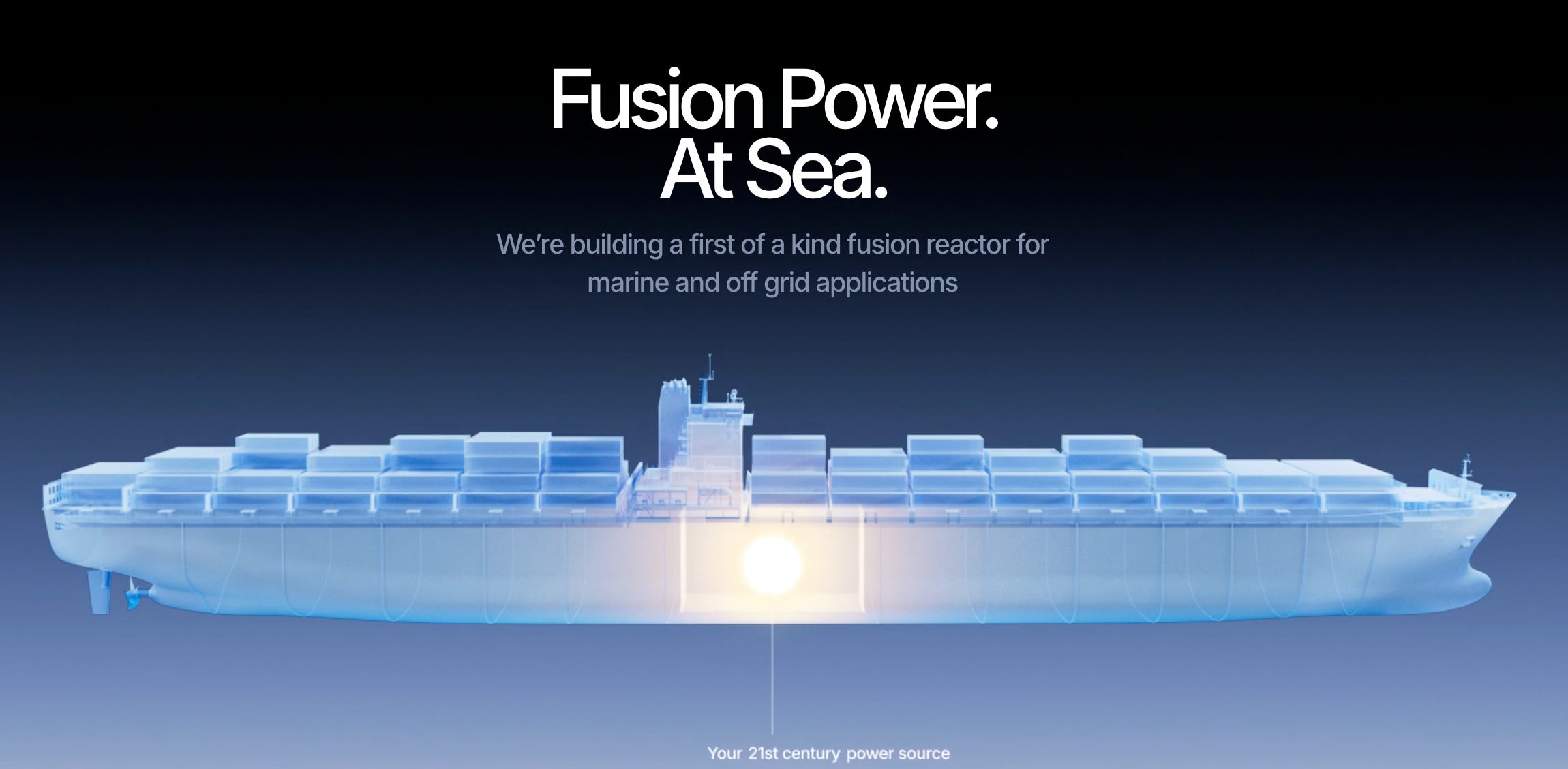
Maritime Fusion, a San Francisco–based fusion energy startup founded by former Tesla engineers, has raised $4.5 million in seed funding to advance its high-temperature superconducting (HTS) cable technology and low-power-density tokamak reactor. The company aims to deliver clean, compact power solutions for maritime and other off-grid applications.
The round was led by Trucks VC, with participation from Paul Graham, Alumni Ventures, Aera VC, Y Combinator (where Maritime participated in the Winter 2025 cohort), and several angel investors. The funding will support expansion of the company’s engineering, manufacturing, and business development teams, as well as accelerate early off-grid pilot deployments, laying the groundwork for future grid-scale fusion adoption.
Unlike most fusion startups focused on utility-scale terrestrial power, Maritime Fusion is initially developing a smaller, more adaptable tokamak designed for lower power output, shorter operating cycles, and rapid installation, particularly for commercial shipping. Co-founder and CEO Justin Cohen noted, referencing the tokamak architecture, “To my knowledge, we are the first to systematically assess the feasibility of installing a tokamak on a vessel.”
Fusion offers ships substantial energy capabilities without the risks associated with fission, including meltdown, proliferation, or high radiation. The concept builds on the legacy of nuclear-powered submarines and aircraft carriers, which have operated safely for decades without frequent refueling. Civilian maritime operators also explored nuclear-powered cargo vessels in the 1960s and 1970s. “Fission has definitely paved the way in terms of nuclear power on ships,” Cohen acknowledged.
Cohen argues that fusion provides key advantages over fission: dramatically lower meltdown and proliferation risks, minimal long-lived radioactive waste, and significant clean energy output. He also maintains that the economic case for fusion is stronger at sea than on land, given the high cost of alternative maritime fuels such as ammonia and hydrogen, two of the few fuels with cost profiles comparable to first-of-a-kind fusion systems. “We can compete directly in those markets,” he said.
If fusion succeeds, Maritime Fusion’s early focus on marine applications could deliver a meaningful strategic edge. Cohen also notes that beginning deployment at sea carries attractive business and regulatory advantages.
The company’s reactor concept, called Yinsen, is progressing through two major research collaborations. A Sponsored Research Agreement with Columbia University focuses on pulse scenarios and time-dependent reactor systems, while work at the Department of Energy’s DIII-D National Fusion Facility provides access to relevant experimental data. Yinsen is designed to deliver 30 MW of electricity from an eight-meter tokamak and is targeted for operations by 2032, at an estimated cost of $1.1 billion.
A central innovation of Yinsen is the SHIELD high-temperature superconducting cable. With a diameter smaller than a U.S. quarter (excluding cryostat hardware), the cable recently achieved a milestone of carrying 5,000 amps at 77 K in liquid nitrogen. Manufactured with materials sourced from Japan, SHIELD is modular, rugged, and scalable to 8,000 amps at 77 K - with even greater performance anticipated under fusion-relevant conditions. Beyond fusion magnets, the cable architecture is suitable for commercial applications such as high-power transmission for AI data centers, where efficient electrical distribution is increasingly critical.
Compared with traditional copper wiring, HTS cables sharply reduce ohmic losses and could save large data centers more than $10 million annually in operating costs. While fusion magnets require advanced REBCO tape to withstand intense magnetic fields, SHIELD’s underlying architecture remains broadly useful. Maritime expects cable sales to generate near-term revenue streams to help support reactor development.
“Breakeven fusion is on the horizon,” Cohen said, “but the grid may not be the first place fusion achieves commercial success. By targeting applications that require lower power and lower uptime, we reduce challenging physics problems—from power exhaust to nuclear activation—while also lowering the cost burden of maintenance that comes with any first-of-a-kind system.”
The timing of Maritime Fusion’s strategy is notable. The fusion sector is approaching a decisive phase, marked by recent demonstrations of net energy gain and rapid advances in AI-driven modeling, computational methods, and superconducting technologies. As feasibility becomes increasingly clear, the industry’s central challenge is shifting toward commercialization.
By prioritizing maritime use cases, Maritime Fusion aims to address immediate needs in the shipping sector, where alternative fuels are simultaneously expensive and urgently required. If fusion technology advances as expected, marine deployment could precede widespread grid-scale adoption.
Cohen’s approach reflects a broader industry shift from scientific proof toward commercial integration. While many fusion companies remain focused on physics milestones, Maritime Fusion is positioning itself for early market entry. Ultimately, its success will depend on the pace of fusion innovation relative to its ambitious 2032 roadmap.
In summary, Maritime Fusion’s ship-based model represents a strategic evolution in commercial fusion. By addressing the high cost of maritime fuels and targeting practical off-grid applications, the company could establish viable pathways for first-generation fusion reactors, and potentially achieve commercial deployment earlier than land-based competitors. The new seed round supports critical milestones necessary to advance this long-term vision.