

Los Angeles Emerges as Funding Magnet As Silicon Valley Bets on Defense
A range of innovative technologies have attracted interest not only from the Department of Defense, but also from venture capitalists supporting their manufacturer, Mach Industries, a startup based in Huntington Beach, California. Founded by Ethan Thornton, Mach has received $185 million in venture funding and relocated from Texas to Southern California last year in order to leverage the region’s expertise in aerospace and defense.
Thornton stated that Mach Industries aims to help deter conflict in the Pacific region over the next decade, explaining that such an objective requires substantial investment. While Mach’s rapid growth stands out, numerous startups in the area are also experiencing increased attention as Silicon Valley investors and entrepreneurs reconsider participation in the defense industry. This shift comes amid concerns about China’s military expansion and changes in conventional military tactics observed in conflicts such as Russia-Ukraine, particularly with the use of drones.
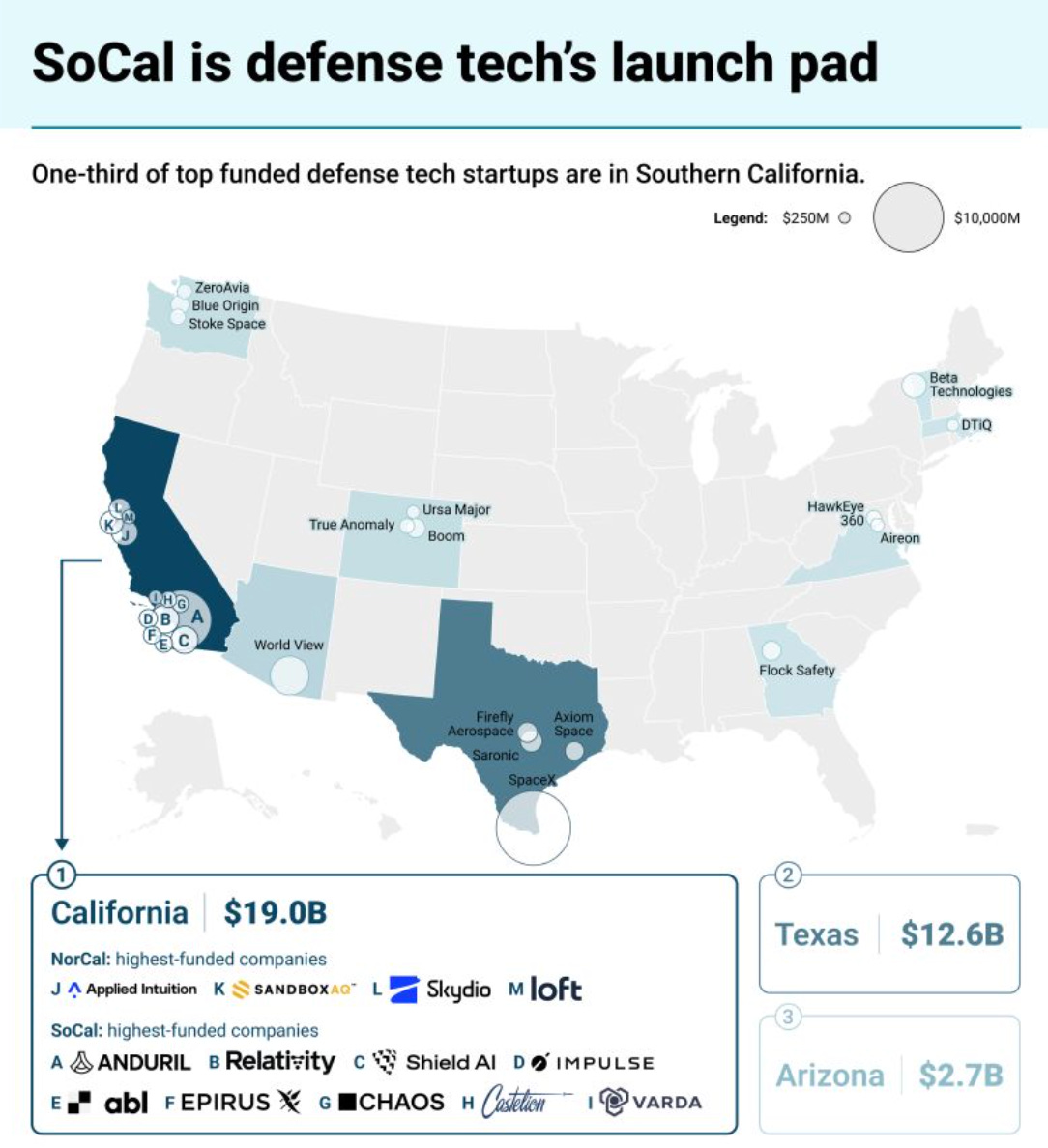
Major venture capital firms, including Andreessen Horowitz, Khosla Ventures, and Sequoia Capital, have increased investments in Los Angeles-area defense tech companies, which surpassed $4 billion so far this year, compared to $1.8 billion in all of 2024. Notable recipients include: Anduril Industries ($2.5 billion), Impulse Space ($300 million), Chaos Industries ($275 million), and Apex Space ($200 million).
In addition to venture capitalists, established companies and artificial intelligence startups are engaging with the defense sector. In July, Google, Anthropic, OpenAI, and xAI received contracts worth up to $200 million each from the Department of Defense to support the integration of advanced AI capabilities for national security purposes. Despite past hesitancy in Silicon Valley toward defense work, recent developments indicate greater acceptance, although some workers continue to express ethical concerns about the use of technology in military contexts. For instance, Google previously ended its Pentagon contract for Project Maven following employee protests, and controversies persist regarding other major cloud computing projects involving military or intelligence applications.
Silicon Valley’s involvement in defense technology is longstanding, dating back to WWII, when Hewlett Packard contributed to microwave technology for the U.S. military. The Pentagon also developed ARPAnet, the internet’s precursor, in collaboration with academic institutions.
Following the Cold War, cuts in military spending led to reductions in Southern California’s defense industry. However, expenditures have risen in the past decade, reaching $2.7 trillion globally in 2024, with the United States accounting for nearly $1 trillion. Increased global tensions and evolving military objectives have contributed to this growth, including proposals for large-scale defense systems such as the “golden dome” initiative.
Industry observers note that the availability of government contracts and funding for defense technology has prompted more startups and university graduates to pursue careers in the sector. Programs like Small Business Administration seed funding, together with venture capital, have supported emerging companies.
Anduril Industries and others benefited early from military seed funding, while additional startups have emerged, developing autonomous weapons, aerospace solutions, and satellite technologies. K2 Space in Torrance, for example, raised $110 million in a recent financing round and secured a $30-million contract for a future space mission carrying military payloads. Its satellites aim to provide cost-effective global coverage with fewer units.
Mach Industries is expanding as well, establishing a second engine testing site in San Luis Obispo and securing investment from Sequoia Capital. The company was recently awarded a contract to develop a vertical takeoff cruise missile. Its manufacturing operations focus on scalable, cost-efficient production methods to increase UAV output in anticipation of potential future needs. According to Thornton, maintaining technological advancement is critical for effective deterrence strategies. The company continues to develop new products with the goal of contributing to U.S. national security.