

Israeli eVTOL Startup, AIR, Raises $23 Million Series A
Israeli eVTOL startup, AIR, recently announced a $23 million Series A funding round, led by Entrée Capital with participation from Dr. Shmuel Harlap. The company plans to use these funds to increase production and expand operations to the United States, in light of recent federal interest in eVTOL development.
Founded in Israel in 2017 by Chen Rosen, Netanel Goldberg, and Rani Plaut, AIR develops eVTOL vehicles for both unmanned cargo missions and crewed flights. AIR’s two-seater model, AIR ONE, is designed for personal aviation, while another variant focuses on unmanned cargo operations. CEO Rani Plaut stated that the company’s approach was influenced by automotive design principles, aiming to build an accessible and user-friendly aircraft.
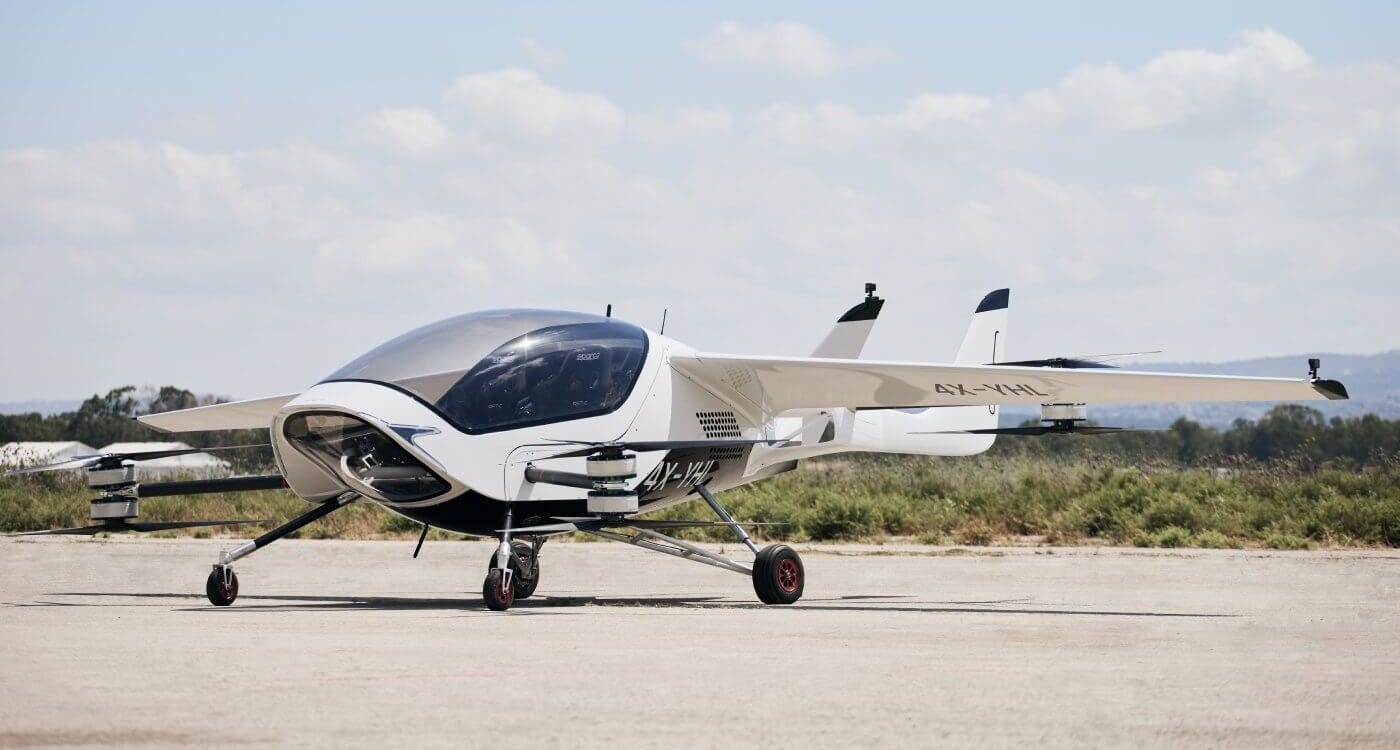
The AIR ONE model is designed for the personal aviation market, particularly in the United States, while the unmanned cargo version has garnered interest from defense clients, due to its value for cargo transport and remote logistics. Traditionally, moving supplies in contested environments requires large and protected convoys, which can be both costly and dangerous; AIR’s unmanned aircraft are specifically engineered to reduce human risk in these scenarios. The cargo aircraft is intended for cargo delivery, disaster response, contested logistics, and remote access operations, featuring a 33-foot wingspan, a range of around 100 miles at 120 knots, a payload capacity of 550 pounds, and 70 cubic feet of cargo space. Utilizing proprietary avionics software in combination with commercial automation tools, the aircraft is predominantly automated but retains human oversight for safety and reliability.
Both the cargo and two-seater versions have folding wings, enabling storage in a standard parking space. The two models share about 90% of their components; the main distinction is that one is for passengers, while the other is for carrying equipment. The piloted version is expected to cost several hundred thousand dollars at the lower end, while the cargo variant may range from several hundred thousand to $1–2 million depending on additional features, such as sensors.
AIR reports that it has successfully demonstrated all phases of flight with its full-scale platform, including extensive nighttime Beyond Visual Line of Sight (BVLOS) autonomous cargo operations. The company collaborates with the U.S. Air Force’s Agility Prime program and Israel’s Ministry of Defense, having delivered its first aircraft to a logistics customer in 2023 and intending to deliver 15 more cargo planes this year. There are reportedly over 2,500 pre-orders for the personal transport version.
Interest in electric aircraft has increased among policymakers. In June, President Trump signed an executive order promoting growth in supersonic technology and drones, including eVTOLs. The order initiated a pilot program to test flying cars (eVTOLs) for emergency services, air taxis, cargo, and defense applications, and instructed the FAA to facilitate certification pathways for such aircraft. AIR is assessing potential sites in various U.S. states for its American production plant, maintains staff and an aircraft in Florida, and intends to expand its 50-person team by 20 to 30, primarily in the U.S., utilizing the new funding.