

Helsing and Kongsberg Plan Multi-Mission European Defense Space Network
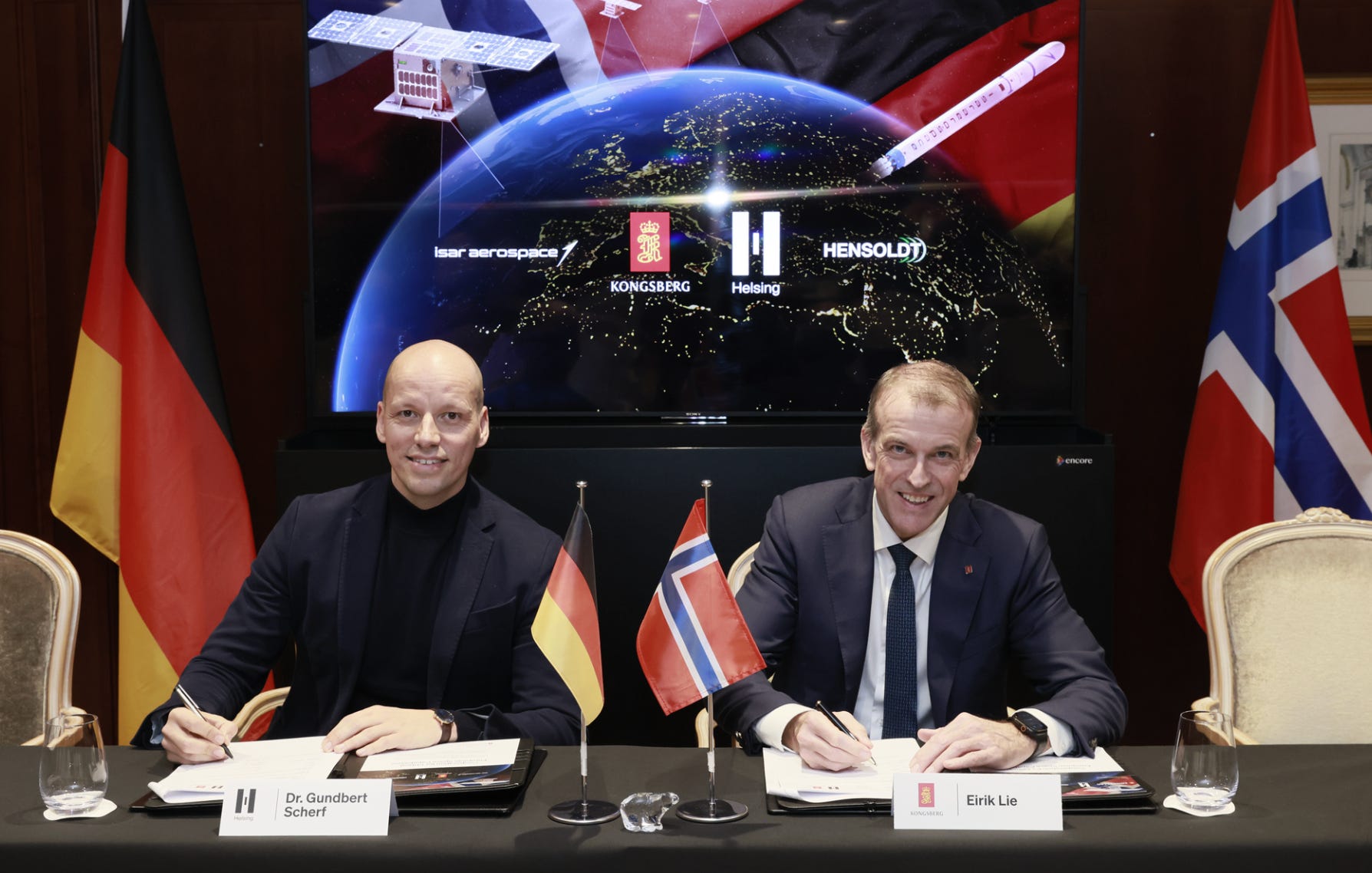
Throughout 2025, European officials have prioritized the advancement of sovereign defensive capabilities in space. Reflecting this commitment, Kongsberg Defence & Aerospace and Helsing, a German defense tech startup, announced last week an initiative to develop a sovereign ISR (Intelligence, Surveillance, and Reconnaissance) and communications satellite constellation, aiming for deployment by 2029.
This partnership builds on the longstanding collaboration between Norway and Germany, which encompasses projects ranging from submarine procurement and maritime security to support for Ukraine.
For the new ISR and communications constellation, Kongsberg will supply satellites, establishing the core infrastructure, while its KSAT ground network will ensure robust communication with ground operators. Helsing will provide integration of AI software, enhancing the fusion of satellite sensor and communication capabilities. HENSOLDT, a German manufacturer, will contribute SAR, electro-optical infrared, and electronic warfare sensors. Isar Aerospace is designated as the preferred launch provider, facilitating orbital deployment from Norway’s Andøya Spaceport.
The comprehensive constellation, potentially comprising hundreds of satellites, will require increased openness and interoperability with other European defense satellites, according to Trond Hegrestad, Kongsberg’s Vice President of Smallsat. The project may expand to involve additional suppliers and launch partners over time.
In September, Germany proposed a €35 billion investment in military space capabilities. While it remains unconfirmed whether this specific initiative is part of that investment, industry leaders are moving forward expeditiously. “To achieve operational capability by 2029 or 2030, timely decision-making is essential,” stated Hegrestad. “This agreement in Germany represents an important starting point, and we are confident in our ability to proceed rapidly.”
“Europe’s security depends on sovereign sensing and intelligence,” Hensoldt CEO Oliver Dörre added separately. “By combining Norway’s satellite expertise with Hensoldt’s advanced SAR, electro-optical and electronic-intelligence sensors, we can build a resilient space architecture that gives Europe the information advantage it needs.”
The development further demonstrates Germany’s growing willingness to engage in defense collaborations with international partners. This trend provides valuable opportunities for companies like Kongsberg and others capable of delivering unique solutions to the German Bundeswehr. As Hegrestad noted, Norway is increasingly emphasizing bilateral and multilateral cooperation in space through engagements with the European Union, ESA, and individual countries, and anticipates that many upcoming projects will be realized through these collaborative frameworks.