

Germany's Stark Defense acquires UK's AeroMass Technologies
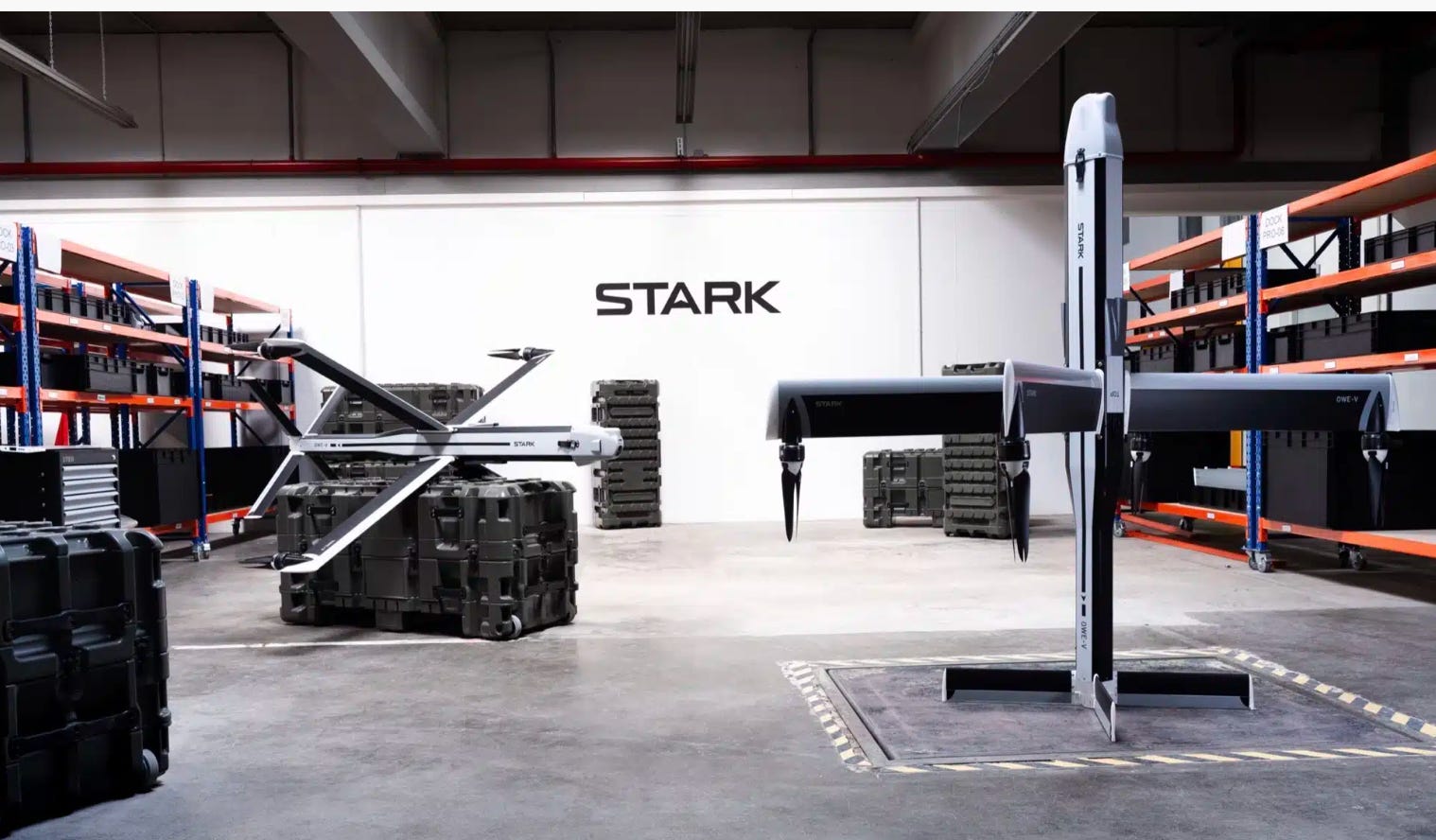
Recent developments underscore the growing role of M&A in shaping the trajectory of Europe’s defense technology sector. Stark, the German defense tech company, recently announced its acquisition of AeroMass Technologies (AMT), a “distributed manufacturing” firm specializing in scalable systems for modern military operations.
This development follows Stark’s recent $62 million fundraising round at a $500 million valuation led by Sequoia, as well as its strategic entry into the maritime domain with the introduction of a new uncrewed surface vehicle (USV) in September. However, these moves suggest that Stark’s ambitions extend further. According to James Earl, Stark Program Manager and Co-Founder of AMT, the company possesses a product portfolio that is significantly broader than what has been publicly disclosed.
Earl noted that AMT’s manufacturing process already supports several ongoing projects. He emphasized that the focus is not merely on accelerating production but on achieving rapid scalability.
The approach involves modularizing manufacturing processes. By designing systems, components, and sub-assemblies compatible with existing manufacturing capabilities, the supply chain is diversified and less reliant on continual government procurement to sustain the workforce.
Founded in 2023, AMT assists organizations in scaling production through an extensive network of traditional and non-traditional European manufacturers, as stated by Stark. Rather than owning its own manufacturing facilities, AMT employs a design-for-manufacturing model that leverages non-defense-aligned resources to deliver capability rapidly.
Practically, this means AMT has assembled a diverse group of manufacturers, including those typically engaged in commercial production, thus enabling flexible and responsive manufacturing of items such as drones and weapon systems. The underlying rationale is that building new factories incurs considerable costs. Instead, AMT, now part of STARK, utilizes existing production lines for efficient and expedited assembly of required components and systems.
Currently, this methodology supports STARK’s aerial technology initiatives, but it can be readily adapted for additional applications. “In acquiring AMT, we are leveraging not only their innovative approach to production but also their expansive manufacturing network, which will enhance NATO’s operational capabilities,” said Stark CTO Johannes Schaback.
Financial details of the transaction were not disclosed. However, Earl confirmed that all existing AMT contracts, including those with the UK Ministry of Defense and other allied militaries, will transition to Stark under the terms of the acquisition. The production system is already being implemented in the UK and across Europe.
This marks Stark’s second acquisition; the also acquired Pleno, a Berlin-based startup focused on navigation solutions for drones operating in communications-denied environments. Stark’s M&A strategy parallels that of Quantum Systems (QS), which this year has acquired AirRobot, Nordic Unmanned, and Spleenlab. QS reportedly intends to utilize its €180 million ($210 million) in capital for further strategic acquisitions to strengthen and diversify its multi-domain offerings.
While M&A activity in European defense tech is increasing, it isn’t creating the kind of roll-up structures seen in more mature U.S. defense markets. Instead, companies are pursuing surgical, capability-led acquisitions aimed at filling specific gaps in manufacturing, autonomy, and operational technologies. Europe’s defense sector remains highly distributed, with innovation spread across numerous small specialists, making selective acquisitions a more practical growth strategy than broad consolidation. As funding accelerates and geopolitical pressures intensify, these focused deals are becoming a key way for emerging players to assemble multi-domain capabilities while preserving the region’s inherently decentralized industrial base.