

Germany Builds Its First AI Factory
Why control of compute is becoming Europe’s real source of power
Europe talks a lot about digital sovereignty. Much less often does it build it.
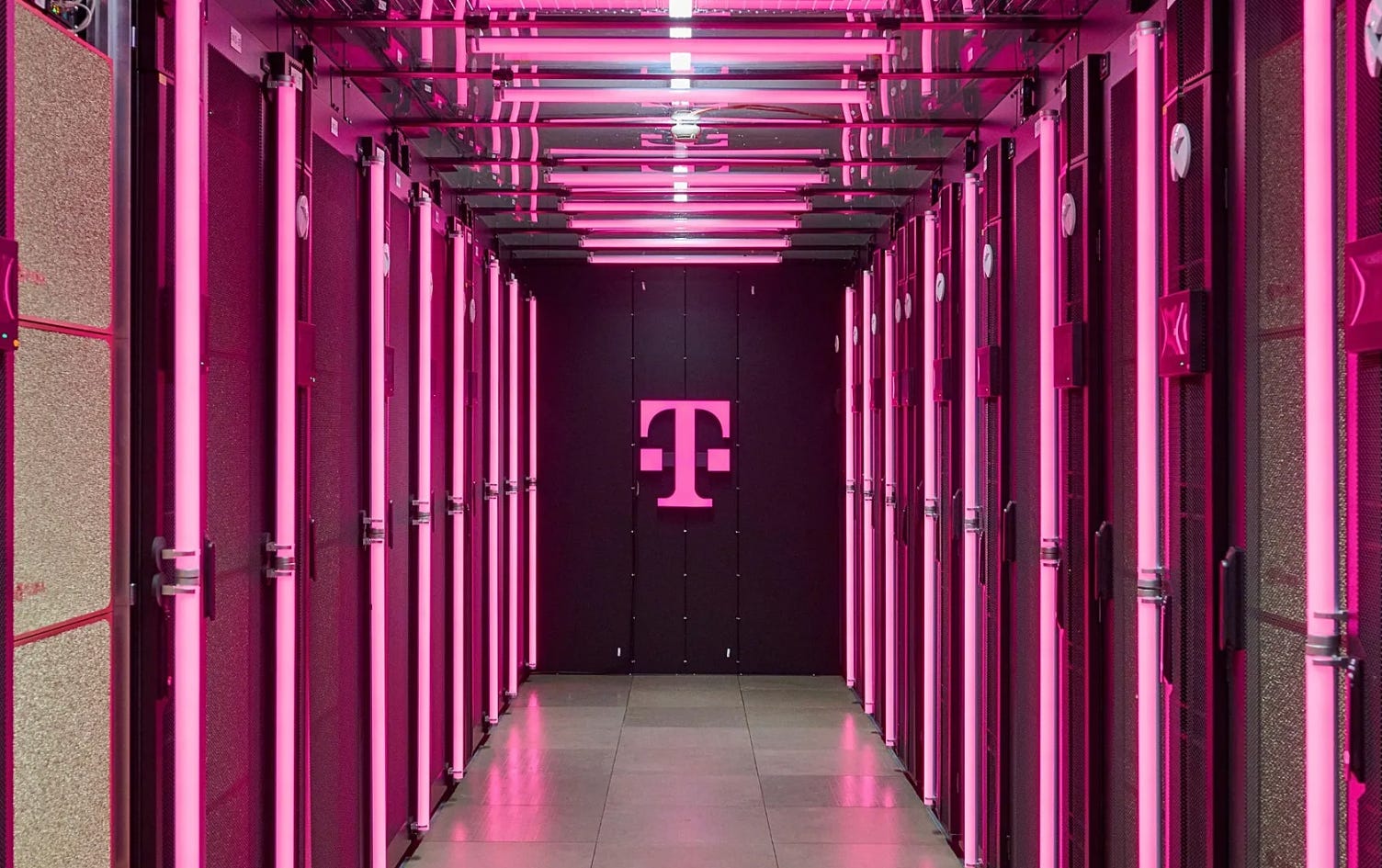
This week, Germany did. In Munich, Deutsche Telekom opened the country’s first large scale industrial AI factory, a facility designed not just to run artificial intelligence, but to determine who controls it, where it operates, and under whose rules.
Built in partnership with NVIDIA and data center operator Polarise, the Industrial AI Cloud marks a deliberate shift in how Europe is approaching AI. Rather than relying almost entirely on foreign hyperscale cloud providers, Germany is attempting to secure a piece of the most important input in the AI economy: large scale compute.
AI is no longer just software. It is infrastructure. Access to powerful computing determines who can train advanced models, deploy them at scale, and integrate AI into real economic systems. Until now, Europe has largely rented that capability from US and Asian firms. The Munich facility represents an effort to stop being a permanent tenant.
The numbers are substantial. The AI factory houses more than 10,000 NVIDIA Blackwell GPUs and delivers up to 0.5 exaFLOPS of computing power. Deutsche Telekom has framed this capacity in attention grabbing terms, suggesting it could theoretically support an AI assistant for every EU citizen at once. The claim is symbolic, but the intention behind it is serious. Europe wants the ability to run advanced AI workloads on its own infrastructure.
At the center of this project is data sovereignty. Running AI systems is not only about performance, but about where data lives and which legal regimes apply. For German manufacturers, energy providers, and public institutions, using foreign cloud platforms means exposing sensitive industrial designs, simulations, and operational data to external jurisdictions and geopolitical risk. A domestically operated AI factory allows these actors to adopt cutting edge AI while keeping control over their most valuable assets.
This matters especially for Germany’s industrial economy. The country’s competitive edge rests on complex engineering, precision manufacturing, and simulation driven design. AI accelerates these processes dramatically, but only if compute is powerful, affordable, and close to where the work happens. Companies using the Munich facility are already applying it to digital twins, robotics, and advanced simulations, cutting development cycles that once took weeks or months. This is not about consumer chatbots. It is about industrial speed.
Strip away the rhetoric, and this is the core issue. Infrastructure, not regulation alone, will decide who holds power in the AI economy. Rules without compute are symbolic. Compute without rules is chaotic. Europe has spent years focusing on the former. Projects like this are an attempt to catch up on the latter.
The AI factory also reflects a broader strategic recalibration. Europe has become highly effective at regulating technology, but far less effective at building it at scale. Without its own AI infrastructure, the EU risks becoming a rule maker on paper and a rule taker in practice. Owning compute changes that balance by creating leverage in standards setting, industrial policy, and future trade negotiations involving digital services.
Beyond hardware, Deutsche Telekom and SAP are advancing what they call the Deutschland stack, a vertically integrated platform that combines cloud infrastructure, enterprise software, and AI services under European governance. The aim is to make AI adoption easier for companies and public bodies that want advanced capabilities without surrendering control of core systems to non European providers. If successful, this model could be replicated across the continent.
Sustainability has also been built into the facility’s design. It runs on renewable energy, uses river water for cooling, and plans to reuse waste heat locally. These choices acknowledge an uncomfortable reality. AI infrastructure is energy intensive, and political support for it depends on integrating environmental constraints from the start.
One AI factory will not close the gap with global hyperscalers. But it does establish a precedent. It shows that digital sovereignty is not just a regulatory ambition or a policy slogan. It is something that must be engineered into physical systems.
If this project succeeds, it challenges the assumption that Europe can regulate technology but cannot build it. If it fails, it reinforces that narrative. Either way, the message is clear. In the AI era, economic sovereignty is no longer abstract. It is built, quite literally, in data centers.