

From Runways to Networks: Enigma and the Future of Military Logistics
The United States military has long relied on fixed infrastructure to project and sustain force. Airfields, ports, and logistics hubs remain indispensable to modern operations, enabling the movement of personnel and materiel at scale. Runways, in particular, are central to this system. They are not going away. No plausible future force can operate without them.
However, recent conflicts have underscored a persistent reality. In Ukraine, both sides have systematically targeted logistics infrastructure, striking fuel depots, ammunition storage, and transportation networks. In a potential Indo-Pacific conflict, the same dynamic would apply at greater scale. U.S. operations depend on a relatively small number of forward bases, many of which fall within range of adversary long-range strike systems. These installations are essential, but they are also exposed. The problem, therefore, is not how to replace traditional logistics, but how to operate when it is disrupted.
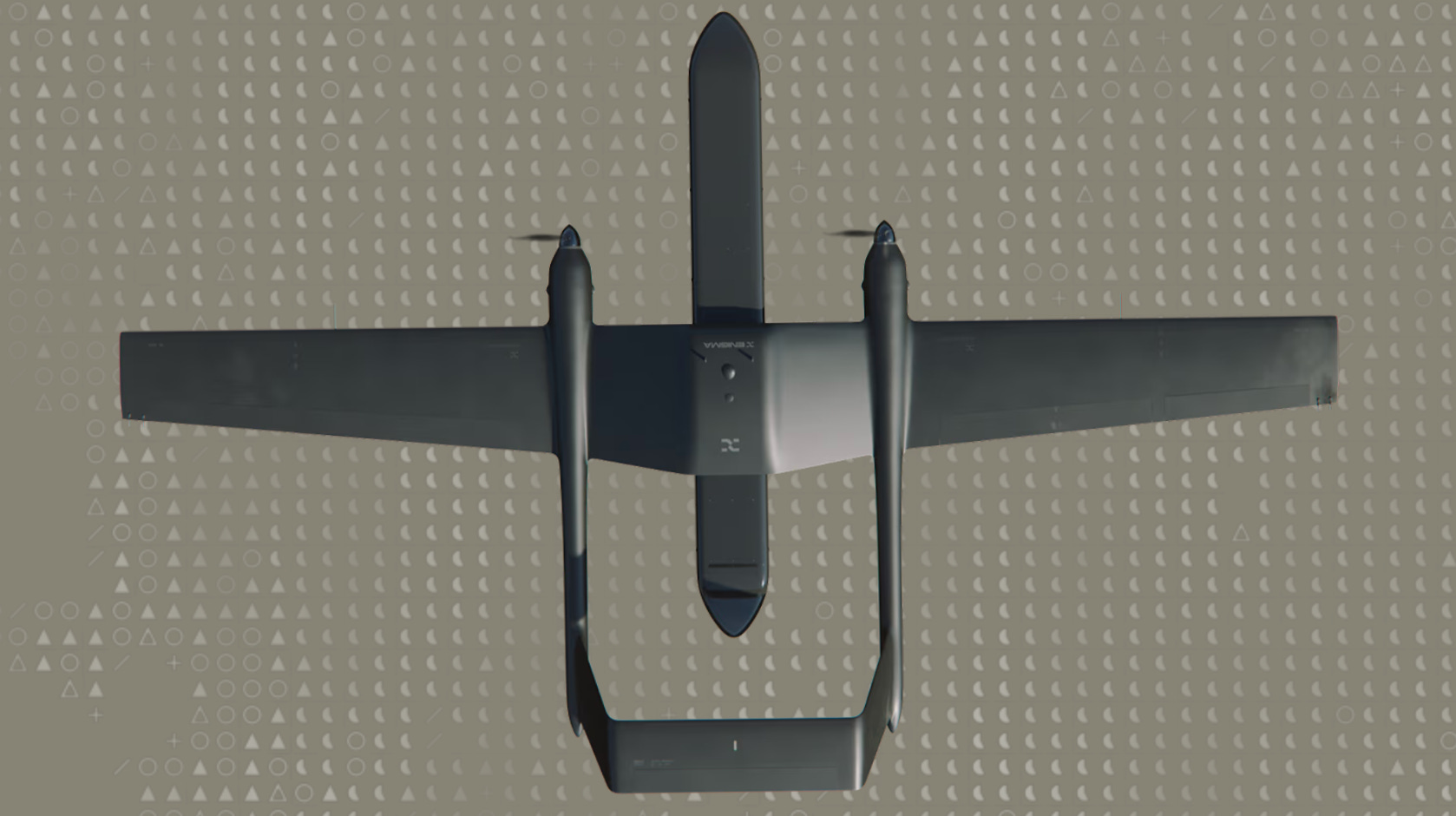
This is the problem that aerospace startup Enigma is attempting to address. Founded by a team with prior experience building and scaling autonomous systems, the company is developing a logistics platform centered on long-range, runway-independent delivery. Its primary system, known as Phoenix, is an autonomous, fixed-wing vehicle designed to carry payloads of up to approximately 1,000 pounds over distances approaching 2,000 nautical miles, depending on configuration. Rather than functioning as a traditional aircraft, Phoenix operates as a deployable delivery system capable of transporting supplies directly to austere environments.
This hardware is paired with Strata, Enigma’s logistics-focused command-and-control software, which is designed to coordinate distributed delivery operations at scale. Strata provides visibility into supply requirements, routes, and available assets, enabling operators to manage logistics flows dynamically rather than through pre-planned schedules. Together, these systems are intended to function as a network, not a single platform.
The distinction is important. Enigma’s system is not designed to replace traditional airlift or move bulk supply into theater. That role will remain with conventional aircraft such as the C-17 and C-130, which provide unmatched capacity and efficiency. Instead, Enigma is focused on what is often the most difficult phase of logistics under contested conditions: the distribution of supplies from secure hubs to dispersed units once the network begins to degrade.
This “last-mile” problem is where traditional systems are most vulnerable. Forward operating bases can be targeted, runways rendered unusable, and ground lines of communication interdicted. When that occurs, the ability to sustain forces depends on alternative delivery methods that do not rely on fixed infrastructure or predictable routes.
Enigma’s approach is to provide that alternative. By enabling delivery without runways and without the need for prepared landing zones, it reduces dependence on high-value nodes and creates additional pathways for sustainment. Supplies can be delivered directly to units operating in austere or contested environments, including locations where communications may be limited or absent.
This reflects a broader shift in how military logistics is being understood. For decades, efficiency has been the dominant organizing principle. Centralized systems maximize throughput and minimize redundancy, but they also concentrate risk. As long as infrastructure remains secure, this tradeoff is acceptable. When it does not, the system becomes fragile.
Distributed logistics offers a different balance. It accepts some loss of efficiency in exchange for resilience. Systems like Enigma’s introduce additional nodes into the network, increasing redundancy and complicating an adversary’s targeting problem. Instead of relying on a small number of critical points, logistics becomes more diffuse and harder to disrupt.
Enigma’s command-and-control architecture reinforces this shift. By integrating real-time data on supply, demand, and asset availability, it allows logistics to be managed as a continuous, adaptive system. This is particularly important in contested environments, where conditions change rapidly and disruption is expected. The ability to reroute, reprioritize, and adapt in real time becomes as important as the ability to deliver at scale.
The implications extend beyond logistics itself. Concepts such as distributed operations and expeditionary advanced basing depend on the ability to sustain forces across wider areas with reduced reliance on fixed infrastructure. Enigma’s model directly supports this approach by enabling resupply to units that may not have access to traditional logistics networks. Without such capabilities, dispersion risks becoming operationally unsustainable.
None of this eliminates the need for runways or centralized logistics. Large-scale operations will continue to depend on them. What is changing is their role. Rather than serving as the sole backbone of sustainment, they are becoming part of a broader system that incorporates distributed, lower-signature alternatives.
In this context, Enigma is best understood not as a standalone solution, but as an indicator of a broader shift in how military logistics is conceived. Its combination of long-range autonomous delivery and software-defined coordination is explicitly designed to sustain forces when traditional infrastructure is unavailable or unusable. By targeting the most vulnerable segment of the logistics chain, distribution under contested conditions, it addresses a problem that conventional systems are not designed to solve. The challenge is no longer optimizing efficiency under permissive conditions, but ensuring continuity under disruption. Fixed infrastructure will remain essential, but it can no longer be assumed to function. The ability to maintain supply flows despite its degradation will be a defining factor in operational effectiveness, and systems like Enigma’s represent a concrete step toward meeting that requirement.