

Frankenburg Raises €30M to Industrialize Europe’s Missile Supply
On a day heavy with symbolism, the fourth anniversary of Russia’s full-scale invasion of Ukraine and Estonia’s Independence Day, Frankenburg Technologies confirmed it has closed a €30 million Series A round led by Plural, with participation from Estonia’s state-backed VC SmartCap.
The timing was not accidental.
Frankenburg is positioning itself not merely as another defense startup, but as part of a broader Baltic-led effort to rebuild Europe’s deterrence capacity through industrial scale. Tytan Technologies, notably, announced its own €30 million raise the same day, underscoring how capital is concentrating around scalable munitions platforms.
The Numbers and the Open Questions
In January, reports indicated that Frankenburg had raised as much as $50 million at a valuation near $400 million, a sharp step-up from its earlier rounds. The officially confirmed €30 million leaves room for interpretation:
Was the larger figure inclusive of follow-on commitments?
Is additional capital still pending?
Or were earlier reports referencing a broader financing package?
Regardless of structure, the implied valuation trajectory suggests investors are pricing in rapid industrial scaling rather than a prolonged R&D cycle.
From Capability to Capacity
Frankenburg’s thesis is blunt: Europe’s missile problem is not technological. It is industrial. The company intends to use the fresh capital to establish manufacturing sites in Germany and the United Kingdom, each targeting output of 100 missiles per day. At that rate, a single facility would produce roughly 30,000 interceptors annually assuming continuous operations, a level of throughput largely absent from Europe’s current air defence industrial base. The credibility of Frankenburg’s thesis will ultimately rest not on design performance, but on whether this manufacturing tempo can be realized under regulatory, supply chain, and energetics constraints.
By adding Germany and the UK, Frankenburg expands its footprint to eight countries: Estonia, Latvia, Lithuania, Denmark, Poland, Ukraine, and two of Europe’s largest defense industrial bases. This distributed architecture matters. The war in Ukraine has exposed how fragile supply chains become under sustained consumption. Stockpiles deplete faster than replenishment cycles can keep up. Frankenburg’s answer is not a more exquisite interceptor but an industrial system designed for repetition.
Cheap, Fast, Abundant
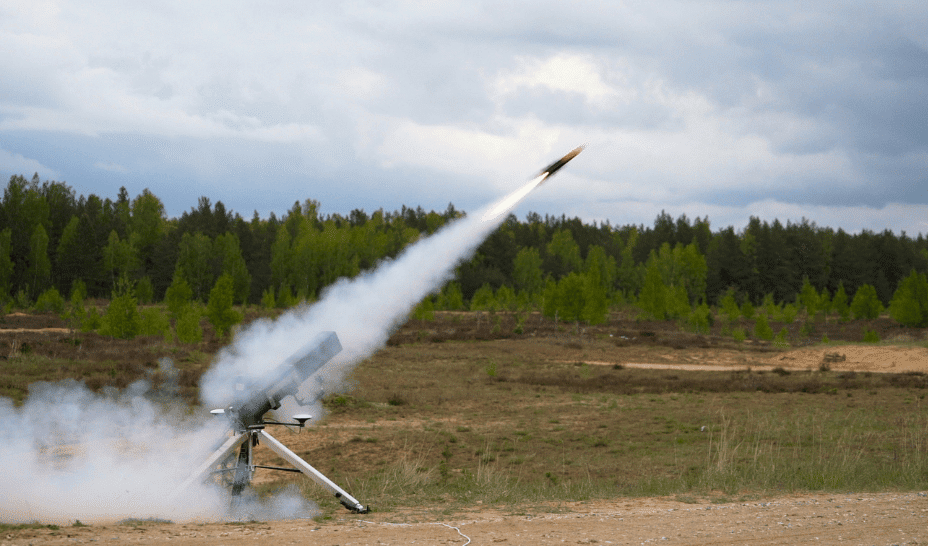
The company’s first product, the Mark I short-range drone interceptor, targets the most immediate battlefield pressure point: mass drone attacks. Rather than compete at the high end of the missile spectrum, Frankenburg is building around a different constraint set:
Short supply chains
Modular production lines
Commercially available components
Rapid qualification processes
The goal is to compress cost and production timelines simultaneously, making missiles viable for high-volume deployment rather than selective use. CEO Kusti Salm framed the challenge succinctly: “You cannot deter with systems that are too scarce, too slow to replace, or too expensive to use at scale.” This represents a doctrinal shift as much as a manufacturing one. Deterrence, in this framing, is an availability problem.
Networks and Credibility
Frankenburg’s leadership reflects deep institutional connectivity. Salm serves as a director at the NATO Innovation Fund and previously held senior roles in Estonia’s Ministry of Defence. Founder Taavi Madiberk, also CEO of Skeleton Technologies, brings industrial hardware experience from the energy storage sector. Board and advisory members, including Marko Virkebau, Martin Herem, and Kuldar Väärsi, add further defense and entrepreneurial depth.
The Broader Signal
The more important signal is that investors are underwriting production capacity, not incremental performance gains. If Frankenburg achieves even a fraction of its stated output of 100 missiles per day per site, this implies industrial throughput measured in tens of thousands annually. That is a different category of deterrence. The constraint is no longer design sophistication. It is manufacturing velocity. Frankenburg is betting that in modern European warfare, scale is the decisive variable.