

France Allocates Nearly $5 Billion in Additional Funding for Space Initiatives
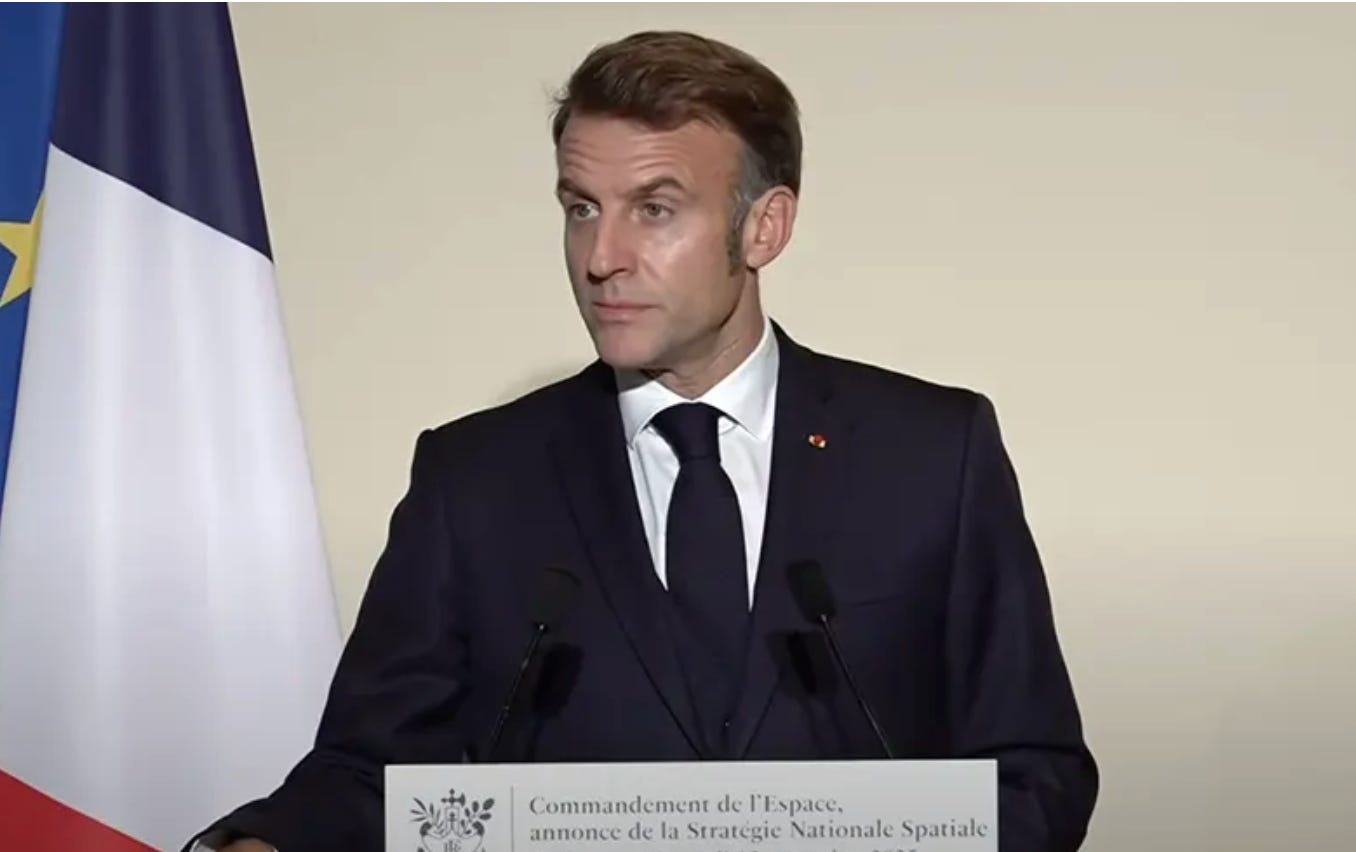
On Wednesday, November 12th, French President Emmanuel Macron announced a proposed €4.2 billion ($4.9 billion) increase in military space expenditure for the 2026–2030 period. Emphasizing the evolving nature of space as an operational domain, Macron stated, “Space is no longer a sanctuary; it has become a battlefield. Preparedness in this arena is essential for successful operations across land, air, and sea.”
During a ceremony in Toulouse, France’s space and aviation hub, marking France’s Space Command achieving operational capability, Macron outlined that these funds would be allocated to support the launch of counter-space satellites by 2027, as part of the Ministry of Defense’s ongoing initiatives. He noted, “Beyond existing plans for active defense, we will deploy our initial patrol satellites from 2027 onwards, designed to monitor, inspect, and, if necessary, respond to orbital threats. These patrols will be supported by additional space-based capabilities, including lasers and signal jamming technologies.”
Since 2024, the French Armed Forces have been developing two maneuvrable microsatellites under the TOUTATIS programme (In-Orbit Test of Action Techniques against Attempted Spatial Interference), aimed at identifying and potentially countering hostile satellites in low Earth orbit. This initiative complements the YODA (Yeux en Orbite pour un Démonstrateur Agile) nanosatellite demonstration project launched in 2019 and the FLAMHE project focused on developing on-board laser systems to neutralise threatening satellites. All efforts fall within the broader ARES (Action et Résilience Spatiale) framework managed by the Ministry of Defense.
Macron further highlighted that the increased investment would expedite the advancement of early warning systems in partnership with Germany. In October, France and Germany jointly introduced the Joint Early Warning for European Lookout (JEWEL) initiative to enhance missile detection and tracking capabilities, contributing to NATO’s Integrated Air and Missile Defense efforts. Germany has separately committed $41 billion towards military space systems over the next five years. The additional funding will also aid the development of AURORE, the French military’s upcoming ground-based space surveillance radar. According to Thales, AURORE will be the largest space surveillance radar deployed in Europe. President Macron underscored that these measures align with France’s national space strategy, which prioritizes strategic and defense capabilities as one of five key pillars.
The remaining four pillars include:
1. Access to Space: Macron stressed the importance of continued investment in European launch infrastructure, such as the Guiana Space Centre and the Ariane program, to reduce reliance on third-party nations or private actors. “Depending on a major third-party power or any space magnate is out of the question.”
2. Industry and Skills: Macron emphasized the necessity of maintaining a competitive and sovereign French space sector, highlighting the need to fundamentally re-evaluate industrial and commercial models and prioritize talent development.
3. Science and Exploration: Macron advocated continued support for scientific research and exploration, particularly addressing climate change, citing collaboration with CNES and international partners.
4. Cooperation: Finally, Macron called for greater European unity and competitiveness in space endeavors, encouraging the development of regional “champions” to contend globally. He advocated for a “European preference” in awarding space-related contracts and emphasized that such measures are prudent rather than protectionist.
Macron concluded by reiterating the significance of policy alignment among European nations to strengthen the continent’s position in space: “The war of today is already being fought in space, and the war of tomorrow will begin in space.” Macron added, “We are investing in means of action from the ground and space while respecting international law, but without any naivety.”