

Firefly Alpha Rocket Explodes During Preflight Test
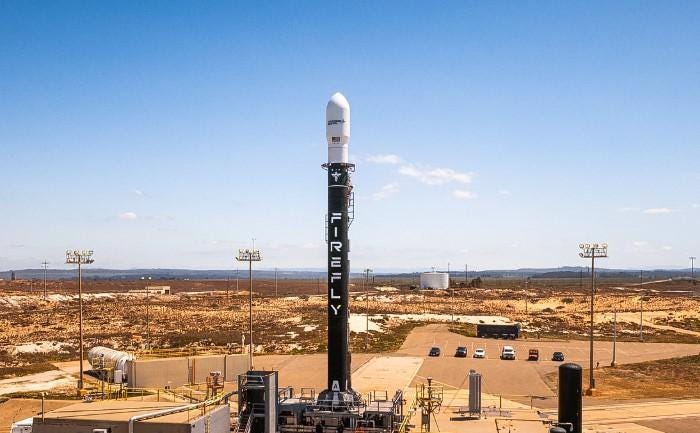
On Monday, September 29th, the first stage of Firefly’s Alpha rocket, an expendable two-stage launch vehicle, experienced an explosion during preflight testing. “During testing at Firefly’s facility in Briggs, Texas, the first stage of Firefly’s Alpha Flight 7 rocket experienced an event that resulted in a loss of the stage,” the Texas-based company wrote in an update on Monday afternoon. “Proper safety protocols were followed, and all personnel are safe. The company is assessing the impact to its stage test stand, and no other facilities were impacted.”
It’s another setback for Firefly, which suffered a failure during its most recent Alpha launch this past April. During that mission, called “Message in a Booster,” Alpha’s first-stage booster broke apart shortly after separating from the upper stage. The anomaly damaged the upper stage’s engine nozzle, compromising its thrust and leading to the loss of the payload, Lockheed Martin’s LM 400 satellite technology demonstrator.
Firefly traced the problem to heat buildup in the first stage, caused by a phenomenon known as “plume-induced flow separation.” Earlier this month, the U.S. Federal Aviation Administration accepted the results of the company’s anomaly investigation and its mitigation plan, clearing Alpha to launch once again.
The two-stage Alpha, which stands 96.7 feet (29.6 meters) tall, debuted in September 2021. Just two of its six orbital launches to date have been fully successful. The booster destroyed on Monday was intended for the seventh launch of Firefly’s Alpha rocket and another mission for Lockheed Martin. Firefly is now targeting a liftoff later this year; it’s too soon to predict how that schedule will play out.
“Regular testing is part of Firefly’s philosophy - we test each critical component, engine, and vehicle stage to ensure it operates within our flight requirements before we ship to the launch pad,” the company wrote in Monday’s update. “We learn from each test to improve our designs and build a more reliable system. We will share more information on the path forward at a later date.”
Although the Alpha rocket continues to face operational challenges, there remains interest in the vehicle, which is larger than Rocket Lab’s Electron and smaller than SpaceX’s Falcon 9. Lockheed Martin announced an agreement last year to purchase up to 25 Alpha launches. The US Space Force, NASA, and the National Oceanic and Atmospheric Administration also have plans to use Alpha rockets for upcoming national security and weather satellite launches.
Firefly doesn’t just build rockets - it’s probably best known for its robotic Blue Ghost moon lander, the first of which aced its lunar mission for NASA in March of this year. Notably, NASA has contracted Firefly for three further lunar landings, and a recent agreement has been reached with a commercial client for an additional dedicated moon mission.
Firefly became publicly traded on NASDAQ last month, raising nearly $900 million from its IPO to support future projects, including the medium-lift Eclipse rocket, developed with Northrop Grumman. The Eclipse will utilize new engines manufactured by Firefly.