

Europe’s ‘Drone Wall’ Initiative
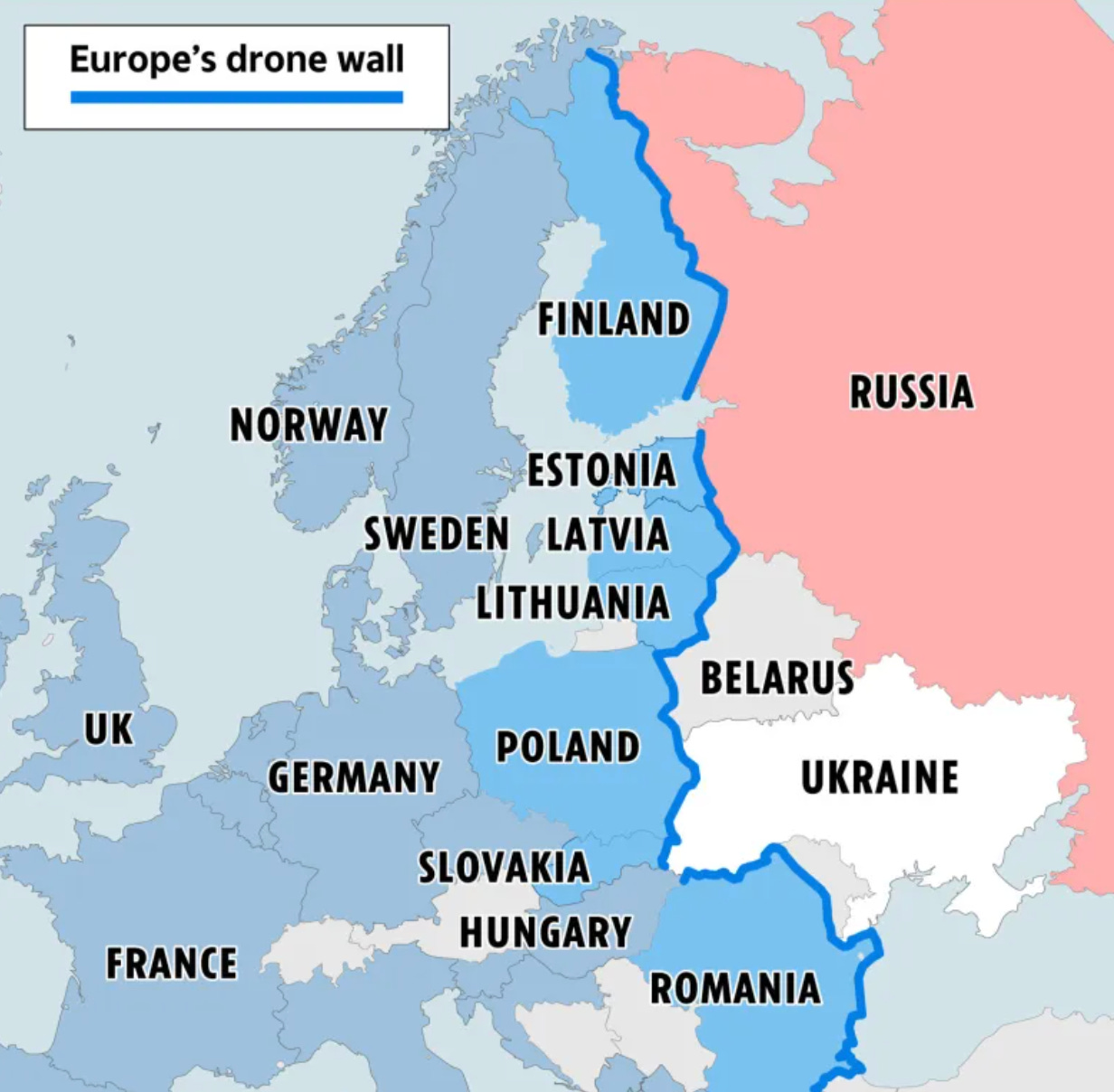
The European Union is currently developing a plan to implement a “drone wall,” a defensive system along its eastern border designed to deter unmanned aircraft originating from Russia. As the initiative remains in its preliminary phase, specific details are limited; however, recent Russian drone incursions into European airspace have created a sense of urgency among officials. This concept was addressed during a meeting in Copenhagen attended by leaders from the 27 EU member states, where it received both optimistic support and cautious skepticism regarding its efficacy.
Ursula von der Leyen, President of the European Commission, proposed the establishment of an “eastern flank watch”, which would include the drone wall, in her most recent State of the Union address. The proposal gained immediate relevance following reports of Russian drones violating Polish airspace on the same day, with subsequent incidents affecting Romania and Estonia. Ms. von der Leyen emphasized the necessity for decisive action, underscoring the need for a robust and unified European response to such security challenges. The concept of a drone wall consisting of a joint allied aerial defense shield with to protect against threats from Russia, had earlier been proposed by Ukraine, following incursions into NATO member countries’ airspace.
NATO leaders have said that Russia has been testing the alliance’s readiness and resolve with airspace incursions in Poland and the Baltic states. Heightened tensions preceded the recent drone intrusions, as Russia continues to expand its military capacity and conscript personnel rapidly. Ongoing uncertainty regarding transatlantic security commitments has prompted the EU to demonstrate greater preparedness.
Many EU countries have already deployed or are developing anti-drone systems. An Australian company reported that it had secured an $84 million deal from a NATO member for a new high-energy laser weapon system. The objective of the proposed project is to establish a joint protective shield capable of more effectively detecting, tracking, and intercepting drones as they enter EU or allied airspace. Rather than constituting a physical barrier, this “wall” would consist of a coordinated network of detection technologies, such as radar, jamming devices, and acoustic sensors, supplemented by enhanced data and information sharing. The joint defense initiative forms part of a broader strategy to enhance security across the EU’s eastern frontier, potentially encompassing improvements to maritime surveillance and real-time space monitoring to bolster military intelligence capabilities.
NATO Secretary General Mark Rutte acknowledged that reliance on expensive missile systems to counter comparatively inexpensive drones is not sustainable. The operational specifics and funding mechanisms for the drone wall remain under discussion, as does the projected timeline for its implementation. Anders Fogh Rasmussen, former NATO Secretary General, noted that the system must become operational without delay. Ukraine, which has already provided guidance to European partners, represents a valuable resource in this area.
While there is consensus on the need for EU financial support, the specific structure of such backing has yet to be determined. Andrius Kubilius, the EU commissioner overseeing defense and space, has announced plans to develop comprehensive financial instruments to realize the project. Certain member states, such as Poland, advocate for robust EU involvement through grant and subsidy programs rather than offering only loans. The extent of political support for these measures will be critical.
Following the Copenhagen discussions, Danish Prime Minister Mette Frederiksen confirmed the inclusion of a European network of anti-drone measures capable of detecting and neutralizing external threats. “There is only one country that are willing to threaten us, and it is Russia,” said Frederiksen, adding that Europe was in the middle of a “hybrid war.” “I think we are in the most difficult and dangerous situation since the end of the Second World War. I want us to rearm. I want us to buy more capabilities. I want us to innovate more.” Frederiksen reiterated the fast pace of technological change, noting that while the drone wall is a promising concept, it is unlikely to provide a complete solution, and continued vigilance will be required to address evolving threats.
Despite disagreement about the drone wall’s size and name, the implementation timeline, and funding, there is broad consensus that Europe must enhance its capacity to defend against Russian drones. The bloc currently lacks advanced detection technology capable of reliably identifying UAVs. When NATO jets downed three Russian drones over Poland last month, they employed multi-million-dollar missiles to intercept Russian Gerberas, valued at approximately $10,000 each.
“Of course, we are realists … we do not expect, for example, a drone wall on our border that will eliminate any threats 100 percent,” said Polish Prime Minister Donald Tusk. “If someone is looking for 100 percent guarantees of security, they will find nothing. We, as NATO, as Europe, must look for methods that maximize our security.”