

Europe’s Air Defense Problem Starts in Orbit
Europe today does not possess a strategic, fully integrated air and missile defense system commensurate with the threat environment it faces. Coverage across the continent remains fragmented, sensor networks are uneven, and interceptor inventories are largely national rather than continental. NATO and independent defense assessments have repeatedly noted that Europe’s air and missile defense remains insufficient against saturation attacks, long-range cruise missiles, ballistic threats, and emerging hypersonic systems. The war in Ukraine has only reinforced this conclusion, demonstrating how quickly modern conflicts exhaust interceptors and how decisive persistent sensing and rapid replenishment have become.
A strategic air defense system is not simply a collection of surface-to-air missiles. It is an integrated, multi-layered architecture that links early warning, tracking, communications, command-and-control, and interception across domains. At continental scale, that architecture increasingly depends on space. Space-based sensors extend detection horizons. Space-based communications knit together distributed batteries and command centers. Space-based timing and navigation underpin coordination and targeting. Once space is part of the defensive stack, access to orbit becomes a prerequisite for readiness rather than a supporting convenience.
This leads to a first-order conclusion that is often avoided because it is uncomfortable: without sovereign, high-cadence access to space, Europe cannot field a truly resilient air and missile defense system. Sovereignty here does not mean owning satellites in principle. It means being able to deploy, refresh, and reconstitute space assets on timelines Europe controls, even under crisis conditions. If Europe cannot do that, its air defense posture inherits a structural dependency.
Europe’s current space posture makes that dependency visible. Institutional European launch capability is overwhelmingly concentrated in one ecosystem, led by Arianespace and operating primarily from the Guiana Space Centre in French Guiana. While legally European, Kourou is geographically located in South America and was selected because continental Europe could not easily provide equivalent orbital efficiency and downrange safety. In practice, Europe’s autonomous access to space has been geographically displaced and operationally centralized.
When that system falters, Europe does not substitute internally. It substitutes externally. During the launcher gap created by the retirement of Ariane 5, delays to Ariane 6, the grounding of Vega-C after its 2022 failure, and the loss of Soyuz access following Russia’s invasion of Ukraine, Europe turned to the United States. Galileo satellites, which underpin Europe’s navigation infrastructure and have clear security relevance, were launched from Florida aboard SpaceX Falcon 9 rockets in 2024. This was not a one-off anomaly. It was revealed behavior under constraint. When Europe’s own launch availability fell below demand, Europe bought responsiveness from the U.S. market.
The scale of the imbalance becomes undeniable when viewed through hard data. According to global launch summaries for 2025, there were roughly 315 successful orbital launches worldwide. The United States conducted approximately 192 of them, around 61 percent of the global total. China followed with roughly 90 launches. Europe, by contrast, recorded only seven successful orbital launches across all providers and programs combined. Seven launches versus 192 is not a marginal gap. It is an order-of-magnitude difference in operational activity.
Launch cadence matters because it is not merely an output metric. It is a driver of capability. High cadence produces learning. Learning produces reliability and cost reduction. Reliability and cost reduction enable scale and resilience. Low cadence does the opposite. It turns each launch into a high-stakes event, amplifies the political impact of failure, and suppresses iteration. A system that launches hundreds of times per year continuously exercises its workforce, supply chains, range operations, and failure-recovery processes. A system that launches a handful of times per year does not.
For defense, this difference is decisive. A strategic air and missile defense system must assume attrition. Sensors may be degraded or destroyed. Communications nodes may fail. A resilient architecture assumes replenishment rather than perfection. If Europe cannot replenish space-based components of its defense network without negotiating foreign launch capacity, then Europe does not fully control its escalation ladder. This is why the launch question is inseparable from the air defense question.
Europe is attempting to rebuild on-continent launch capability. Several land-based spaceports are emerging, particularly in Northern Europe. These sites are technically credible and strategically useful, especially for polar and sun-synchronous missions relevant to Earth observation and intelligence. But they face structural constraints that make them poor engines of rapid iteration in the near term. High-latitude weather, limited orbital geometries, complex range safety requirements, and the realities of operating hazardous systems close to populated areas all work against frequent testing. More importantly, Europe’s regulatory direction is toward tighter harmonization and oversight. The proposed EU Space Act seeks to standardize authorization, safety, sustainability, and resilience requirements across member states. While sensible from a governance perspective, it increases compliance burden and raises the political cost of failure, precisely where early-stage launch development requires tolerance.
There are better land-based options within Europe, and the Atlantic edge stands out. Portugal and Spain offer west-facing coastlines, major ports, and cleaner downrange corridors over open ocean. Portugal’s Azores, in particular, have already advanced beyond theory, with licensing efforts and institutional backing positioning them as an Atlantic space node. From a purely geographic and physical perspective, Iberia is the closest continental analogue to Kourou. Yet the land-based path still collides with a first-order political economy problem. Once a high-energy testing program is anchored on land, it becomes a local political object. Environmental review, zoning disputes, public scrutiny, and litigation risk do not scale down with ambition. They scale up with cadence. The more often you want to test, the harder it becomes to sustain political permission.
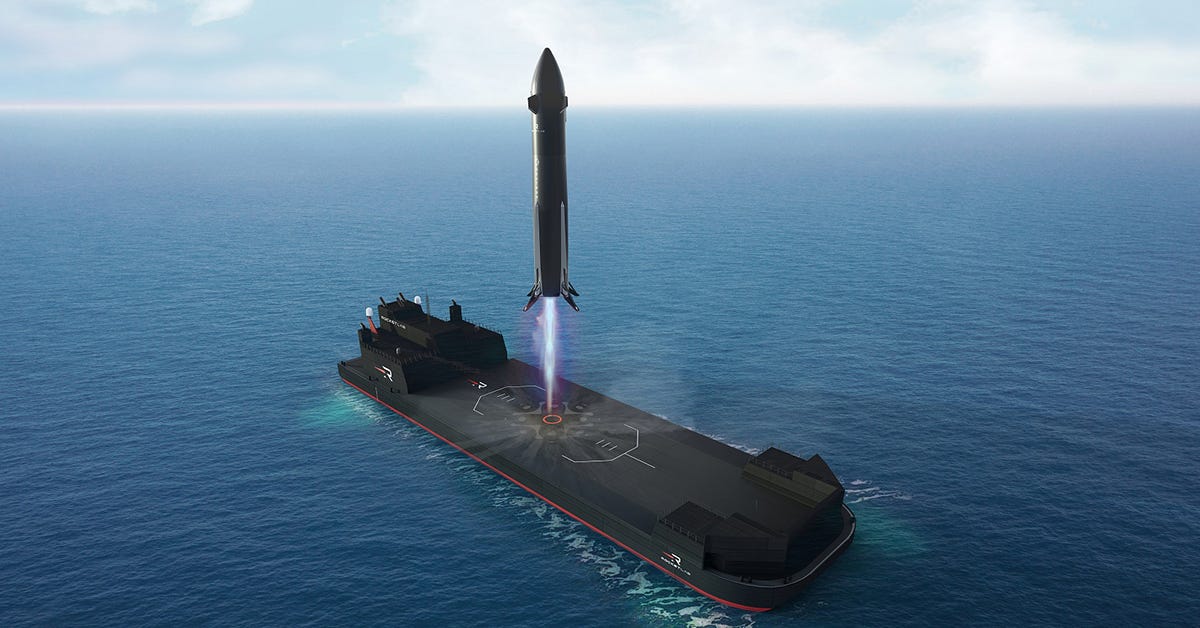
This is where maritime platforms fundamentally change the equation. The strongest case for a launch barge is not that it replaces fixed spaceports or magically removes regulation. It is that it lowers the political and procedural cost of iteration. By moving the most hazardous phases of launch offshore, a maritime platform reduces third-party risk to populations and shifts governance into maritime and aviation safety regimes that are already accustomed to managing dangerous operations. Testing can proceed without turning each anomaly into a national political crisis. Failure becomes data again rather than a shutdown trigger.
This logic is no longer speculative. China has already operationalized sea-based orbital launch. Commercial Chinese company Orienspace has successfully launched satellites into orbit from a barge in the Yellow Sea using its Gravity-1 rocket. This follows multiple Chinese sea-based launches over recent years using different vehicles and platforms. These are not demonstrations staged for prestige. They are operational missions integrated into China’s broader launch ecosystem, showing that maritime platforms can support real cadence.
The United States provides complementary proof, not only through launches but through landings. Blue Origin’s New Glenn rocket has successfully landed its reusable booster on a barge at sea, demonstrating precise maritime operations for heavy launch systems. Rocket Lab is retrofitting a barge specifically to support sea landings of its Neutron rocket, further embedding maritime infrastructure into its operational concept. These examples matter because sea landings impose many of the same operational demands as sea launches: platform stability, range safety, maritime coordination, weather tolerance, and recovery logistics. The fact that multiple U.S. companies are normalizing barge operations shows that the maritime environment is no longer exotic or prohibitive for advanced launch systems.
Even more telling, U.S. startups are developing floating offshore launchpads despite already having access to the world’s most active land ranges. The motivation is not lack of land. It is congestion, cadence, and flexibility. When even a launch-rich ecosystem sees value in moving offshore to unlock capacity, the lesson for Europe is clear.
For Europe, the economic case hinges on framing. A launch barge viewed narrowly as an alternative spaceport produces a modest and debatable return. A launch barge viewed as shared testing and iteration infrastructure produces a fundamentally different outcome. A mobile maritime platform can support engine tests, early prototype flights, stage separation experiments, avionics updates, recovery trials, and other partial-system demonstrations without blocking operational launches or freezing national ranges after a single failure. It allows research and operations to proceed in parallel rather than sequentially. It decouples testing from national siting disputes and consensus politics. That is where the leverage lies.
Cost comparisons reinforce this conclusion when done correctly. Sea-based systems add real expenses related to platform acquisition or conversion, maritime operations, and weather risk. Land-based systems in Europe carry less visible but equally real costs in the form of long permitting timelines, recurring compliance friction, and political exposure that slows learning. The relevant metric is not cost per launch in isolation. It is time to reliable cadence. A system that reaches frequent testing sooner will often be cheaper in total program cost because it compresses the learning curve and reduces years of delay.
From a feasibility standpoint, the hardest problems are institutional, not technical. Europe has the maritime engineering capability, the capital, and the launch startups that could use such infrastructure. The open questions are about demand aggregation, liability and licensing frameworks, and whether European institutions are willing to treat controlled failure during testing as a feature of progress rather than a scandal. These are real risks, but they are market and governance risks, not physics problems.
The conclusion follows directly from the evidence. Europe’s lack of a strategic air and missile defense system is inseparable from its lack of sovereign, high-cadence access to space. The 2025 launch numbers make the imbalance explicit. The United States launched 192 times. Europe launched seven. In a world where space is integral to defense, that gap translates directly into strategic dependence. Fixed land sites will matter, and Iberia may offer Europe its best continental geography. But in the near to medium term, a maritime launch and test platform offers Europe a way to attack its binding constraint: the inability to test, iterate, and learn at speed under its own control. The real value of a launch barge is not just access to orbit. It is access to iteration. For Europe’s defense ambitions, that distinction may be decisive.