

ESA Selects Five Companies for European Launcher Challenge
The European Space Agency (ESA) has selected five launch startups eligible for up to 169 million euros ($198 million) in funding to develop alternatives to Arianespace, the current primary launch service provider in Europe. The challenge requires that each of the rocket-makers achieve an orbital launch no later than 2027.
The initiative aims to strengthen Europe's commercial space launch sector and reduce reliance on traditional heavy-lift rockets. By encouraging independent launch system proposals, ESA seeks to create a more diverse and commercially sustainable ecosystem, securing European autonomy in both institutional and commercial space access.
The companies chosen by ESA are Isar Aerospace, MaiaSpace, Rocket Factory Augsburg, PLD Space, and Orbex. Of these, only Isar Aerospace has previously attempted an orbital rocket launch, with its Spectrum rocket experiencing a failure shortly after liftoff from Norway during a test flight in March.
Selection as an eligible company does not guarantee an ESA contract or funding. In the coming months, ESA and these five companies will negotiate with European governments regarding funding ahead of the ministerial council meeting in November, where ESA member states will determine the agency's budget for at least two years. Binding agreements may be signed following this process. ESA referred to these companies as "preselected challengers" for potential launch contracts and a demonstration to showcase upgraded launch vehicles capable of carrying heavier payloads into orbit. At present, all five are focusing on small rockets.
Earlier this year, ESA issued a request for proposals for the European Launch Challenge, receiving twelve bids and selecting five companies to proceed to the next phase. ESA is now seeking program funding from their respective home governments. Two of the selected companies, Isar Aerospace and Rocket Factory Augsburg, are based in Germany. Isar Aerospace, located in Munich, is developing the Spectrum vehicle, while Rocket Factory Augsburg is working on RFA One. MaiaSpace, owned by ArianeGroup in France, is developing the reusable Maia rocket. PLD Space from Spain is developing Miura 5 and previously conducted a suborbital test with a liquid-fueled rocket in 2023. UK-based Orbex is developing Prime.
All five companies' projects focus on the small satellite launch market. The launcher challenge includes two parts: launch services for ESA missions scheduled between 2026 and 2030, and a demonstration contract for upgraded launch capacity. Funding per challenger is capped at 169 million euros for all activities.
ESA evaluated criteria such as technical maturity, business sustainability, target institutional markets, and adherence to procurement rules in selecting the five companies. The startups selected mostly rely on private investment and some national support. Spain invested €40.5M ($47.5M) in PLD Space last year; Germany committed €95M ($111.5M) to its national launchers in December; and the UK government invested £20M ($27.2M) in Orbex’s Series D in January.
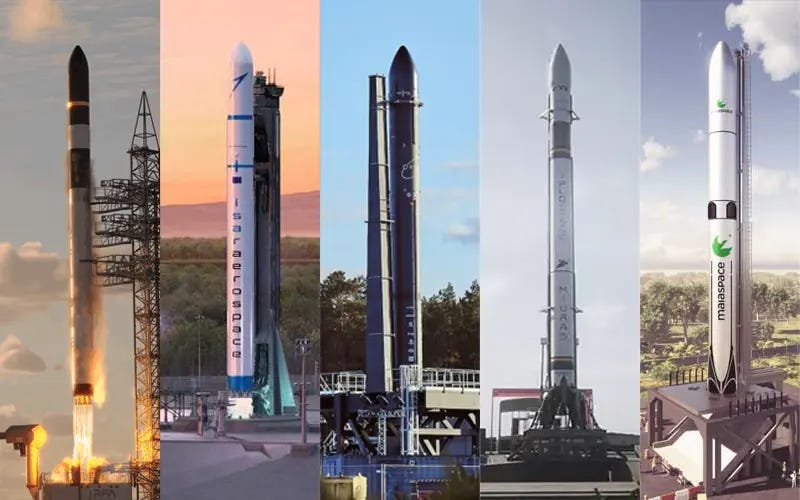
The following selection reflect ESA’s efforts to diversify and advance Europe's commercial launch capabilities:
Isar Aerospace: Based in Munich, Isar Aerospace has conducted an orbital-class launch attempt and secured over 550 million euros since 2018, including recent financing from Eldridge Industries. Its Spectrum rocket can carry up to 1 metric ton to low-Earth orbit or 700 kilograms to a Sun-synchronous orbit. Following its unsuccessful launch in March, Isar is preparing additional rockets for further testing at Andøya Spaceport in Norway.
MaiaSpace: Based in Paris and wholly owned by ArianeGroup, MaiaSpace is developing the Maia rocket, which features a recoverable booster and utilizes methane/liquid oxygen engines. ArianeGroup has invested 125 million euros to date, and Maia is planned to launch from French Guiana with a capability of placing 1.5 metric tons into Sun-synchronous orbit in 2026.
Rocket Factory Augsburg: Located in Augsburg, Germany, Rocket Factory Augsburg is developing the three-stage RFA One, which aims to deliver up to 1.3 metric tons to polar Sun-synchronous orbit. An earlier test anomaly delayed development; the company continues work on qualifying subsequent stages and preparing for future tests. Funding totals are estimated near 100 million euros. The company confirmed it’s attempting a 2025 inaugural launch from SaxaVord Spaceport in the UK.
PLD Space: Headquartered in Elche, Spain, PLD Space achieved a suborbital test in October 2023 with a technology demonstrator for its partially reusable Miura 5. The main engine qualification campaign has begun, and a launchpad is being constructed in French Guiana with a first flight expected in early 2026. Miura 5 is designed for 540 kilograms to Sun-synchronous orbit. Total funds raised are approximately 160 million euros, with significant portions in loans.
Orbex: Based in the United Kingdom, Orbex is developing the Prime rocket, with ongoing changes to its launch site now focused on SaxaVord Spaceport in Scotland in 2026. The Prime rocket targets 180 kilograms to low-Earth orbit, and the company plans to develop a larger Proxima vehicle. Orbex has raised about £130 million to date.
After their initial first flights, ESA will purchase launch services from a challenge participant for future ESA missions by 2030. The challenge also requires companies to demonstrate a payload capacity upgrade by 2028.