

Delian Alliance Industries Secures €12M to Expand Autonomous Defense Systems in Europe
Delian Alliance Industries, a defense technology company based in Athens that develops autonomous defense systems, announced on July 29th that the company has secured $14 million (approximately €12 million) in Series A funding.
The round was co-led by Air Street Capital and Marathon Venture Capital, with additional investment from 201 Ventures, HCVC, Entropy Industrial Capital, and Nebular. Funding will go towards international expansion, as Delian aims to challenge incumbent defense industry leaders such as BAE Systems, Airbus, Rheinmetall, Saab, and Leonardo.
“It is exceptionally rare for an opportunity to arise when new prime contractors can establish themselves,” stated Dimitrios Kottas, co-founder and Chief Executive Officer of Delian. “If such a window has existed at all over the past several decades, it is now. I anticipate that the coming decade will witness a technological race that will fundamentally reshape the conduct of warfare in the West.”
A former Apple engineer, who contributed to the company’s confidential robotics division, Delian founder Dimitrios Kottas exemplifies a broader trend of ex-Silicon Valley professionals transitioning into military technology sectors. Kottas returned to Greece in 2021 amidst escalating tensions between Greece and Turkey in the Aegean Sea to found Delian. While the company relocated its headquarters to London in 2023, the majority of its team remains based in Greece.
In contrast to many other start-ups, Delian develops its own hardware, software, and sensor fusion systems, which allows the company to move more rapidly than traditional defense organizations. “Our main adversary is time,” Kottas explained. “Our opponents are innovating and deploying technology at an unprecedented pace. Current national security processes are not optimized for this velocity, as they have historically been designed for peacetime conditions.” Delian Alliance Industries’ vertically integrated model, similar to those employed by Tesla and Apple, also means its platforms costs significantly lower than those of traditional leading defense contractors to both produce and operate.
Currently, Delian supplies sensor fusion solutions to the Greek armed forces and civilian authorities for applications in fire detection and environmental monitoring. Its target clientele comprises western-aligned “middle powers” with more modest defense budgets relative to larger nations such as the United States.
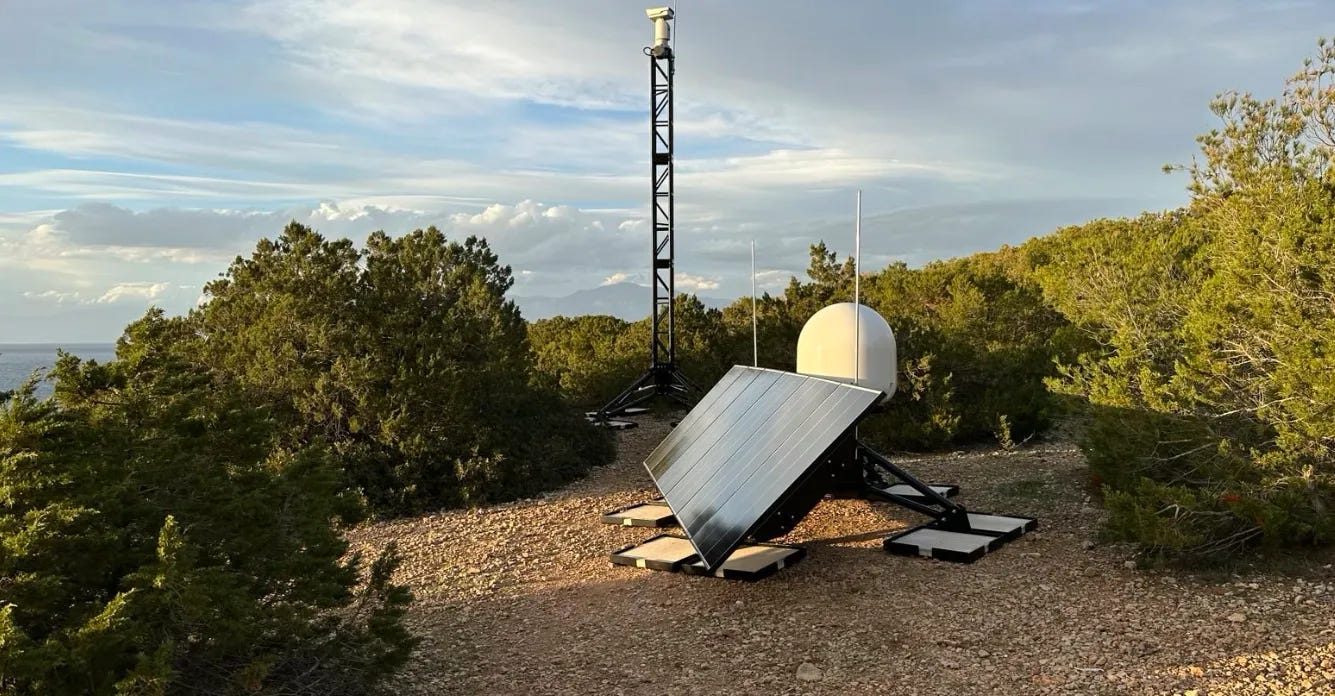
Delian’s autonomous surveillance towers are engineered for dual-use in both defence and civilian contexts. Kottas noted that while the market for high-cost airborne drones is highly saturated, the maritime sector remains comparatively underdeveloped. “The operational scenario we encounter in the Aegean - defending small islands against proximate revisionist threats - is common among several countries,” he observed, referencing markets in Asia, including India, South Korea, and Singapore, as well as Northern Europe.
Delian manufactures its products near Athens and has recently demonstrated prototypes of its Interceptigon unmanned autonomous systems, which are designed for kamikaze-style interception. These fixed-wing drones or personal-watercraft-inspired vessels can launch from concealed sites to neutralize naval or aerial threats.
Nathan Benaich, an investor at Air Street Capital, the lead investor in Delian’s latest funding round alongside Marathon Venture Capital of Greece, emphasized the importance of Delian's integrated product development strategy. “Software alone cannot ensure border security or the safety of citizens,” he said. “Successful protection requires end-to-end integration of hardware, software, and manufacturing within a single entity. Retrofitting existing solutions is insufficient.”
Related: