

Why Did it Take so Long to Rescue NASA Astronauts Butch Wilmore and Suni Williams?
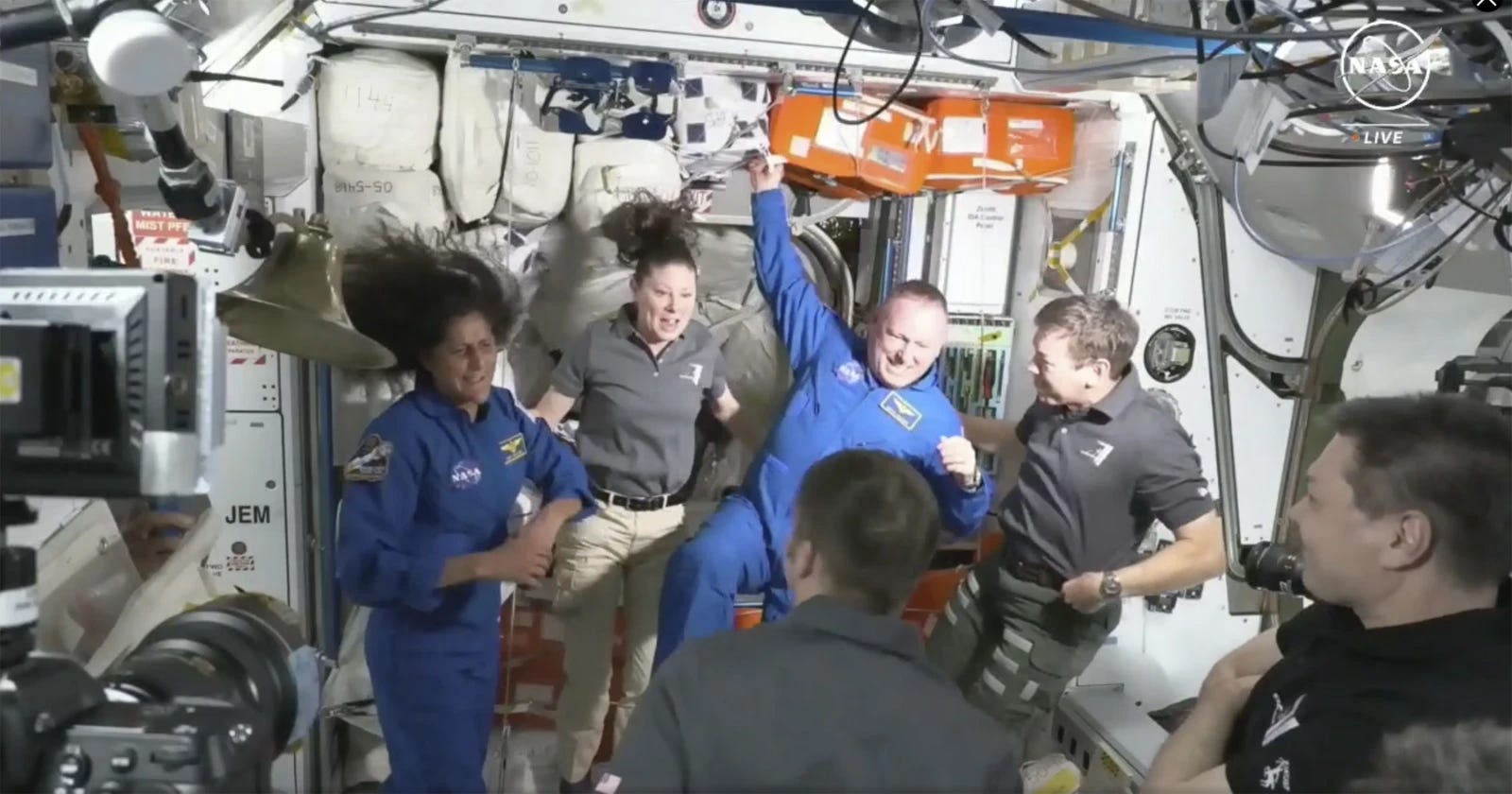
Williams and Wilmore left Earth on June 5, 2024, from Cape Canaveral Space Force Station in Florida aboard Boeing’s Starliner spacecraft on a mission that was supposed to last eight days. The purpose of the mission was to evaluate if the spacecraft could be used for regular astronaut rotation missions. However, shortly after liftoff, the Starliner experienced multiple helium leaks that caused the return mission to be halted until further testing could be conducted.
Even though the helium leaks stabilized after arrival, problems with the thrusters convinced NASA to send the Starliner aircraft back to Earth empty. That's when Musk came into the picture, as NASA and SpaceX officials huddled last summer to determine a plan to bring the astronauts back.
NASA astronauts Butch Wilmore and Suni Williams on June 5, 2024, the day of their launch on the Boeing CST-100 Starliner spacecraft bound for the International Space Station.
In August 2024, NASA announced that it would use SpaceX’s Dragon capsule to return the astronauts in February 2025. In September, the mission launched Crew-9 with NASA’s Nick Hague and Russian cosmonaut Aleksandr Gorbunov, who successfully reached the International Space Station on Sept. 29. The capsule was launched with two empty seats for the crew, including Williams and Wilmore, to return in February, after being replaced on the space station by astronauts from Crew-10. NASA officials said late February was the earliest the crew could return on SpaceX without interrupting other scheduled missions.
In recent months, Musk and Trump have claimed the Biden administration decided to leave the astronauts on the space station until after the November election to avoid bad publicity.
During a Fox News interview with host Sean Hannity on February 18, Trump asserted that he had authorized Musk to expedite a mission to retrieve the astronauts, claiming that they had been intentionally abandoned by former President Joe Biden to avoid political fallout. Trump remarked, “They didn’t have the go-ahead with Biden. He was going to leave them in space. I think he was going to leave them in space… He didn’t want the publicity. Can you believe it?”
This was not Trump’s first such accusation. On January 28, Trump posted on Truth Social, “I have just asked Elon Musk and @SpaceX to ‘go get’ the 2 brave astronauts who have been virtually abandoned in space by the Biden Administration.”
During the Hannity interview, Musk stated that at Trump’s request, “we are accelerating the return of the astronauts, which was postponed to a ridiculous degree,” adding that “they were left up there for political reasons, which is not good.”
In response to Musk’s claims, several astronauts took to X to refute the notion that the astronauts were deliberately abandoned. Andreas Mogensen, a former SpaceX astronaut from Denmark, posted: “What a lie. And from someone who complains about lack of honesty from the mainstream media.” Musk replied, “You are fully retarded. SpaceX could have brought them back several months ago. I OFFERED THIS DIRECTLY to the Biden administration and they refused. Return WAS pushed back for political reasons. Idiot.”
Mogensen responded by stating, “Elon, I have long admired you and what you have accomplished, especially at SpaceX and Tesla. You know as well as I do, that Butch and Suni are returning with Crew-9, as has been the plan since last September. Even now, you are not sending up a rescue ship to bring them home. They are returning on the Dragon capsule that has been on ISS since last September.”
The White House has not responded to inquiries regarding Trump’s and Musk’s claims.
During a CNN interview with Williams and Wilmore on February 13, host Anderson Cooper asked if they felt abandoned by the Biden administration.
"We don’t feel abandoned. We don’t feel stuck. We don’t feel stranded," Wilmore stated from the space station, which orbits the Earth and functions as a science laboratory. "I understand why others may think that. We come prepared. We come committed. That is what your human space flight program is about. It prepares for any and all contingencies that we can conceive of, and we prepare for those. So if you’ll help us change the rhetoric, help us change the narrative, let’s shift it to prepared and committed like what you’ve been hearing. That’s what we prefer."
Williams reiterated, "Butch and I knew this was a test flight" and "that we would probably find some issues with Starliner, and indeed we did, so that was not a surprise."
Regarding the prospect of sending up a SpaceX flight solely to bring them back earlier, Wilmore said, "We would never expect to come back just for us, or anyone, unless it was a medical issue or something really extraordinary."
In a March 4 news conference from the space station with Williams, Wilmore, and NASA's Nick Hague — one of the two astronauts who arrived via a SpaceX capsule in September — Wilmore stated he had no reason to doubt Musk’s claims about offering to bring them home earlier, though he was not aware of such an offer.
"We have no information on that, whatsoever," Wilmore said. "That’s information that we simply don’t have. So I believe him, but I don’t know all those details, and I don’t think any of us can give you the answer you might be hoping for."
Asked about the claims of political motivations for their extended stay, Wilmore said Musk and Trump may have information "that we are not privy to."
But, he added, "from my standpoint, politics is not playing into this at all. From our standpoint, I think that they would agree, we came prepared to stay long, even though we planned to stay for a short time."
Hague emphasized, "When I launched in late September, our planned return date was the end of February. Considering the amount of training required to prepare a crew and the complexities involved in getting a spacecraft ready to launch and operate in space, targeting a March return is pretty much on track."
Several NASA leaders were unaware of Musk’s offer to expedite the astronauts’ return. Bill Nelson, former NASA administrator, said he was not informed of such an option. During a March 4 NASA news conference, officials repeatedly addressed Musk’s claim and the decision-making process.
Ken Bowersox, NASA’s associate administrator for space operations, mentioned conversations he was not part of and ruled out the separate mission due to budget constraints and the importance of maintaining crews on the space station. Steve Stich and Dana Weigel explained the decision to attach the astronauts to the Crew-9 mission after considering various options.
Bowersox praised Wilmore and Williams as experienced astronauts who would enjoy their extended time on orbit. Bill Gerstenmaier from SpaceX declined to provide specifics about Musk’s offer.
NASA clarified that Trump's involvement did not expedite the mission to return astronauts. Crew-9's handoff to Crew-10 was delayed due to processing a new Dragon spacecraft, with Crew-10 now targeting late March 2025 for launch. NASA and SpaceX accelerated the schedule by using a previously flown Dragon spacecraft called Endurance.
Program Manager Stich stated the timeline depended on capsule readiness and launch pad availability, unaffected by Trump’s comments. Bowersox added that discussions on flight schedules and capsule switches predated any external remarks.
Crew-10 reached the International Space Station on March 16, and Crew-9 departed aboard the SpaceX Dragon capsule, landing off the coast of Florida on March 18, 2025.