

Australian-Built Rocket Conducts First Orbital Launch Attempt
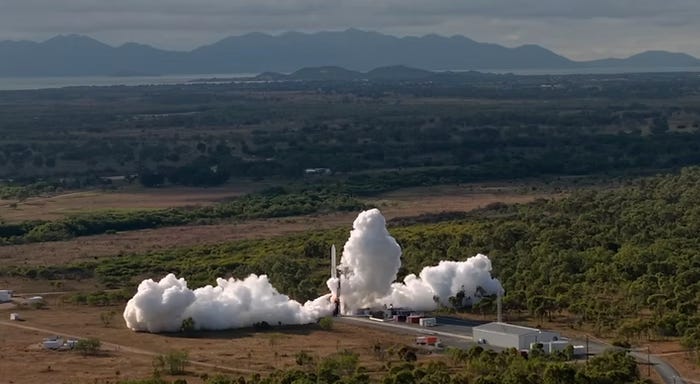
Gilmour Space achieved a milestone on July 29th by launching its first Eris rocket from the Bowen Orbital Spaceport in Queensland. The Eris rocket experienced difficulties shortly after liftoff, sliding sideways and returning to Earth just 14 seconds after launch. This event was similar to Astra’s third orbital launch attempt in August 2021, which also involved a lateral deviation off the launch pad.
The result was anticipated, as it is uncommon for new rockets to complete their inaugural flight without incident. Gilmour Space had indicated that any outcome would provide valuable data for ongoing development of its rockets. In a February statement regarding the Eris-1 mission, the company noted that information gathered from each second of flight would be used to enhance reliability and performance for subsequent launches.
Adam Gilmour, CEO of Gilmour Space, noted that Eris was the first Australian-made orbital rocket to launch from Australian soil. He emphasized the valuable collection of data, describing the launch as an important test of the company's rocket systems, propulsion technology, and spaceport operations, indicating that several aspects functioned as intended. "Getting off the pad and into flight is a huge step forward for any new rocket program. This was the first real test of our rocket systems, our propulsion technology, and our spaceport - and it proved that much of what we've built works. Only six nations currently launch to orbit regularly and just a handful are developing sovereign capability to join them. We've now taken a big step toward joining that group," Gilmour stated.
Gilmour Space initially targeted March for the launch but postponed due to Tropical Cyclone Alfred. A subsequent mid-May attempt was delayed following a technical issue when Eris' payload fairing detached unexpectedly, attributed to a power surge from electrical backfeed. After addressing this issue, further launch plans in late June were hindered by strong winds near the spaceport. The date was ultimately shifted multiple times due to predominantly unfavorable weather conditions until the successful liftoff on July 29th.
Gilmour Space was founded in 2015 by Adam and James Gilmour, with the intention of contributing to Australia's involvement in the global space industry. The Eris rocket, standing 82 feet tall, has a planned capacity to transport up to 474 pounds of payload to sun-synchronous orbit. The company now employs around 200 people and manufactures satellites, including the ElaraSat spacecraft bus, which launched for the first time in the previous month on a SpaceX Transporter-14 rideshare mission. The ElaraSat carried a hyperspectral imager for CSIRO, Australia’s national science agency, for water quality monitoring.
Gilmour Space’s Eris rocket launch this week marked the first attempt at orbital flight from Australian territory in over five decades, following the British Black Arrow rocket's successful October 1971 launch of the Prospero satellite from the Woomera Rocket Range in South Australia. The team will review flight data and incorporate findings into the development of the next Eris rocket, which is scheduled for launch within the next 6-8 months.