

Astro Mechanica Secures $27.1M for Supersonic Flight Development
Supersonic engine and aircraft manufacturing company, Astro Mechanica, recently announced that it has raised $27.1M in funding, co-led by a16z, Lowercarbon, and Giant Step, with participation from Alumni Ventures and Voyager.
Astro Mechanica CEO Ian Brooke stated in an interview with Tectonic, who first broke the story, that the funding will be used to enhance the company’s software team, further develop and test its efficient supersonic jet engine, and establish a team for air frame construction. “Our goal is to achieve the world’s first supersonic trans-Pacific demonstrator flight within two to three years,” he said. Within ten years, the company aims for supersonic commercial flight at a cost comparable to traditional air travel.
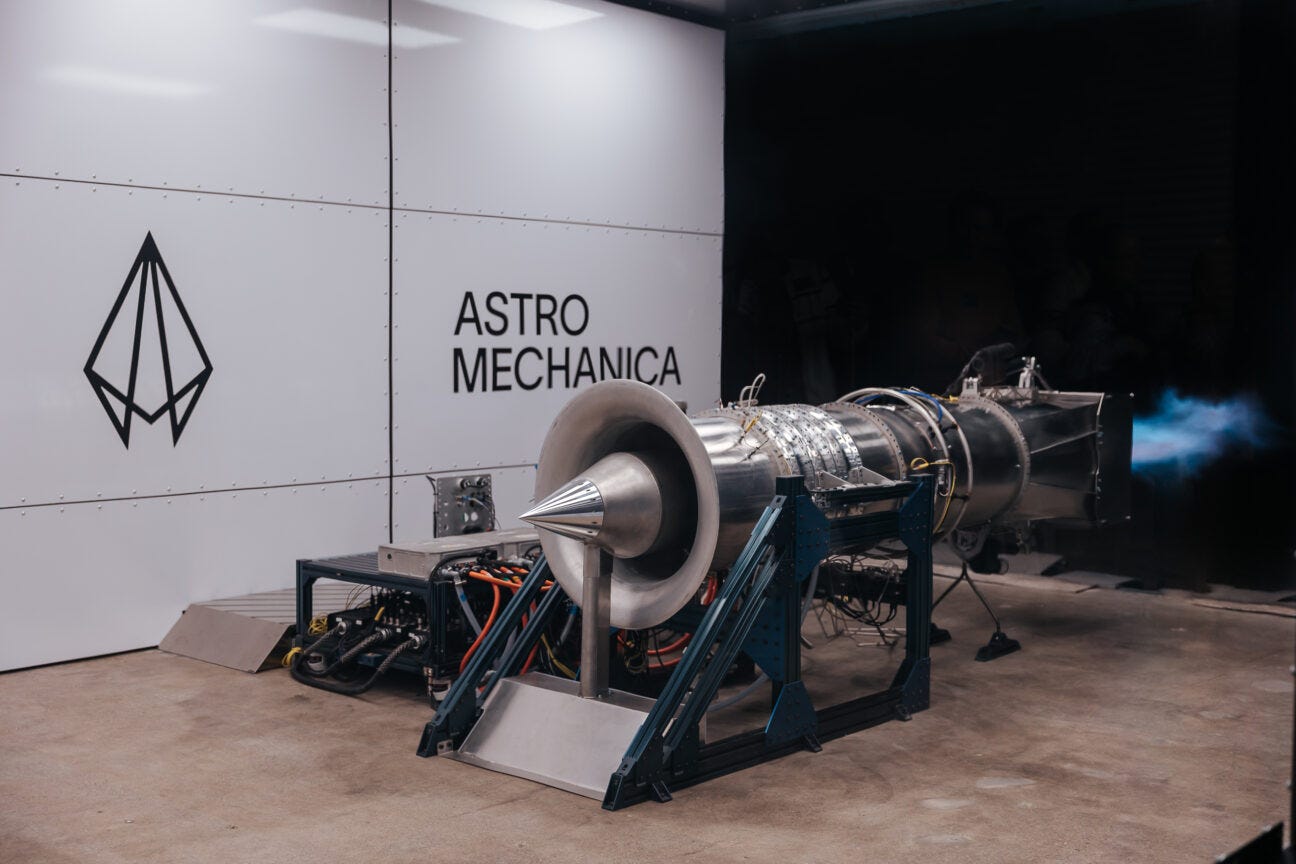
Astro Mechanica has developed a propulsion system named a turboelectric adaptive engine, which is more efficient than traditional jet engines. “The functioning of high-speed engines differs significantly from low-speed engines. Low-speed engines are more efficient, while high-speed engines can achieve higher speeds. Therefore, developing an engine capable of both is essential,” Brooke explained. To achieve this, they have divided the engine structure into two main components; the turbogenerator is a compact gas turbine that produces electricity through a generator, while the propulsor’s electric power drives the fan and compressor independently via powerful electric motors.
By separating the airflow components from the turbine, the engine can adjust compressor speeds to suit different flight conditions, maintaining efficiency from low-speed taxiing to high-Mach cruising. “In a typical engine, all processes occur simultaneously, limiting exhaust velocity variation. By separating these functions, we can vary them more flexibly,” Brooke added. This means that aircraft will require significantly less fuel to reach supersonic speeds.
Tests indicate Astro Mechanica’s engine could fly an unmanned aircraft of similar size to Anduril’s Fury (or any CCA aircraft) across the Pacific non-stop at Mach 2–3 speeds, which is currently unattainable. The cost of the engine itself will be in the “low single-digit millions for a Mach-plus capable engine,” according to Brooke. An aircraft using the engine could cost between $15-50M, depending on capabilities.
The company's target is a trans-Pacific demonstration flight within three years. While aiming to build their own aircraft, Astro Mechanica also plans to sell propulsion systems to other defense manufacturers. The engine’s structure allows it to provide substantial electricity, which could power functions like EW and ISR.
The funding will also enable Astro Mechanica to pursue government contracts and demonstrate the viability of their technology. So far, the company is in discussions with organizations including: Air Force Research Laboratory, INDOPACOM, and the Air Force Rapid Capabilities Office.