

Arago Secures $26M to Develop Photonic Chip Aimed at Reducing AI Energy Consumption
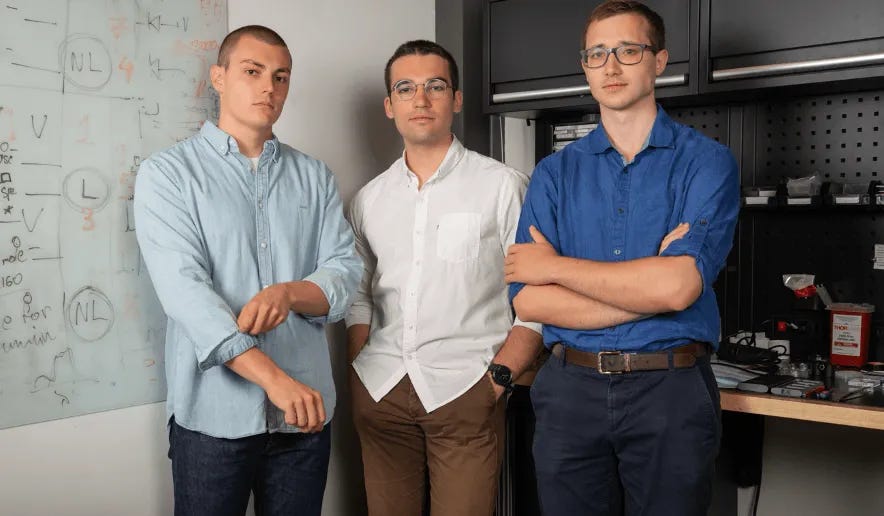
Arago, a startup based in Paris that develops energy-efficient chips for AI, announced its $26 million seed funding round. Founded over a year ago by Eliott Sarrey and Ambroise Müller, both former researchers at ETH Zurich, alongside CEO Nicolas Muller, who previously worked as a data scientist at several deeptech startups, Arago seeks to address the energy requirements of AI technologies.
The oversubscribed seed round was co-led by European venture capital firms Earlybird and Visionaries Tomorrow and US investor, Protagonist. Participants included GenerativeIQ and C4 Ventures. The round also includes investment from prominent angel investors, such as Bertrand Serlet (former VP at Apple), Christophe Frey (GM at Arm), Olivier Pomel (co-founder of Datadog), Thomas Wolf, (co-founder of Hugging Face), and Jack Abraham (co-founder of Exowatt), among others
AI processing often involves significant energy use, necessitating large-scale data centers with numerous graphics processing units (GPUs). Currently, GPUs are predominantly supplied by Nvidia. Muller stated that Arago is approaching chip design differently, utilizing photons instead of electricity for computations. According to Muller, this approach can reduce energy consumption by 10 to 30 times compared to standard Nvidia chips.
Arago operates in France, the US, the UK, and Israel, and has completed its first product, which it designs but manufactures through industry partners. The company’s value chain is situated in Europe and the US, though specific manufacturing partners were not disclosed. The technology has been tested in collaboration with business and industry partners, and the chips are compatible with existing AI software and infrastructure.
Increasing efficiency in AI chips is a growing area within the sector, with other companies such as Germany’s Black Semiconductor and Belgian-French Vertical Compute raising significant funding for their own approaches to photonic and memory-focused chips, respectively.
With the new funding, Arago intends to commence commercialization of its product, anticipating initial sales in the near future. Muller indicated that current constraints are related to mass manufacturing rather than demand. The company, which employs 20 people, also plans to expand its workforce across the US, France, and Israel.