

America’s Rare Earth Strategy Takes Shape
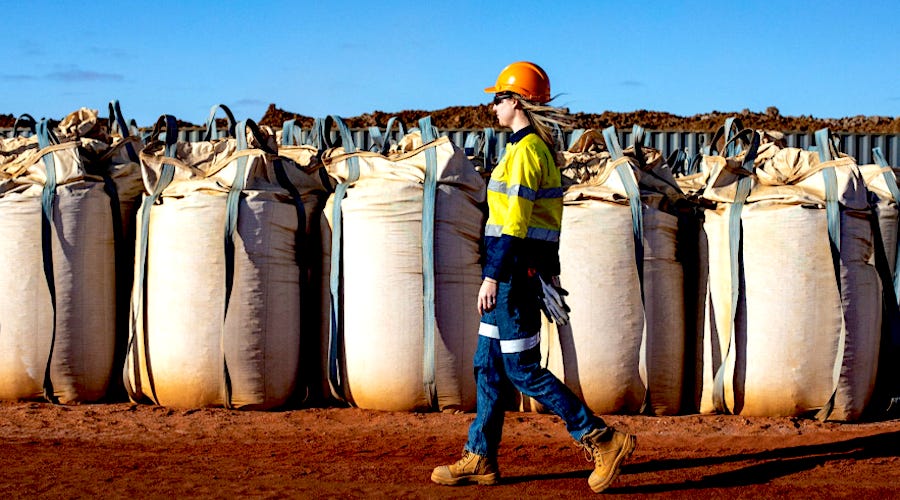
The Pentagon’s $96 million agreement with Lynas Rare Earths is one step in a broader effort to rebuild the supply chain behind modern weapons systems.
Rare earths sit inside everything from missile guidance systems and radar arrays to fighter aircraft and drones. For decades, however, the United States allowed the industrial ecosystem that processes these materials to consolidate in China. Today Beijing controls the majority of global rare earth processing and magnet manufacturing, creating a structural vulnerability for the US defense industrial base.
Washington is now trying to reverse that reality. The Lynas deal is one of several recent moves that show how the US government is beginning to rebuild critical mineral supply chains through a mix of investment, allied partnerships, and long term demand support.
The contract itself is straightforward. Lynas, the largest rare earth producer outside China, will supply the US Department of Defense with light and heavy rare earth oxides under a four year agreement reportedly worth $96 million. The deal also reportedly includes a price floor for neodymium praseodymium, one of the most important rare earth materials used in defense applications.
On its own, the agreement does not transform the global rare earth market. What it reveals instead is how Washington’s approach to critical minerals is changing. For years the United States recognized that rare earth supply chains posed a strategic risk, but policy responses were limited and fragmented. Over the past several years, that has begun to change. Washington is increasingly treating critical minerals as a core element of defense industrial policy.
The Lynas agreement follows another major intervention involving MP Materials, which operates the Mountain Pass rare earth mine in California. The Pentagon supported a large scale effort to expand rare earth magnet manufacturing in the United States, including long term offtake commitments and price guarantees intended to stabilize investment in domestic production.
Both deals reflect a similar strategy. The United States is attempting to build an alternative rare earth supply ecosystem outside China by supporting producers that can operate at industrial scale. Rather than relying solely on private markets, Washington is beginning to use tools such as investment, price floors, and guaranteed demand to anchor that ecosystem.
Several federal institutions are involved in this effort. The Department of Defense has taken the lead, particularly through its industrial base authorities and the Defense Production Act. Federal financing institutions are also increasingly involved. The Export Import Bank has begun supporting critical mineral supply chains through its supply chain resilience programs, while the US International Development Finance Corporation has been positioned to support projects in allied countries. The Department of Energy has also funded research and demonstration projects aimed at expanding rare earth processing and manufacturing capacity.
A newer initiative illustrates how this strategy is expanding beyond individual supply contracts. Washington has begun developing what is known as Project Vault, a proposed strategic reserve for critical minerals intended to support the defense industrial base. The program is expected to combine private capital with federal financing support and could mobilize large scale investment into the sector. The Export Import Bank is expected to play a central role through financing mechanisms designed to strengthen supply chain resilience. The goal is not only to stockpile materials but also to stabilize markets and support long term production capacity outside China.
This broader policy architecture reflects the real nature of the rare earth problem. The core vulnerability is not simply mining. The real choke points sit further downstream. China’s dominance comes primarily from its control of processing, separation, metal making, alloy production, and magnet manufacturing. Even when rare earth minerals are mined outside China, they are often sent there for refining before entering global supply chains.
Rare earth elements are essential to many advanced defense systems. Neodymium and praseodymium are used to produce powerful permanent magnets that drive electric motors and guidance systems in missiles, drones, and radar arrays. Dysprosium and terbium allow those magnets to operate at high temperatures, which is critical for aircraft and other demanding environments. Yttrium is used in night vision devices, targeting lasers, and thermal coatings that protect aircraft engines.
Beyond rare earths themselves, the broader category of critical minerals includes materials such as gallium and germanium for electronics and infrared systems, antimony for munitions and alloys, tungsten for armor piercing ammunition, and lithium, nickel, cobalt, and graphite for advanced battery systems. These materials form the industrial foundation of many modern military technologies.
Despite recent progress, the United States remains far behind China across much of this supply chain. China still dominates rare earth processing and magnet manufacturing, and it maintains significant leverage over global supply. Rebuilding alternative production capacity will take years of investment in processing plants, metallurgical facilities, magnet manufacturing, and skilled workforce development.
This is why agreements like the Lynas deal matter. They help anchor the early stages of a new supply network built around allied producers and domestic manufacturing capacity. But they also illustrate how much work remains. One Australian supplier and one American rare earth company do not yet constitute a resilient supply chain. Closing the gap with China will require sustained policy support, large scale industrial investment, and deeper cooperation between the United States and its allies.
Rare earths are not the only industrial vulnerability in US competition with China. Semiconductors, batteries, shipbuilding inputs, and munitions production all present major challenges. What makes rare earths distinctive is how concentrated the supply chain has become and how difficult it is to rebuild once it disappears.
One reason Washington is moving more aggressively on critical minerals is the concern that supply chain dependence could become a geopolitical lever in a crisis with China. Beijing has already shown a willingness to impose export restrictions on several strategic minerals and related materials, and it continues to dominate much of the rare earth processing and magnet manufacturing ecosystem. In response, the United States has begun supporting alternative supply chains through investments, financing tools, and long term procurement commitments with companies such as MP Materials and Lynas, as well as initiatives like Project Vault. These efforts remain in their early stages and the structural gap with China is still significant. But the direction of policy is becoming clearer: Washington is beginning to rebuild critical mineral capacity with allies rather than relying on a supply chain dominated by China.