

Amazon Launch Marks Beginning of "Project Kuiper" Satellite-Internet Constellation
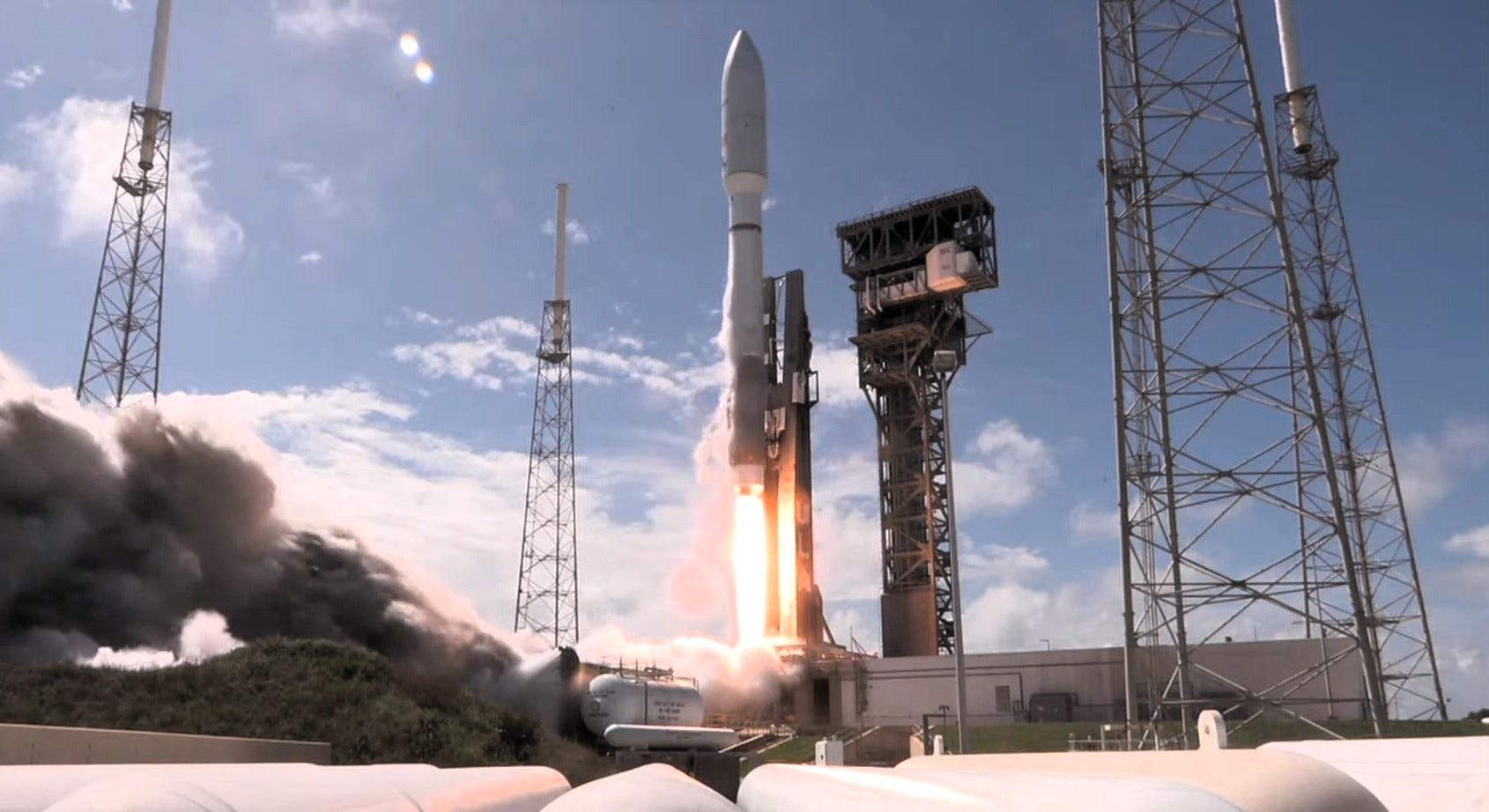
A United Launch Alliance (ULA) Atlas V rocket successfully launched from Florida's Cape Canaveral Space Force Station on April 28th carrying 27 of Amazon's "Project Kuiper" broadband satellites into low Earth orbit (LEO).
This event marks the first of over 80 planned launches aimed at establishing the Project Kuiper megaconstellation, which will ultimately comprise more than 3,200 satellites. Although substantial, this number does not set a record; SpaceX's Starlink broadband network, currently operational globally, consists of more than 7,200 active satellites.
Starlink, likely Project Kuiper's most significant competitor, continues its expansion: SpaceX has executed 31 Starlink missions so far this year, with additional launches scheduled. Remarkably, a Starlink launch occurred less than three hours prior to today's Atlas V launch, with another slated for less than four hours afterward.
Amazon anticipates that Project Kuiper will begin offering coverage to customers later this year. "While the satellites complete the orbit-raising process, we will look ahead to our ultimate mission objective: providing end-to-end network connectivity," Amazon representatives conveyed in a prelaunch statement. "This involves transmitting data from the internet, through our ground infrastructure, up to the satellites, then down to customer terminal antennas, and repeating the journey in reverse," they elaborated.
Today's launch represents the second mission for the Project Kuiper initiative. In October 2023, an Atlas V rocket deployed two prototype satellites to orbit during a test mission designed to validate the company's technology and refine the design of the operational constellation. Noteworthy advancements distinguish these latest satellites from their predecessors. "We have enhanced the performance of every system and subsystem onboard, including phased array antennas, processors, solar arrays, propulsion systems, and optical inter-satellite links," Amazon representatives stated in the same announcement. "Furthermore, the satellites feature a unique dielectric mirror film that disperses reflected sunlight to reduce visibility to ground-based astronomers," they added.
Most of the remaining 80-plus launches will be facilitated by the Atlas V and its successor, ULA's Vulcan Centaur rocket. Additionally, Amazon has secured launch agreements with Jeff Bezos' Blue Origin, SpaceX, and France-based Arianespace.
The initial launch date for today's mission was set for April 9 but was postponed due to adverse weather conditions.