

Airbus, Leonardo, and Thales Have Reached an Agreement to Merge Space Divisions
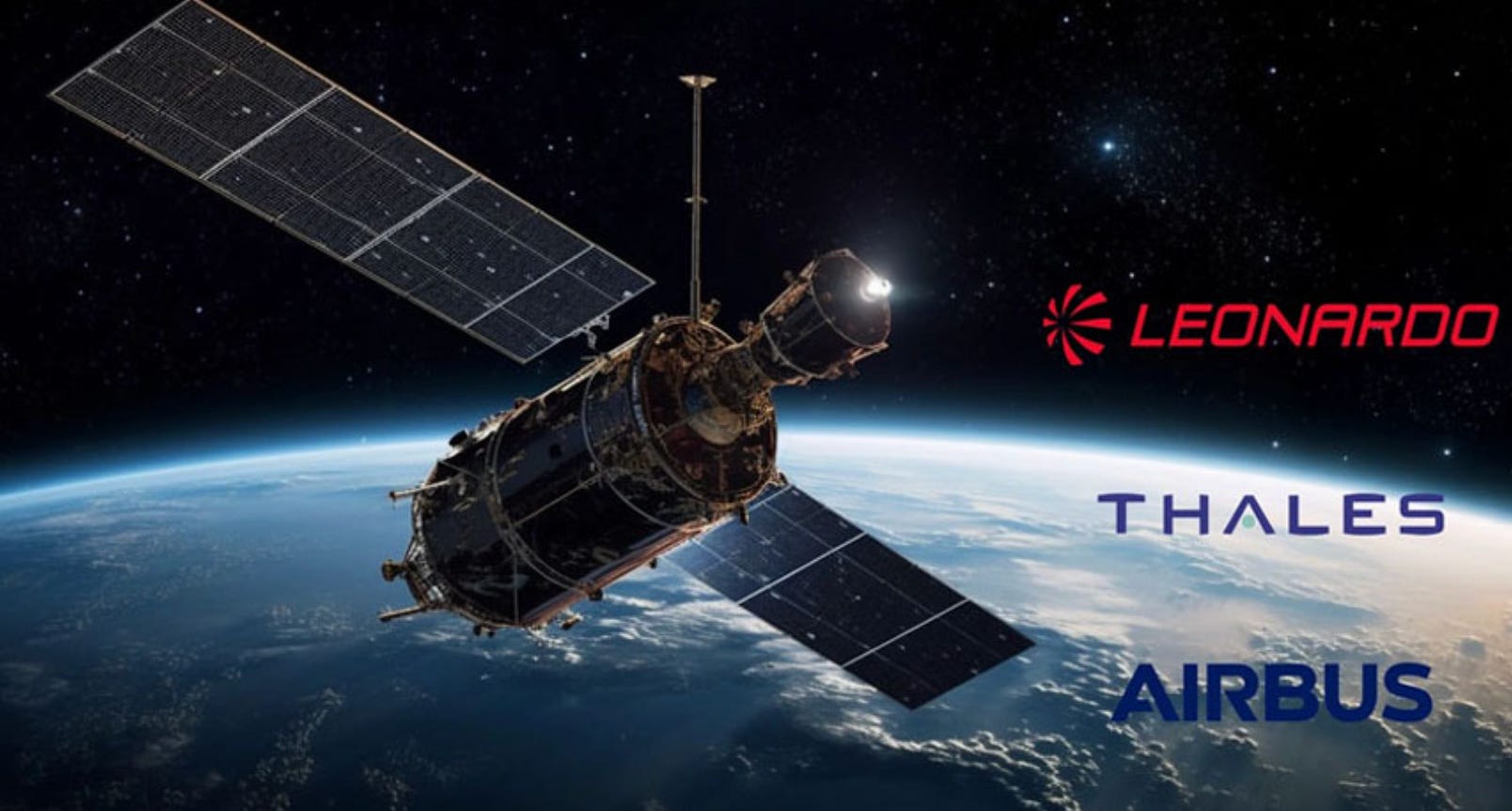
Airbus, Leonardo, and Thales have reached an agreement to merge their space operations, forming a unified European technology entity intended to compete with Elon Musk’s SpaceX.
The companies said the joint venture would develop and build, “a comprehensive portfolio of complementary technologies and end-to-end solutions, from space infrastructure to services.” The development of space launchers will be excluded from the new company’s operations. This as-yet-unnamed consortium will represent one of the largest collaborations in Europe’s aerospace sector, integrating satellite manufacturing, space systems, components, and services under a single organization.
In a joint statement, Guillaume Faury (Airbus Chief Executive), Roberto Cingolani (Leonardo Chief Executive), and Patrice Caine (Thales Chief Executive) described the venture as “a pivotal milestone for Europe’s space industry.” And added that: “This new company also intends to serve as the trusted partner for developing and implementing national sovereign space programs.” They emphasized the intention to leverage collective talent, resources, expertise, and R&D capacity to foster growth, accelerate innovation, and deliver enhanced value to clients and stakeholders.
Headquartered in Toulouse, France, the company will employ roughly 25,000 people and aims to commence operations by 2027, pending regulatory approvals. While the collaborating companies have implemented workforce reductions in recent years, they affirmed that there would be no immediate site closures or job losses; consultations with relevant unions will occur as the project progresses. According to the partners, anticipated annual operational synergies are expected to reach “mid-triple digit” millions of euros within five years post-launch. Ownership will be divided with Airbus holding 35%, while Leonardo and Thales each retain 32.5%. This strategic partnership draws inspiration from the model established by MBDA, the European missile manufacturer jointly owned by Airbus, Leonardo, and BAE Systems.
Recent challenges have affected the space divisions of Airbus, Leonardo, and Thales, with Airbus recording €1.3 billion in charges from underperforming contracts and announcing 2,000 layoffs in its defense and space segment last year. Similarly, Thales Alenia Space, a Thales and Leonardo joint venture, eliminated more than 1,000 positions in the same period.
SpaceX, established by Elon Musk in 2002, has since grown into one of the world’s most valuable startups, with a valuation of $400 billion (£300 billion). Its cost-effective launch services and Starlink constellation of low-earth orbit satellites have been highly competitive against European manufacturers’ larger geostationary satellites. SpaceX remains the leading provider of rocket launches and satellite internet services, facing competition primarily from United Launch Alliance and Blue Origin.
It should be noted that Arianespace, a launch service provider jointly owned by Airbus and Safran, is not part of this merger. Operational issues with one of Arianespace’s rockets temporarily led to increased European reliance on SpaceX for launching components of the Galileo navigation system.
Concerns regarding dependency on SpaceX have heightened, particularly as Elon Musk became a significant political donor to US President Donald Trump. Earlier this month, SpaceX successfully completed its eleventh Starship launch from Texas, landing in the Indian Ocean. In August, President Trump issued an executive order aimed at simplifying regulations to facilitate commercial rocket launches.