

2025 Space Launches
Global Launch Activity Overview
2025 marked another record setting year for orbital launches, underscoring the accelerating pace of global space activity.
A total of 315 successful orbital launches were conducted worldwide in 2025, 61 more than the 254 launches in 2024, representing a 24 percent year over year increase. Spacecraft deployments grew even faster, exceeding 4,500 satellites, up roughly 60 percent from the 2,800 plus deployed in 2024.
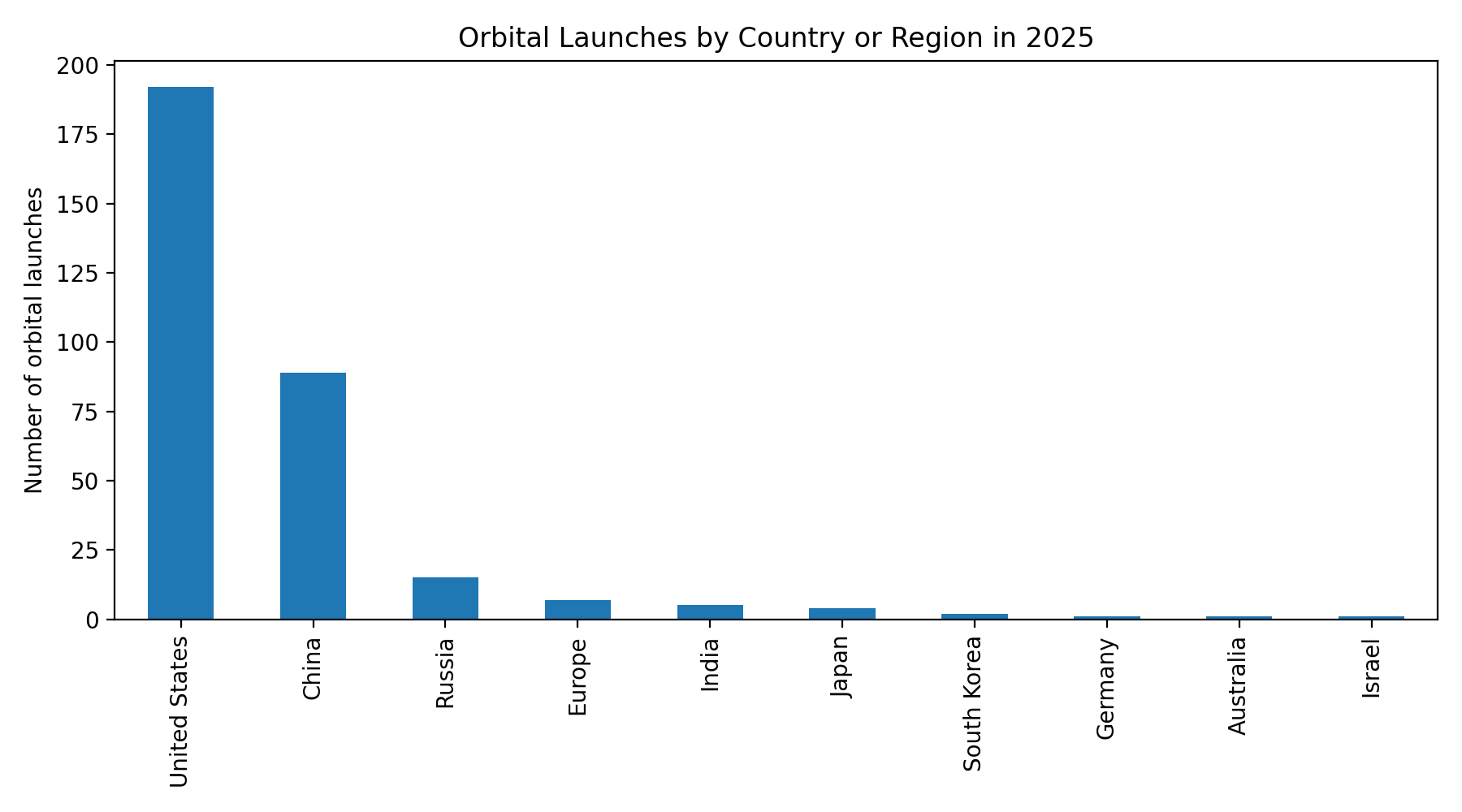
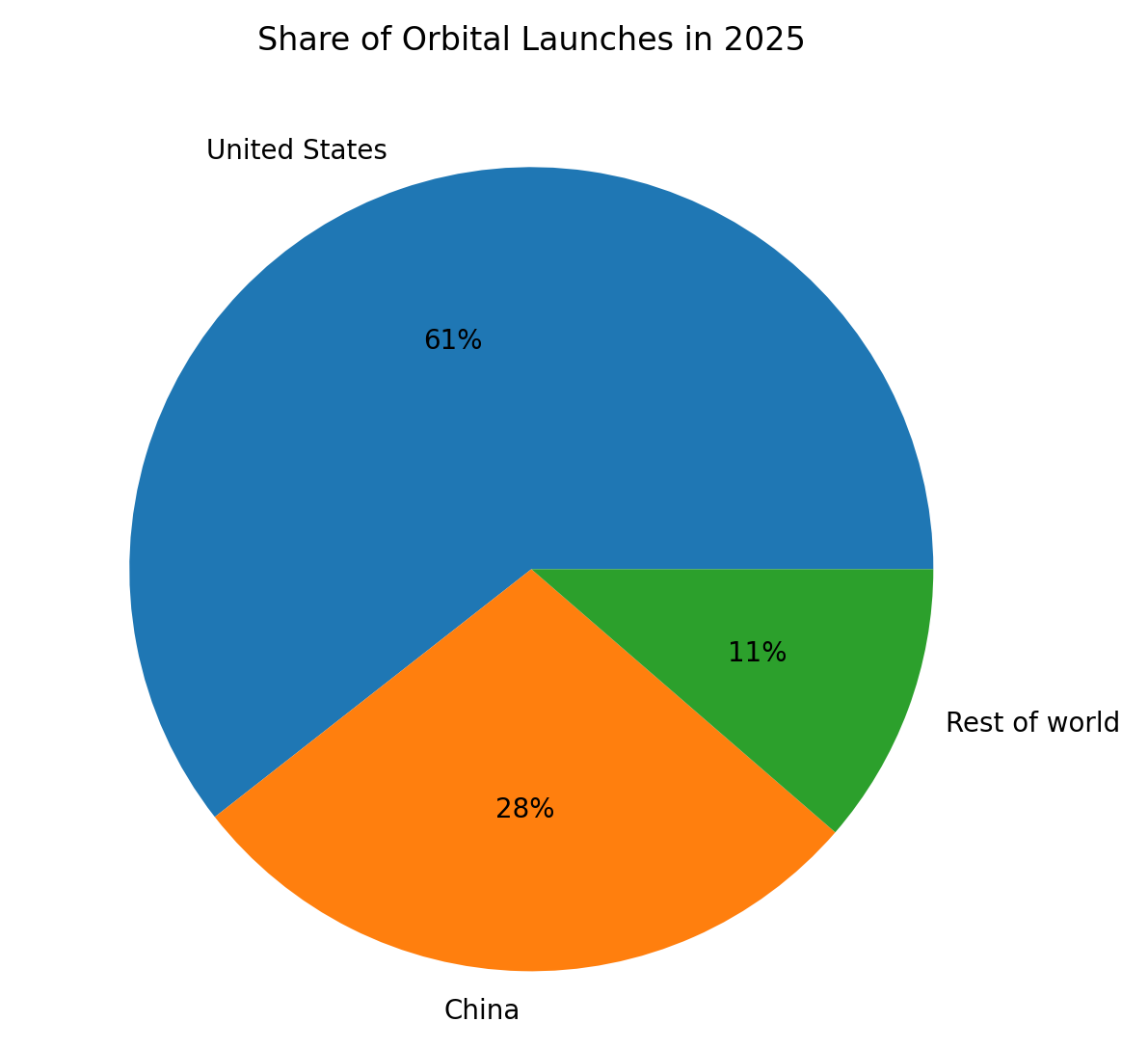
The majority of launches were conducted by established spacefaring nations. The United States and China together accounted for roughly 90 percent of all orbital launches worldwide. The United States led with 192 launches, representing 61 percent of the global total and rising from 154 in 2024. China conducted 90 launches, or 29 percent of the global total, up from 66 the prior year. Other countries, including Russia, France, India, Japan, Israel, and South Korea, contributed modestly and reflected more limited deployment capacity.
United States Launch Performance
The United States solidified its leadership with 192 successful orbital launches in 2025, a 25 percent increase over 2024. It remains uniquely positioned as the only nation with two companies operating reusable orbital class rockets.
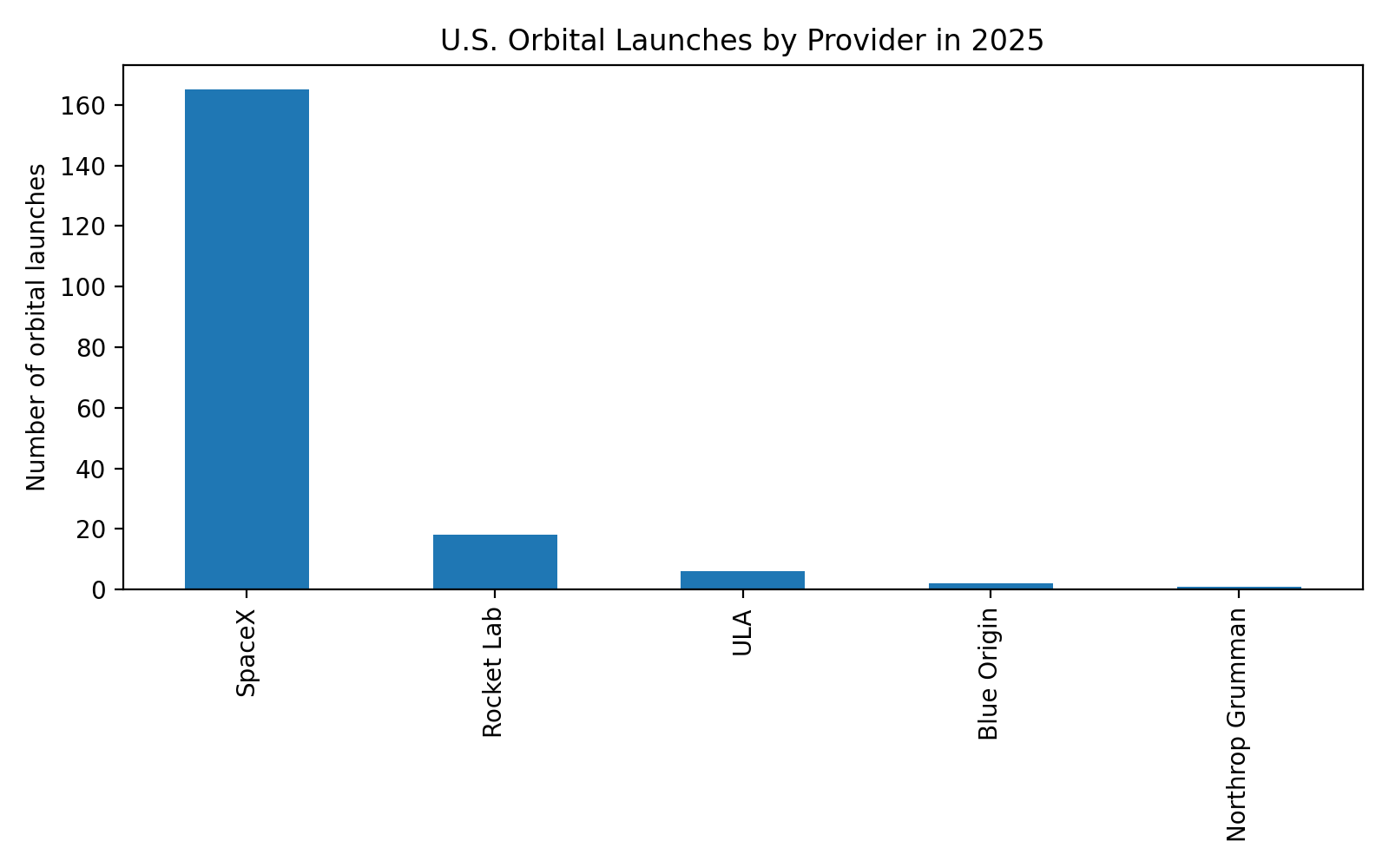
Five U.S. commercial providers contributed to the launch total: SpaceX, Rocket Lab, United Launch Alliance, Blue Origin, and Northrop Grumman.
SpaceX and Reusable Launch Dominance
SpaceX accounted for 165 launches, or 86 percent of all U.S. activity, up from 134 in 2024. All missions were flown on Falcon 9. Of these, 122 missions deployed Starlink satellites, while non Starlink launches remained largely flat year over year. This stability suggests continued expansion of the broader launch market beyond proprietary constellations and reinforces the attractiveness of Falcon 9 pricing and availability.
Falcon 9 continued its record of zero failures, a notable achievement given the increased launch cadence and expectations for continued growth beyond 2025.
Other U.S. Launch Providers
Rocket Lab completed 18 launches, up from 14 in 2024, representing roughly 9 percent of U.S. launches. United Launch Alliance conducted six launches, accounting for just over 3 percent. Blue Origin flew New Glenn twice in its debut year, while Northrop Grumman executed a single Minotaur IV launch.
Blue Origin’s successful recovery of New Glenn’s first stage following an orbital mission marked a major milestone. Continued progress will depend on increasing launch cadence and expanding the customer base beyond two annual flights. If utilization improves, New Glenn’s superior payload capacity could enable more cost effective missions than Falcon 9 for heavy lift requirements.
U.S. Spaceport Utilization and Growth
Five spaceports supported U.S. orbital launches in 2025: Cape Canaveral Space Force Station, Kennedy Space Center, Vandenberg Space Force Base, the Mid Atlantic Regional Spaceport, and Mahia Launch Complex in New Zealand.
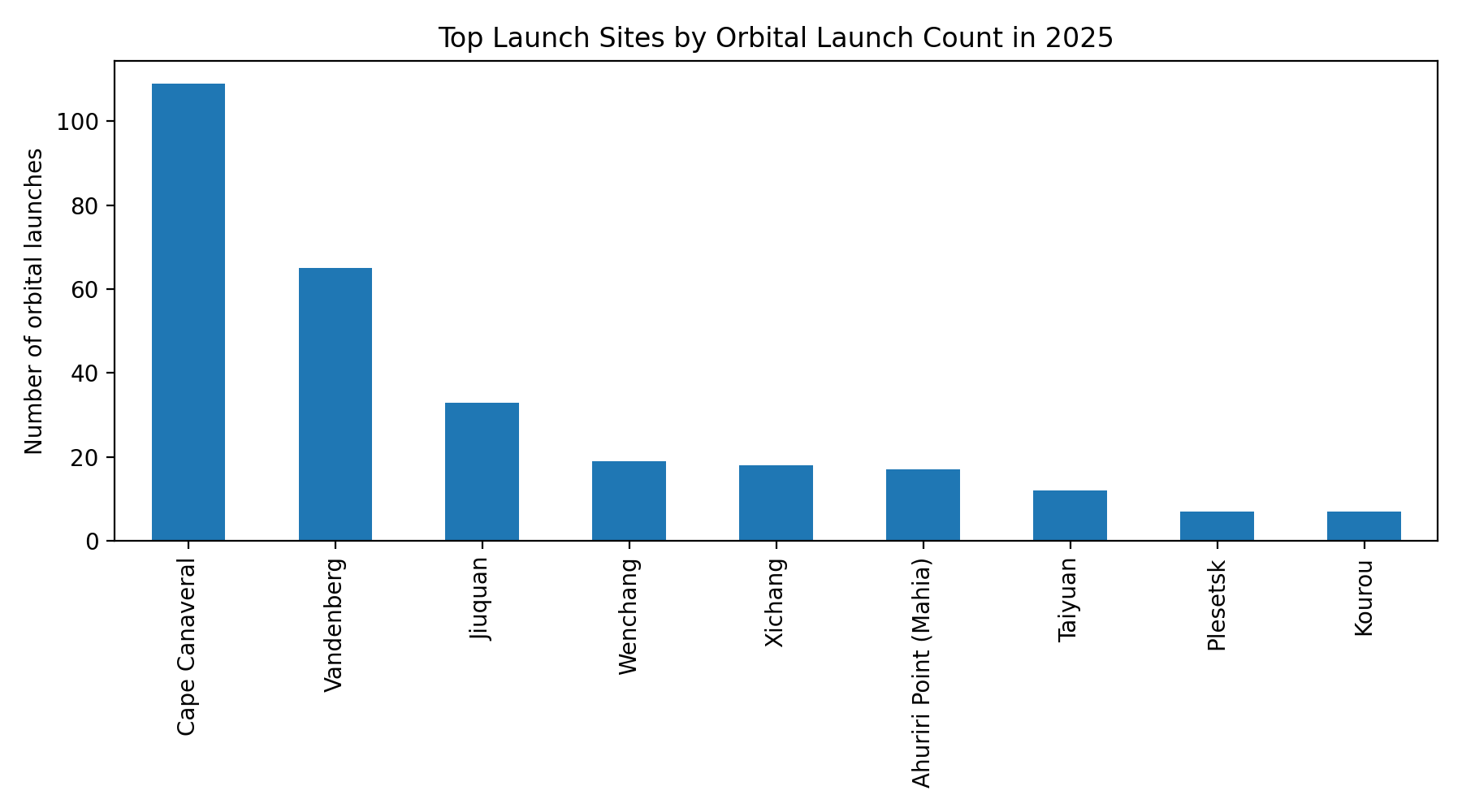
U.S. launch activity averaged just under one launch every two days. Cape Canaveral and Kennedy Space Center handled 109 launches, accounting for 57 percent of U.S. launches and 35 percent of the global total. Florida’s growth has been dramatic, rising from 31 launches in 2021 to 109 in 2025, a roughly 252 percent increase, cementing its role as a global spaceflight hub.
Continued infrastructure upgrades at CCSFS and KSC will be essential if 2026 launch rates meet or exceed those of 2025. These investments also offer regional economic upside, particularly in satellite manufacturing and spacecraft processing, should Blue Origin and ULA scale operations alongside SpaceX. Florida was the only region globally to host two operators of reusable orbital rockets in 2025.
Vandenberg and Mahia Launch Trends
Vandenberg Space Force Base experienced significant growth, increasing from six launches in 2021 to 65 in 2025, a roughly 983 percent increase. Sixty four of these missions were flown on Falcon 9. The infrastructure challenges and scaling opportunities faced in Florida increasingly apply to California as well.
Mahia Launch Complex supported 17 Rocket Lab Electron launches in 2025, up from 13 in 2024. Future growth may be constrained by Rocket Lab’s plans to launch Neutron from other locations, the lack of additional tenants, and declining demand for dedicated small launch vehicles amid widespread rideshare availability from providers such as SpaceX.
China’s Launch Capacity Expansion
China conducted 90 launches in 2025, a 24 percent increase over 2024 and nearly three times its 2018 launch count. Its cadence, slightly more than one launch every four days, reflects a rapidly expanding national space capability in both mass to orbit and satellite deployment.
Approximately 22 percent of Chinese launches supported domestic constellations such as Qianfan, Guowang, and Adaspace, alongside commercial efforts like Geespace’s GeeSats. While most missions served domestic customers, the scale and consistency of activity underscore China’s growing international relevance. Should China further open its launch market, it could become more competitive globally, particularly if cost and availability offset geopolitical and intellectual property concerns.
China operates 27 active rocket models, utilizes maritime launch platforms, and supports four primary spaceports. Jiuquan led activity with 31 launches, followed by Taiyuan with 12, alongside Xichang and Wenchang. While no Chinese rocket achieved first stage reusability in 2025, multiple programs continue to pursue it. Two vehicles, Long March 5 and Zhuque 3, now match or exceed Falcon 9 payload capacity.
Russia’s Launch Activity and Constraints
Russia conducted 17 launches in 2025, matching its 2024 total and only marginally exceeding its 2018 level. This performance indicates stagnant growth over nearly a decade.
Approximately three quarters of launches relied on the upgraded but aging Soyuz system. Angara 1.2 flew three times in 2025, while Angara A5 flew once. Since its debut in 2014, Angara A5 has achieved only four successful launches. Continued reliance on legacy systems suggests constrained investment and potentially shifting national priorities away from space infrastructure expansion.
European Launch Developments
Europe recorded seven successful launches in 2025, up from three in 2024. These missions used Ariane 6 and Vega C from the Guiana Space Centre.
Germany’s Isar Aerospace conducted its maiden orbital attempt from Andøya Spaceport in Norway, though the mission failed shortly after liftoff. Despite this setback, Europe is positioned for a rebound.
In 2026, Europe is projected to conduct 13 to 15 orbital launches, nearly doubling its 2025 total. Growth will be driven by increased Ariane 6 deployment, the full return of Vega C, and multiple commercial launch attempts. Isar Aerospace is targeting a second Spectrum flight from Andøya, Rocket Factory Augsburg plans to retry RFA ONE from SaxaVord Spaceport, and PLD Space aims to conduct the debut orbital flight of Miura 5 from the Guiana Space Centre.
Implications for the Launch Market
The elevated launch rates of 2025 reflect strong and growing demand for satellite services. Approximately 70 percent of the 4,500 plus deployed spacecraft were Starlink units, while roughly 1,300 supported independent missions, continuing a diversification trend that began in 2024.
The emergence of multiple reusable orbital launch systems challenges the long term viability of fully expendable rockets. Reusable vehicles enable efficient deployment to high inclination and sun synchronous orbits, missions once thought to require high latitude spaceports. SpaceX has demonstrated that sun synchronous launches from Florida, including Transporter rideshare missions, can be conducted at significantly lower cost than current small launch alternatives.
As reusable capacity expands, the strategic advantage of developing new small launch vehicles diminishes, particularly in regions requiring bespoke infrastructure. At the same time, New Glenn’s entry into service introduces a second reusable heavy lift option, offering the United States a path toward reduced dependence on SpaceX and a more diversified domestic launch ecosystem.